
Transaction signing & verification
The signing / verification pipeline for secp256k1 and ed25519, canonical signatures and malleability.
What you'll learn
- Sign and verify with secp256k1 (DER, RFC 6979) and ed25519.
- Explain signature malleability and fully-canonical signatures.
- Understand `HashPrefix::TxSign` and multi-signing.
Introduction
≈45 min · Advanced · builds on Base58Check encoding
Watch this short video by XRPL Commons first, then dive into the details below.
Signing is where a key proves it authorized a transaction, and where subtle bugs can undo everything. In this module you'll learn the signing and verification pipelines for secp256k1 and ed25519, and confront signature malleability: what it is, why it's dangerous, and how fully-canonical signatures shut it down. This is authorization done right.
The Signature: Mathematical Proof of Authorization
A digital signature proves three things:
- Authenticity: The signature was created by someone with the secret key
- Integrity: The signed data hasn't been modified
- Non-repudiation: The signer cannot deny having signed
Transaction Data + Secret Key  →  Signature
Transaction Data + Public Key + Signature  →  Valid/Invalid
Creating a Signature
In brief: sign the transaction with the account's private key (secp256k1 or ed25519).
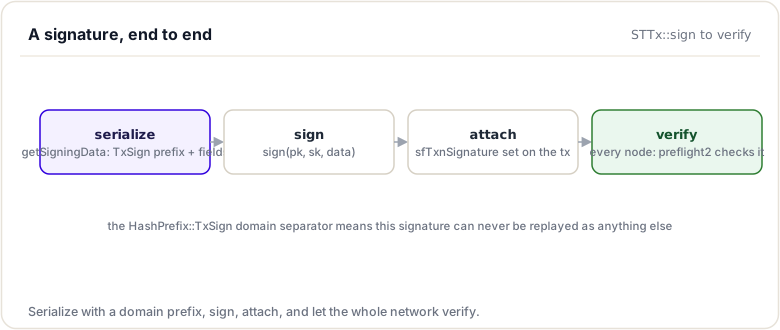
The High-Level Interface
// From src/libxrpl/protocol/SecretKey.cpp
Buffer sign(
    PublicKey const& pk,
    SecretKey const& sk,
    Slice const& m)
{
    // Automatically detect key type from public key
    auto const type = publicKeyType(pk.slice());

    switch (*type)
    {
        case KeyType::ed25519:
            return signEd25519(pk, sk, m);

        case KeyType::secp256k1:
            return signSecp256k1(pk, sk, m);
    }
}
Parameters:
pk: Public key (for key type detection)sk: Secret key (the signing key)m: Message (the data to sign)
Returns:
- A
Buffercontaining the signature bytes
Ed25519 Signing: Simple and Fast
case KeyType::ed25519: {
    Buffer b(64);  // Ed25519 signatures are always 64 bytes

    ed25519_sign(
        m.data(), m.size(),     // Message to sign
        sk.data(),               // Secret key
        pk.data() + 1,           // Public key (skip 0xED prefix)
        b.data());               // Output buffer

    return b;
}
How it works:
- Allocate 64-byte buffer
- Call
ed25519_signwith message, keys, and output buffer - Return the signature
Properties:
- Always produces exactly 64 bytes
- Deterministic: same message + key = same signature
- Fast: ~50 microseconds
- No pre-hashing needed
Signature format:
[R (32 bytes)][S (32 bytes)] = 64 bytes total
Where R and S are elliptic curve points/scalars (mathematical details abstracted by the library).
Secp256k1 Signing: More Complex
case KeyType::secp256k1: {
    // Step 1: Hash the message with SHA-512-Half
    sha512_half_hasher h;
    h(m.data(), m.size());
    auto const digest = sha512_half_hasher::result_type(h);

    // Step 2: Sign the digest (not the raw message)
    secp256k1_ecdsa_signature sig_imp;
    secp256k1_ecdsa_sign(
        secp256k1Context(),
        &sig_imp,
        reinterpret_cast<unsigned char const*>(digest.data()),
        reinterpret_cast<unsigned char const*>(sk.data()),
        secp256k1_nonce_function_rfc6979,  // Deterministic nonce
        nullptr);

    // Step 3: Serialize to DER format
    unsigned char sig[72];
    size_t len = sizeof(sig);
    secp256k1_ecdsa_signature_serialize_der(
        secp256k1Context(),
        sig,
        &len,
        &sig_imp);

    return Buffer{sig, len};
}
How it works:
- Pre-hash the message: Compute SHA-512-Half of the message
- Sign the digest: Use ECDSA to sign the 32-byte hash
- Serialize: Encode signature in DER format
Why pre-hash?
- ECDSA works on fixed-size inputs (32 bytes)
- Messages can be any size
- Hashing first normalizes all inputs to 32 bytes
- Security proof for ECDSA assumes you're signing a hash
Why DER encoding?
DER (Distinguished Encoding Rules) is a standard binary format from X.509:
DER Format:
0x30 [total length]
    0x02 [R length] [R bytes]
    0x02 [S length] [S bytes]

Example:
30 44
   02 20 [32 bytes of R]
   02 20 [32 bytes of S]
Total: ~70-72 bytes (variable length!)
Deterministic Nonces (RFC 6979):
secp256k1_nonce_function_rfc6979
This is critical for security. ECDSA requires a random "nonce" (number used once) for each signature. If:
- The same nonce is used twice with the same key → secret key can be extracted
- The nonce is predictable → secret key can be extracted
RFC 6979 derives the nonce deterministically from the message and secret key, making it:
- Different for every message
- Unpredictable to attackers
- Free from random number generation failures
Verifying a Signature
In brief: check the signature against the public key before trusting the transaction.
The High-Level Interface
// From src/libxrpl/protocol/PublicKey.cpp
bool verify(
    PublicKey const& publicKey,
    Slice const& m,
    Slice const& sig,
    bool mustBeFullyCanonical) noexcept
{
    // Detect key type
    auto const type = publicKeyType(publicKey);
    if (!type)
        return false;

    if (*type == KeyType::secp256k1)
    {
        return verifySecp256k1(publicKey, m, sig, mustBeFullyCanonical);
    }
    else if (*type == KeyType::ed25519)
    {
        return verifyEd25519(publicKey, m, sig);
    }

    return false;
}
Parameters:
publicKey: The public key to verify againstm: The message that was signedsig: The signature to verifymustBeFullyCanonical: Whether to enforce strict canonicality (important!)
Returns:
trueif signature is validfalseif signature is invalid or malformed
Ed25519 Verification
else if (*type == KeyType::ed25519)
{
    // Check signature is canonical
    if (!ed25519Canonical(sig))
        return false;

    // Verify signature
    return ed25519_sign_open(
        m.data(), m.size(),              // Message
        publicKey.data() + 1,             // Public key (skip 0xED prefix)
        sig.data()) == 0;                 // Signature
}
Canonicality check:
static bool ed25519Canonical(Slice const& sig)
{
    // Signature must be exactly 64 bytes
    if (sig.size() != 64)
        return false;

    // Ed25519 curve order (big-endian)
    static std::uint8_t const Order[] = {
        0x10, 0x00, 0x00, 0x00, 0x00, 0x00, 0x00, 0x00,
        0x00, 0x00, 0x00, 0x00, 0x00, 0x00, 0x00, 0x00,
        0x14, 0xDE, 0xF9, 0xDE, 0xA2, 0xF7, 0x9C, 0xD6,
        0x58, 0x12, 0x63, 0x1A, 0x5C, 0xF5, 0xD3, 0xED
    };

    // S component (second 32 bytes) must be < Order
    auto const le = sig.data() + 32;
    std::uint8_t S[32];
    std::reverse_copy(le, le + 32, S);  // Convert to big-endian

    return std::lexicographical_compare(S, S + 32, Order, Order + 32);
}
Why check canonicality?
Ensures the S component is in the valid range. This prevents malformed signatures from being processed.
Secp256k1 Verification
if (*type == KeyType::secp256k1)
{
    // Hash the message first (same as signing)
    return verifyDigest(
        publicKey,
        sha512Half(m),
        sig,
        mustBeFullyCanonical);
}
The digest verification function:
bool verifyDigest(
    PublicKey const& publicKey,
    uint256 const& digest,
    Slice const& sig,
    bool mustBeFullyCanonical)
{
    // Check signature canonicality
    auto const canonical = ecdsaCanonicality(sig);
    if (!canonical)
        return false;

    if (mustBeFullyCanonical && *canonical != ECDSACanonicality::fullyCanonical)
        return false;

    // Parse public key
    secp256k1_pubkey pubkey_imp;
    if (secp256k1_ec_pubkey_parse(
            secp256k1Context(),
            &pubkey_imp,
            reinterpret_cast<unsigned char const*>(publicKey.data()),
            publicKey.size()) != 1)
        return false;

    // Parse signature from DER
    secp256k1_ecdsa_signature sig_imp;
    if (secp256k1_ecdsa_signature_parse_der(
            secp256k1Context(),
            &sig_imp,
            reinterpret_cast<unsigned char const*>(sig.data()),
            sig.size()) != 1)
        return false;

    // Verify!
    return secp256k1_ecdsa_verify(
        secp256k1Context(),
        &sig_imp,
        reinterpret_cast<unsigned char const*>(digest.data()),
        &pubkey_imp) == 1;
}
Steps:
- Check canonicality: Ensure signature is in canonical form
- Parse public key: Convert from compressed format to library format
- Parse signature: Decode DER encoding
- Verify: Check mathematical relationship between public key, message, and signature
Signature Malleability and Canonicality
In brief: why a signature must be fully canonical, and how that blocks tampering.
The Problem: Signature Malleability
In secp256k1, a signature is a pair of numbers (R, S). Due to the mathematics of elliptic curves:
If (R, S) is valid, then (R, -S mod n) is also valid
Where n is the curve order. This means one message has two valid signatures.
Why this is dangerous:
// Alice creates and signs a transaction
Transaction tx = Payment{ /* ... */ };
Signature sig1 = sign(alice.publicKey, alice.secretKey, tx);

// Transaction ID includes the signature
uint256 txID1 = hash(tx, sig1);

// Attacker sees tx + sig1 in network
// Attacker creates malleated signature sig2 = (R, -S mod n)
Signature sig2 = malleate(sig1);

// sig2 is also valid!
bool valid = verify(alice.publicKey, tx, sig2);  // Returns true

// But produces different transaction ID
uint256 txID2 = hash(tx, sig2);
assert(txID1 != txID2);  // Different IDs!
Attack scenarios:
- Transaction ID confusion: Applications tracking txID1 won't see the transaction confirmed (it confirms as txID2)
- Double-spend attempts: Submit both versions, one might get through
- Chain reaction: If txID is used as input to another transaction, that transaction becomes invalid
The Solution: Canonical Signatures
Require S to be in the "low" range:
// Canonical if S <= order/2
if (S > order/2) {
    S = order - S;  // Flip to the low range
}
This makes each signature unique, only one valid signature per message.
Checking Canonicality
std::optional<ECDSACanonicality>
ecdsaCanonicality(Slice const& sig)
{
    // Parse DER-encoded signature
    auto r = sigPart(p);  // Extract R
    auto s = sigPart(p);  // Extract S

    if (!r || !s)
        return std::nullopt;  // Invalid DER encoding

    // uint264: local alias in PublicKey.cpp for a 264-bit
    // boost::multiprecision integer (large enough for any DER value)
    uint264 R(sliceToHex(*r));
    uint264 S(sliceToHex(*s));

    // secp256k1 curve order
    static uint264 const G(
        "0xFFFFFFFFFFFFFFFFFFFFFFFFFFFFFFFEBAAEDCE6AF48A03BBFD25E8CD0364141");

    // Both R and S must be < G
    if (R >= G || S >= G)
        return std::nullopt;

    // Calculate G - S (the "flipped" value)
    auto const Sp = G - S;

    // Is S in the lower half?
    if (S > Sp)
        return ECDSACanonicality::canonical;  // Valid but not fully canonical

    return ECDSACanonicality::fullyCanonical;  // Perfect!
}
Canonicality levels:
enum class ECDSACanonicality {
    fullyCanonical,  // S <= order/2 (preferred)
    canonical        // S > order/2 but valid (deprecated)
};
Enforcement:
if (mustBeFullyCanonical && *canonical != ECDSACanonicality::fullyCanonical)
    return false;  // Reject non-canonical signatures
In production, XRPL always sets mustBeFullyCanonical = true to prevent malleability.
Ed25519: No Malleability
Ed25519 signatures are inherently canonical, there's only one valid signature per message. The curve mathematics don't allow the kind of malleability that exists in ECDSA.
// Ed25519: Each message has exactly ONE valid signature
Signature sig = sign(pk, sk, message);
// No way to create sig2 that's also valid
This is one of the design advantages of Ed25519 over secp256k1.
Watch out. secp256k1 signatures are malleable unless required to be fully canonical; otherwise an attacker can alter a signature (and the transaction id) while keeping it valid. ed25519 has no such problem.
Transaction Signing in Practice
Signing a Transaction
// From src/libxrpl/protocol/STTx.cpp
void STTx::sign(PublicKey const& publicKey, SecretKey const& secretKey)
{
    // Serialize transaction for signing (single signature path)
    auto const data = getSigningData(*this);

    // Create signature
    auto const signature = xrpl::sign(publicKey, secretKey, s.slice());

    // Add signature to transaction
    setFieldVL(sfTxnSignature, signature);
}
What gets signed:
Serializer getSigningData(STTx const& tx)   // single-sign; multisign uses
{                                            // startMultiSigningData + TxMultiSign
    Serializer s;

    // Add signing prefix
    s.add32(HashPrefix::TxSign);

    // Serialize all transaction fields except signature
    tx.addWithoutSigningFields(s);

    return s;
}
The signature is computed over:
- A prefix (
HashPrefix::TxSign) - All transaction fields (except the signature itself)
Verifying a Transaction
bool STTx::checkSign(bool mustBeFullyCanonical) const
{
    try
    {
        // Get the signing public key
        auto const publicKey = getSigningPubKey();

        // Get the signature
        auto const signature = getFieldVL(sfTxnSignature);

        // Rebuild the data that was signed
        Serializer s = buildMultiSigningData(*this, publicKey);

        // Verify!
        return verify(publicKey, s.slice(), signature, mustBeFullyCanonical);
    }
    catch (...)
    {
        return false;  // Any error = invalid
    }
}
Multi-Signing
In brief: combine several signers' signatures to authorize a single transaction.
XRPL supports multi-signature transactions where multiple parties must sign:
struct Signer {
    AccountID account;
    PublicKey publicKey;
    Buffer signature;
    uint16_t weight;
};

bool checkMultiSign(STTx const& tx) {
    auto const signers = tx.getFieldArray(sfSigners);
    uint32_t totalWeight = 0;

    for (auto const& signer : signers) {
        // Extract signer info
        auto const account = signer.getAccountID(sfAccount);
        auto const pubKey = signer.getFieldVL(sfSigningPubKey);
        auto const sig = signer.getFieldVL(sfTxnSignature);

        // Verify this signer's signature
        Serializer s = buildMultiSigningData(tx, account, pubKey);
        if (!verify(pubKey, s.slice(), sig, true))
            return false;  // Invalid signature

        // Add weight
        totalWeight += getSignerWeight(account);
    }

    // Check if total weight meets quorum
    return totalWeight >= getRequiredQuorum(tx);
}
Each signer independently signs the transaction, and all signatures are verified.
Performance Characteristics
Signing Speed
Ed25519:    ~50 microseconds
Secp256k1:  ~200 microseconds

Ed25519 is 4x faster for signing.
Verification Speed
Ed25519:    ~100 microseconds
Secp256k1:  ~500 microseconds

Ed25519 is 5x faster for verification.
Why verification speed matters:
Every validator must verify every transaction signature. In a high-throughput system:
1000 transactions/second × 500 μs/verification = 0.5 seconds of CPU time
1000 transactions/second × 100 μs/verification = 0.1 seconds of CPU time
Ed25519's speed advantage is significant at scale.
Signature Size
Ed25519:    64 bytes (fixed)
Secp256k1:  ~71 bytes (variable, DER encoded)

Ed25519 signatures are slightly smaller and fixed-size.
Summary
This module traced signing and verification for secp256k1 and ed25519. You saw how a transaction is signed and then verified against the public key, and confronted signature malleability, where a valid signature can be altered into another valid one and change the transaction id. XRPL requires fully-canonical signatures to shut that down for secp256k1; ed25519 is not malleable in the first place.
To remember:
- What is signed: the serialized transaction with
HashPrefix::TxSignprepended - secp256k1: ECDSA with DER encoding and RFC 6979 deterministic nonces; ed25519: EdDSA, not malleable
- Malleability = altering a valid signature into another valid one, changing the tx hash; fully-canonical signatures kill it
- Verification path:
Transactor::checkSignthenSTTx::checkSignthenverify()(dispatch on key type) - Multisigning combines a SignerList's weighted signatures against a quorum
- Code:
include/xrpl/protocol/SecretKey.h(sign) andPublicKey.h(verify + canonicality) - The key-type prefix (0xED or not) decides which verifier runs
- Watch out: accepting a non-canonical secp256k1 signature reintroduces malleability; never bypass that check
Next up. You can prove a transaction came from you. But when your node talks to a peer, who proves the peer is real? Next: the peer handshake.
Resources
Assignments
0 of 2 complete