
Base58Check encoding
How XRPL encodes account IDs, keys and seeds as human-readable strings with a checksum and type byte.
What you'll learn
- Explain the Base58Check format and its checksum.
- Map TokenType values to address prefixes (r, s, n…).
- Encode and decode account IDs with `encodeBase58Token`.
Introduction
≈45 min · Intermediate · builds on Secure memory handling
That familiar r... address is more than a random string, it's a carefully encoded value with a built-in typo detector. In this module you'll learn the Base58Check format, how its checksum catches errors, and how the type byte decides whether you see an r, s or n prefix. Encode and decode an address yourself and it'll never look opaque again.
The Problem with Raw Binary
In brief: raw bytes are error-prone to type and copy, so humans need a safer encoding.
Consider an account ID in different formats:
Binary (20 bytes):
10001011 10001010 01101100 01010011 00111111 ...

Hexadecimal:
8B8A6C533F09CA0E5E00E7C32AA7EC323485ED3F

Base58Check:
rN7n7otQDd6FczFgLdlqtyMVrn3LNU8B4C
Problems with hex:
- Easy to mistype:
8B8Avs8B8B - Visually similar characters:
0(zero) vsO(letter O) - No error detection: One wrong character, wrong address
- Not compact: 40 characters for 20 bytes
Base58Check solutions:
- Excludes confusing characters
- Includes checksum (detects errors)
- More compact: 34 characters for 20 bytes + checksum
- URL-safe (no special characters)
The Base58 Alphabet
In brief: 58 characters chosen to drop look-alikes such as 0/O and I/l.
// From src/libxrpl/protocol/tokens.cpp (kAlphabetForward)
static const char* BASE58_ALPHABET =
    "rpshnaf39wBUDNEGHJKLM4PQRST7VWXYZ2bcdeCg65jkm8oFqi1tuvAxyz";
Watch out. Base58 is a family of encodings: the algorithm (divide by 58, map each remainder to a character) is universal, but the alphabet (which character represents which value) is chosen per project. XRPL's alphabet above is not the Bitcoin alphabet (
123456789ABCDEFGHJKLMNPQRSTUVWXYZabcdefghijkmnopqrstuvwxyz), it is a different permutation of the same 58 characters. Encode the same bytes with the wrong alphabet and you get a string that looks plausible but decodes to nothing meaningful on the real network.
Excluded characters (true of both Bitcoin's and XRPL's alphabet, only the order differs):
0 (zero)        - Looks like O (letter O)
O (letter O)    - Looks like 0 (zero)
I (letter I)    - Looks like l (lowercase L) or 1
l (lowercase L) - Looks like I (letter I) or 1
These exclusions prevent human transcription errors.
Included: 58 characters, XRPL's order
9 digits:      3 9 4 7 2 6 5 8 1
24 uppercase:  B U D N E G H J K L M P Q R S T V W X Y Z C F A
25 lowercase:  r p s h n a f w b c d e g j k m o q i t u v x y z
Total:         58 characters
Base58 Encoding Algorithm
Base58 is like converting a number to a different base (like hexadecimal is base 16):
Decimal:    255 = 2×100 + 5×10 + 5×1
Hex:        FF  = 15×16 + 15×1
Base58:     4k  = 4×58 + 45×1
The Mathematics
// Conceptually: treat byte array as big integer
std::vector<uint8_t> input = {0x8B, 0x8A, ...};

// Convert to big integer
BigInt value = 0;
for (uint8_t byte : input)
    value = value * 256 + byte;

// Convert to base58
std::string result;
while (value > 0) {
    int remainder = value % 58;
    result = BASE58_ALPHABET[remainder] + result;
    value = value / 58;
}
Handling Leading Zeros
// Special case: preserve leading zero bytes as ALPHABET[0] characters
// (that's 'r' for XRPL's alphabet, not '1' as in Bitcoin's)
for (uint8_t byte : input) {
    if (byte == 0)
        result = BASE58_ALPHABET[0] + result;
    else
        break;
}
This ensures the encoding is one-to-one: every distinct byte sequence produces a distinct string.
Implementation
// From src/libxrpl/protocol/tokens.cpp (simplified)
std::string base58Encode(std::vector<uint8_t> const& input)
{
    // Skip leading zeros, but count them
    int leadingZeros = 0;
    for (auto byte : input) {
        if (byte == 0)
            ++leadingZeros;
        else
            break;
    }

    // Allocate output buffer (worst case size)
    std::vector<uint8_t> b58(input.size() * 138 / 100 + 1);

    // Process the bytes
    for (auto byte : input) {
        int carry = byte;
        for (auto it = b58.rbegin(); it != b58.rend(); ++it) {
            carry += 256 * (*it);
            *it = carry % 58;
            carry /= 58;
        }
    }

    // Convert to string, skipping leading zeros in b58
    std::string result;
    for (int i = 0; i < leadingZeros; ++i)
        result += BASE58_ALPHABET[0];  // 'r' for XRPL, not '1'

    for (auto value : b58) {
        if (value != 0 || !result.empty())
            result += BASE58_ALPHABET[value];
    }

    return result.empty() ? "1" : result;
}
Base58Check: Adding Error Detection
In brief: append a double-SHA-256 checksum so typos are caught before use.
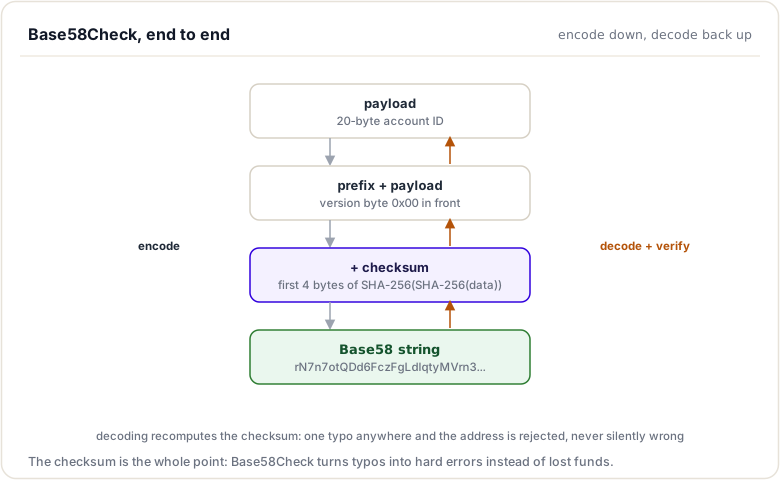
Base58 alone doesn't detect errors. Base58Check adds a checksum:
Structure:
[Type Byte] [Payload] [Checksum (4 bytes)]
     ↓          ↓           ↓
   0x00     20 bytes    SHA256(SHA256(prefix + payload))
Encoding Process
// From src/libxrpl/protocol/tokens.cpp
std::string encodeBase58Token(
    TokenType type,
    void const* token,
    std::size_t size)
{
    std::vector<uint8_t> buffer;
    buffer.reserve(1 + size + 4);

    // Step 1: Add type prefix
    buffer.push_back(static_cast<uint8_t>(type));

    // Step 2: Add payload
    auto const* tokenBytes = static_cast<uint8_t const*>(token);
    buffer.insert(buffer.end(), tokenBytes, tokenBytes + size);

    // Step 3: Compute checksum
    // First SHA-256
    auto const hash1 = sha256(makeSlice(buffer));
    // Second SHA-256
    auto const hash2 = sha256(makeSlice(hash1));

    // Step 4: Append first 4 bytes of second hash as checksum
    buffer.insert(buffer.end(), hash2.begin(), hash2.begin() + 4);

    // Step 5: Base58 encode everything
    return base58Encode(buffer);
}
Token Types
enum class TokenType : std::uint8_t {
    None            = 1,
    NodePublic      = 28,   // Node public keys:  starts with 'n'
    NodePrivate     = 32,   // Node private keys
    AccountID       = 0,    // Account addresses: starts with 'r'
    AccountPublic   = 35,   // Account public keys: starts with 'a'
    AccountSecret   = 34,   // Account secret keys (deprecated)
    FamilySeed      = 33,   // Seeds: starts with 's'
};
The type byte determines the first character of the encoded result:
Type 0  (AccountID)     → starts with 'r'
Type 33 (FamilySeed)    → starts with 's'
Type 28 (NodePublic)    → starts with 'n'
Type 35 (AccountPublic) → starts with 'a'
This provides visual identification of what kind of data you're looking at.
Key idea. The checksum is what makes an address self-verifying: mistype one character and decoding fails, instead of silently pointing at the wrong account.
Decoding and Validation
In brief: reverse the process and reject anything whose checksum does not match.
std::string decodeBase58Token(
    std::string const& s,
    TokenType type)
{
    // Step 1: Decode from Base58
    auto const decoded = base58Decode(s);
    if (decoded.empty())
        return {};  // Invalid Base58

    // Step 2: Check minimum size (type + checksum = 5 bytes minimum)
    if (decoded.size() < 5)
        return {};

    // Step 3: Verify type byte matches
    if (decoded[0] != static_cast<uint8_t>(type))
        return {};  // Wrong type

    // Step 4: Verify checksum
    auto const dataEnd = decoded.end() - 4;  // Last 4 bytes are checksum
    auto const providedChecksum = Slice{dataEnd, decoded.end()};

    // Recompute checksum
    auto const hash1 = sha256(makeSlice(decoded.begin(), dataEnd));
    auto const hash2 = sha256(makeSlice(hash1));
    auto const computedChecksum = Slice{hash2.begin(), hash2.begin() + 4};

    // Compare
    if (!std::equal(
            providedChecksum.begin(),
            providedChecksum.end(),
            computedChecksum.begin()))
        return {};  // Checksum mismatch

    // Step 5: Return payload (skip type byte and checksum)
    return std::string(decoded.begin() + 1, dataEnd);
}
Error Detection
The 4-byte (32-bit) checksum provides strong error detection:
Probability of random error passing checksum:
1 / 2^32 = 1 / 4,294,967,296

Approximately: 1 in 4.3 billion
Types of errors detected:
- Single character typos: 100%
- Transpositions: 100%
- Missing characters: 100%
- Extra characters: 100%
- Random corruption: 99.9999999767%
Complete Example: Account Address
// Start with public key
PublicKey pk = /* ed25519 public key */;
// ED9434799226374926EDA3B54B1B461B4ABF7237962EEB1144C10A7CA6A9D32C64

// Step 1: Calculate account ID (RIPESHA hash)
AccountID accountID = calcAccountID(pk);
// 8B8A6C533F09CA0E5E00E7C32AA7EC323485ED3F (20 bytes)

// Step 2: Encode as Base58Check address
std::string address = toBase58(accountID);
// rN7n7otQDd6FczFgLdlqtyMVrn3LNU8B4C

// Encoding breakdown:
// 1. Prepend type byte 0x00
//    008B8A6C533F09CA0E5E00E7C32AA7EC323485ED3F
//
// 2. Compute checksum:
//    SHA-256: 7C9B2F8F...
//    SHA-256: 3D4B8E9C...
//    Take first 4 bytes: 3D4B8E9C
//
// 3. Append checksum:
//    008B8A6C533F09CA0E5E00E7C32AA7EC323485ED3F3D4B8E9C
//
// 4. Base58 encode:
//    rN7n7otQDd6FczFgLdlqtyMVrn3LNU8B4C
Seeds and Human Readability
Seeds can be encoded in two formats:
Base58Check Format
Seed seed = generateRandomSeed();
std::string b58 = toBase58(seed);
// Example: sp5fghtJtpUorTwvof1NpDXAzNwf5
Properties:
- Compact (25-28 characters)
- Checksum for error detection
- Safe to copy-paste
RFC 1751 Word Format
std::string words = seedAs1751(seed);
// Example: "MAD WARM EVEN SHOW BALK FELT TOY STIR OBOE COST HOPE VAIN"
Properties:
- 12 words from a dictionary
- Easier to write down by hand
- Easier to read aloud (for backup)
- Checksum built into last word
Practical Usage
Creating an Account
// Generate key pair
auto [publicKey, secretKey] = randomKeyPair(KeyType::ed25519);

// Derive account ID
AccountID accountID = calcAccountID(publicKey);

// Encode as address
std::string address = toBase58(accountID);

std::cout << "Your XRPL address: " << address << "\n";
// Your XRPL address: rN7n7otQDd6FczFgLdlqtyMVrn3LNU8B4C
Validating User Input
bool isValidAddress(std::string const& address)
{
    // Try to decode
    auto decoded = decodeBase58Token(address, TokenType::AccountID);

    // Valid if:
    // 1. Decoding succeeded
    // 2. Payload is correct size (20 bytes)
    return !decoded.empty() && decoded.size() == 20;
}

// Usage
if (!isValidAddress(userInput)) {
    std::cerr << "Invalid XRPL address\n";
    return;
}
Parsing Different Token Types
std::optional<PublicKey> parsePublicKey(std::string const& s)
{
    // Try AccountPublic type (starts with 'a')
    if (s[0] == 'a') {
        auto decoded = decodeBase58Token(s, TokenType::AccountPublic);
        if (!decoded.empty())
            return PublicKey{makeSlice(decoded)};
    }

    // Try NodePublic type (starts with 'n')
    if (s[0] == 'n') {
        auto decoded = decodeBase58Token(s, TokenType::NodePublic);
        if (!decoded.empty())
            return PublicKey{makeSlice(decoded)};
    }

    return std::nullopt;  // Invalid
}
Comparison with Other Encodings
| Encoding | Characters | Case-Sensitive | Checksum | Compact | URL-Safe |
|---|---|---|---|---|---|
| Hex | 16 | No | No | No (2×) | Yes |
| Base64 | 64 | Yes | No | Yes (1.33×) | No (+, /) |
| Base58 | 58 | Yes | No | Yes (1.37×) | Yes |
| Base58Check | 58 | Yes | Yes (4 bytes) | Yes (1.37×) | Yes |
Base58Check wins for:
- Human readability (no confusing characters)
- Error detection (checksum)
- URL safety (no special characters)
- Blockchain addresses
Common Pitfalls
Typos Without Validation
// User types address wrong
std::string userAddress = "rN7n7otQDd6FczFgLdlqtyMVrn3LNU8B4D";  // Last char wrong

// Send funds without validation
sendPayment(userAddress, amount);  // WRONG ADDRESS!
Solution:
if (!isValidAddress(userAddress)) {
    throw std::runtime_error("Invalid address - check for typos");
}
Assuming All Addresses Start with 'r'
// ❌ WRONG
bool isAddress(std::string const& s) {
    return s[0] == 'r';  // Too simplistic
}
Solution:
// ✅ CORRECT
bool isAddress(std::string const& s) {
    return !decodeBase58Token(s, TokenType::AccountID).empty();
}
Manual Base58 Implementation
// ❌ WRONG - Don't implement yourself
std::string myBase58Encode(/* ... */) {
    // Custom implementation - likely has bugs
}
Solution:
// ✅ CORRECT - Use library functions
std::string encoded = encodeBase58Token(type, data, size);
Performance Considerations
// Base58 encoding is relatively slow compared to hex:
// Hex encoding:     ~1 microsecond
// Base58 encoding:  ~10 microseconds

// But this doesn't matter for user-facing operations:
// - Displaying addresses: once per UI render
// - Parsing user input: once per input
// - Not a bottleneck in practice
When performance matters:
// For internal storage and processing, use binary:
AccountID accountID;  // 20 bytes, fast comparisons

// Only encode to Base58 when presenting to users:
std::string address = toBase58(accountID);  // For display only
Summary
This module explained how XRPL turns raw bytes into the human-readable strings you see. Base58 drops look-alike characters (0/O, I/l), and Base58Check adds a double-SHA-256 checksum so a mistyped address fails to decode instead of pointing at the wrong account. A type byte sets the visible prefix (r for accounts, s for seeds, n for node keys), so you can tell at a glance what an encoded value is.
To remember:
- The Base58 algorithm is universal, but the alphabet is not: XRPL's (
rpshnaf39wBUDNEGHJKLM4PQRST7VWXYZ2bcdeCg65jkm8oFqi1tuvAxyz) is a different permutation of the same 58 characters than Bitcoin's, never assume the two are interchangeable - The Base58 alphabet drops the look-alikes 0, O, I, l
- Layout: type byte + payload + 4-byte checksum (double SHA-256), all Base58-encoded
- The type byte sets the visible prefix:
raccount,sseed,nnode public key - A typo makes decoding fail; it can never silently resolve to another account
- Code:
include/xrpl/protocol/tokens.h(encodeBase58Token/decodeBase58Token) - Seeds also exist in RFC 1751 word form
- Validate input by decoding it, not with a regex: the checksum is the real check
- Watch out: an address that LOOKS valid is not valid until the checksum passes; length and prefix prove nothing
Next up. Addresses identify accounts; signatures prove them. Next: transaction signing and verification, end to end, canonicality included.
Resources
Assignments
0 of 2 complete