
The peer handshake
How two nodes prove identity and bind a session cryptographically during the peer handshake.
What you'll learn
- Explain the shared-value derivation from the TLS session.
- Understand how nodes prove key ownership and prevent MITM / replay.
- Locate `makeSharedValue` / `buildHandshake` / `verifyHandshake`.
Introduction
≈30 min · Advanced · builds on Transaction signing & verification
Before two nodes trust each other, they have to prove who they are, cryptographically. In this module you'll learn how the peer handshake derives a shared value from the TLS session to bind the connection, how each node proves it owns its key, and how that stops man-in-the-middle and replay attacks cold. It's the moment a stranger becomes a trusted peer.
The Challenge
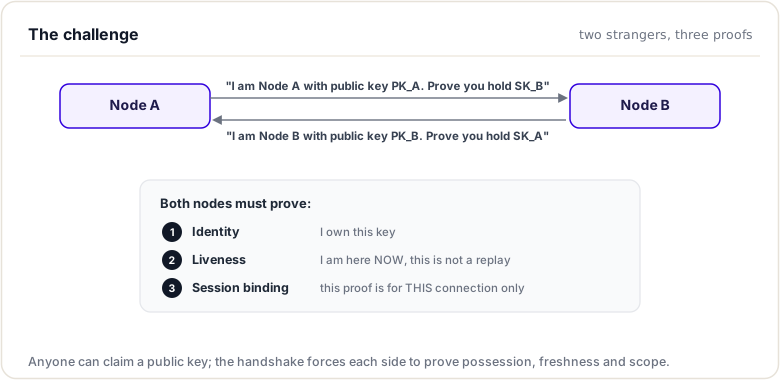
In brief: two strangers must prove their identities and confirm they share one secure channel.
What We Need to Prove
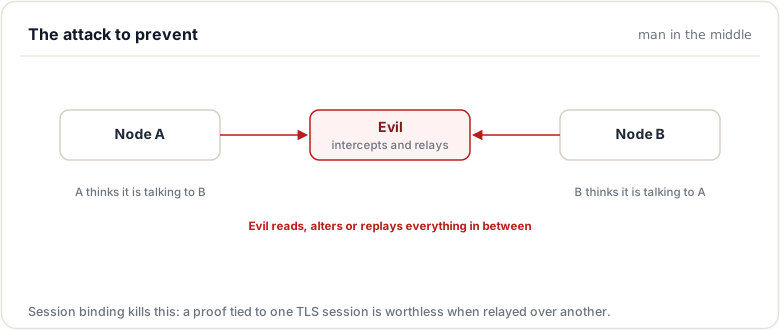
Attack Scenarios to Prevent
1. Man-in-the-Middle (MITM)
2. Replay Attack
Evil records handshake messages from previous session
Replays them to impersonate Node A
3. Self-Connection
Node A tries to connect to itself through network loop
Could cause infinite recursion/waste resources
4. Network Mismatch
Mainnet node connects to testnet node
Could cause confusion/invalid transactions
The Solution: Cryptographic Handshake
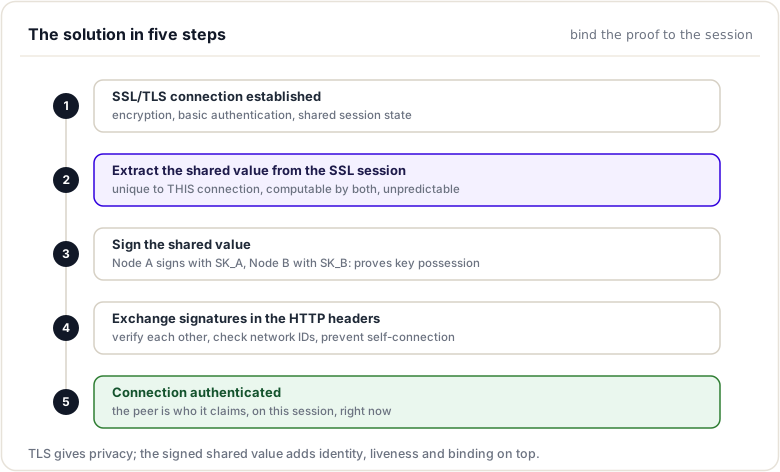
High-Level Flow
The Shared Value: Session Binding
In brief: a value derived from the TLS session that ties the handshake to this exact connection.
Why We Need It
Signatures alone aren't enough:
// ❌ INSECURE: Sign static message
auto sig = sign(pk, sk, "I am Node A");
// Problem: Can be replayed in future connections!
We need something unique to THIS specific connection:
// ✅ SECURE: Sign session-specific value
auto sharedValue = deriveFromSSL(session);
auto sig = sign(pk, sk, sharedValue);
// Can only be used for THIS session
Implementation
// From src/xrpld/overlay/detail/Handshake.cpp

std::optional<uint256>
makeSharedValue(stream_type& ssl, beast::Journal journal)
{
    // Get our "Finished" message from SSL handshake
    auto const cookie1 = hashLastMessage(
        ssl.native_handle(),
        SSL_get_finished);

    // Get peer's "Finished" message from SSL handshake
    auto const cookie2 = hashLastMessage(
        ssl.native_handle(),
        SSL_get_peer_finished);

    if (!cookie1 || !cookie2)
        return std::nullopt;

    // XOR the two hashes together
    auto const result = (*cookie1 ^ *cookie2);

    // Ensure they're not identical (would result in zero)
    if (result == beast::kZero)
    {
        JLOG(journal.error()) << "Identical finished messages";
        return std::nullopt;
    }

    // Hash the XOR result to get final shared value
    return sha512Half(Slice(result.data(), result.size()));
}
Hashing the SSL Finished Messages
static std::optional<base_uint<512>>
hashLastMessage(
    SSL const* ssl,
    size_t (*get)(const SSL*, void*, size_t))
{
    // Buffer for SSL finished message
    unsigned char buf[1024];
    size_t len = get(ssl, buf, sizeof(buf));

    if (len < 12)  // Minimum valid length
        return std::nullopt;

    // Hash it with SHA-512
    base_uint<512> cookie;
    SHA512(buf, len, cookie.data());
    return cookie;
}
What are "Finished" messages?
In the SSL/TLS handshake, both parties send a "Finished" message that contains:
- A hash of all previous handshake messages
- A MAC (Message Authentication Code) proving they know the session keys
These messages are:
- Unique per session: Different for every SSL connection
- Unpredictable: Depend on random values exchanged during handshake
- Authenticated: Part of SSL's own security
Properties of the Shared Value
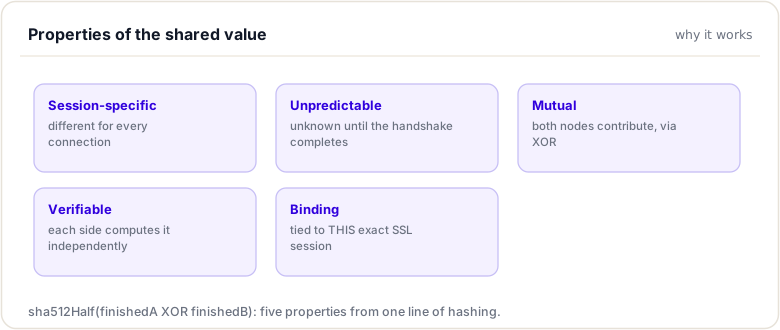
Key idea. Binding the proof to the TLS session is the trick that defeats man-in-the-middle: a stolen handshake is worthless on any other connection.
Building the Handshake
In brief: what each side sends to prove it owns its node key.
// From src/xrpld/overlay/detail/Handshake.cpp

void buildHandshake(
    boost::beast::http::fields& h,
    xrpl::uint256 const& sharedValue,
    std::optional<std::uint32_t> networkID,
    beast::IP::Address public_ip,
    beast::IP::Address remote_ip,
    Application& app)
{
    // 1. Network identification
    if (networkID)
        h.insert("Network-ID", std::to_string(*networkID));

    // 2. Timestamp (freshness, prevent replay)
    h.insert("Network-Time",
        std::to_string(app.timeKeeper().now().time_since_epoch().count()));

    // 3. Node's public key
    h.insert("Public-Key",
        toBase58(TokenType::NodePublic, app.nodeIdentity().first));

    // 4. CRITICAL: Session signature
    auto const sig = signDigest(
        app.nodeIdentity().first,   // Public key
        app.nodeIdentity().second,  // Secret key
        sharedValue);                // Session-specific value

    h.insert("Session-Signature", base64_encode(sig));

    // 5. Instance cookie (prevent self-connection)
    h.insert("Instance-Cookie",
        std::to_string(app.getInstanceCookie()));

    // 6. Optional: Server domain
    auto const domain = app.config().SERVER_DOMAIN;
    if (!domain.empty())
        h.insert("Server-Domain", domain);

    // 7. Ledger information
    if (auto closed = app.getLedgerMaster().getClosedLedger())
        h.insert("Closed-Ledger", to_string(closed->info().hash));
}
Header Fields Explained
Network-ID:
// Mainnet: 0
// Testnet: 1
// Devnet:  2, etc.

// Prevents nodes from different networks connecting
Network-Time:
// Current time in milliseconds since epoch
// Helps detect replayed handshakes (timestamps too old)
// Not strictly enforced (clocks may be slightly off)
Public-Key:
// Node's public key in Base58 format
// Example: nHUpcmNsxAw47yt2ADDoNoQrzLyTJPgnyq5o3xTmMcgV8X3iVVa7
// Used to verify the signature
Session-Signature:
// Signature of the shared value
// Proves: "I have the secret key for this public key"
//     AND "I'm participating in THIS specific SSL session"
Instance-Cookie:
// Random value generated on node startup
// If we receive our own cookie back → we're connecting to ourselves!
Server-Domain (optional):
// Domain name like "ripple.com"
// Can be verified against validator list
// Helps with node identification
Verifying the Handshake
std::optional<PublicKey>
verifyHandshake(
    http_request_type const& request,
    uint256 const& sharedValue,
    std::optional<std::uint32_t> networkID,
    uint64_t instanceCookie,
    beast::Journal journal)
{
    // 1. Extract and parse public key
    auto const pkStr = request["Public-Key"];
    auto const pk = parseBase58<PublicKey>(
        TokenType::NodePublic,
        pkStr);

    if (!pk)
    {
        JLOG(journal.warn()) << "Invalid public key";
        return std::nullopt;
    }

    // 2. Check network ID matches
    if (networkID)
    {
        auto const theirNetworkID = request["Network-ID"];
        if (theirNetworkID.empty() ||
            std::to_string(*networkID) != theirNetworkID)
        {
            JLOG(journal.warn()) << "Network ID mismatch";
            return std::nullopt;
        }
    }

    // 3. Check for self-connection
    auto const theirCookie = request["Instance-Cookie"];
    if (theirCookie == std::to_string(instanceCookie))
    {
        JLOG(journal.warn()) << "Detected self-connection";
        return std::nullopt;
    }

    // 4. Verify session signature
    auto const sigStr = request["Session-Signature"];
    auto const sig = base64_decode(sigStr);

    if (!verifyDigest(*pk, sharedValue, sig, true))
    {
        JLOG(journal.warn()) << "Invalid session signature";
        return std::nullopt;
    }

    // 5. Optional: Validate server domain
    auto const domain = request["Server-Domain"];
    if (!domain.empty() && !isProperlyFormedTomlDomain(domain))
    {
        JLOG(journal.warn()) << "Invalid server domain";
        return std::nullopt;
    }

    // Success! Return authenticated public key
    JLOG(journal.info()) << "Handshake verified for " << toBase58(*pk);
    return pk;
}
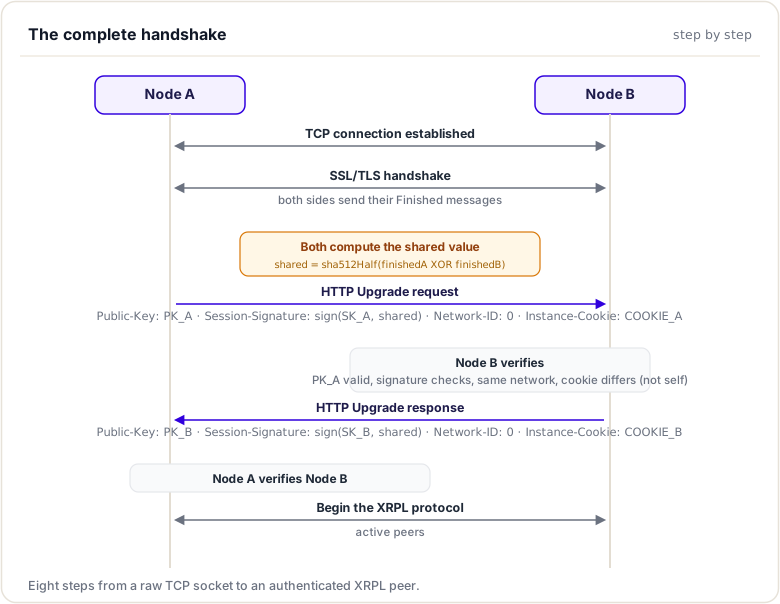
Complete Handshake Flow
Security Properties
In brief: what the handshake guarantees: mutual authentication, session binding, no replay, no MITM.
1. Mutual Authentication
Both nodes prove they possess their private keys:
Node A proves: "I have SK_A"
Node B proves: "I have SK_B"
2. Session Binding
Signatures are specific to this connection:
Signature valid ONLY for THIS SSL session
Cannot be replayed in different session
3. Replay Prevention
sharedValue = derived from THIS session's SSL handshake
Old signatures from previous sessions won't verify
4. MITM Prevention
Attacker cannot forge signatures without private keys
SSL provides encryption, handshake provides authentication
5. Self-Connection Prevention
if (theirCookie == myCookie) {
    // We're talking to ourselves!
    reject();
}
6. Network Segregation
if (theirNetwork != myNetwork) {
    // Different networks (mainnet vs testnet)
    reject();
}
Attack Analysis
Can an attacker impersonate Node A?
No:
Attacker needs to:
1. Know Node A's secret key (impossible - properly secured)
2. Sign the shared value (requires secret key)
Without SK_A, cannot create valid signature
Can an attacker replay old handshakes?
No:
Shared value is different for each SSL session
Old signature: sign(SK, oldSharedValue)
New session:   verify(PK, newSharedValue, oldSignature)
Result: Verification fails (different shared values)
Can an attacker perform MITM?
Very difficult:
SSL provides:
- Encryption (attacker can't read/modify)
- Certificate validation (can detect impersonation)

Application handshake provides:
- Signature verification (requires private keys)
- Session binding (tied to SSL session)

Attacker would need to:
1. Break SSL (extremely difficult)
2. AND forge signatures (impossible without keys)
Implementation Best Practices
DO:
// 1. Always verify the shared value
auto sharedValue = makeSharedValue(ssl, journal);
if (!sharedValue) {
    disconnect("Failed to create shared value");
}

// 2. Always require canonical signatures
if (!verifyDigest(pk, sharedValue, sig, true)) {
    disconnect("Invalid signature");
}

// 3. Always check network ID
if (theirNetwork != myNetwork) {
    disconnect("Network mismatch");
}

// 4. Always check instance cookie
if (theirCookie == myCookie) {
    disconnect("Self-connection detected");
}
DON'T:
// ❌ Don't skip signature verification
if (config.TRUSTED_NODE) {
    // Skip verification - WRONG!
}

// ❌ Don't ignore network ID
// connect();  // Oops, might be wrong network

// ❌ Don't allow self-connections
// They waste resources and can cause issues
Performance Considerations
// Handshake happens once per connection
// Not a performance bottleneck

Typical handshake time:
- SSL/TLS handshake:      50-100ms
- Shared value computation: <1ms
- Signature creation:      <1ms
- Signature verification:  <1ms
Total:                    ~50-100ms

// Amortized over connection lifetime (hours/days)
// Cost is negligible
Summary
This module covered how two strangers become trusted peers. The handshake derives a shared value from the TLS session, binding the proof to that exact connection, and each node proves it owns its node key. Together these give mutual authentication and defeat man-in-the-middle and replay attacks: a stolen handshake is worthless on any other connection.
To remember:
- Goal: prove node-key ownership AND bind the proof to this exact TLS session
- Shared value = a hash derived from the TLS Finished messages (
makeSharedValue) - Each side signs the shared value with its node key:
buildHandshake/verifyHandshake - This defeats MITM and replay: a captured handshake is worthless on any other connection
- Self-connection is detected and dropped
- It happens during the HTTP Upgrade to the peer protocol
- Code:
src/xrpld/overlay/detail/Handshake.cpp - Watch out: the identity proved here is the NODE key (
n...), not a validator's master key; do not conflate the two
Next up. The crypto all works; now learn where it quietly breaks. Next, the tour every reviewer needs: crypto pitfalls and performance.
Resources
Assignments
0 of 2 complete