
Phase overview: Cryptography
Your map of the Cryptography phase: primitives, keys and encoding, and the applied crypto of signing and the peer handshake, across eight modules.
Introduction
≈2 min · Phase overview · read this before diving in
Everything you traced in the previous phase, every transaction, every ledger, every peer message, is held together by cryptography. This phase teaches it the way a core developer needs it: not the mathematics of elliptic curves, but which primitive rippled uses where, what the code looks like, and what breaks when you get it wrong.
Three arcs again. Primitives: the security model and the hash functions (SHA-512-Half and friends) that give every object its identity. Keys and encoding: how key pairs are generated and derived, how secrets are kept out of memory dumps, and how Base58Check turns bytes into the addresses users see. Applying it: transaction signing and verification end to end, the peer handshake that authenticates nodes to each other, and a tour of the ten classic pitfalls with the real performance numbers behind XRPL's algorithm choices.
The road through this phase
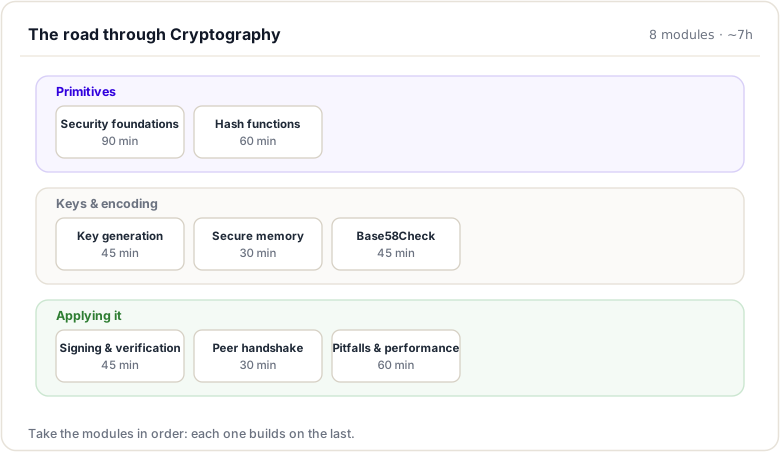
| Module | Duration | What it covers |
|---|---|---|
| Primitives | ||
| Security foundations | 90 min | The four pillars of blockchain security and the lifecycle of a cryptographic key in XRPL |
| Hash functions in XRPL | 60 min | SHA-512Half, hash prefixes and ledger namespaces, and how hashing underpins IDs, keys and integrity |
| Keys & encoding | ||
| Key generation & derivation | 45 min | How rippled turns randomness (or a seed) into secp256k1 / ed25519 key pairs and account IDs |
| Secure memory handling | 30 min | Why secrets must be wiped from memory and how rippled does it (secure_erase / OPENSSL_cleanse) |
| Base58Check encoding | 45 min | How XRPL encodes account IDs, keys and seeds as human-readable strings with a checksum and type byte |
| Applying it | ||
| Transaction signing & verification | 45 min | The signing / verification pipeline for secp256k1 and ed25519, canonical signatures and malleability |
| The peer handshake | 30 min | How two nodes prove identity and bind a session cryptographically during the peer handshake |
| Crypto pitfalls & performance | 60 min | Common cryptographic mistakes to avoid and the performance characteristics of XRPL's cryptography |
Total: about 7 hours of module time, plus your own exploration. The modules are ordered so each builds on the previous one; resist the temptation to skip ahead.
Where you will land
By the end of this phase you can follow a signature from key generation to on-ledger verification, explain why ed25519 is the recommended default, spot the classic crypto mistakes in a code review, and understand the handshake that networking builds on next.