
Security foundations
The four pillars of blockchain security and the lifecycle of a cryptographic key in XRPL.
What you'll learn
- Explain confidentiality, integrity, authenticity and non-repudiation in XRPL.
- Trace a key from entropy to account address.
- Understand where secrets live and how they're protected.
Introduction
≈90 min · Intermediate · builds on Case study — the CheckCreate transactor
Watch this short video by XRPL Commons first, then dive into the details below.
Everything valuable in XRPL rests on cryptography, so let's start with what it actually promises. In this module you'll learn the four pillars (confidentiality, integrity, authenticity and non-repudiation) the hard math behind them, and how a single key travels from raw entropy to an account address. It's the ground floor for the whole cryptography phase.
The Cryptographic Promise
In brief: the four guarantees cryptography provides: confidentiality, integrity, authenticity, and non-repudiation.
When you interact with the XRP Ledger, cryptography provides four essential security properties. Understanding these properties, what they mean, why they matter, and how they're achieved, is foundational to everything else in this module.
1. Confidentiality
Confidentiality means that sensitive information remains hidden from those who shouldn't see it.
In XRPL Context
When two rippled nodes establish a connection, their communication is encrypted so that eavesdroppers on the network can't read their messages. The SSL/TLS layer provides this guarantee, ensuring that even though the internet is fundamentally public, peer-to-peer conversations remain private.
How It Works
// From src/libxrpl/basics/make_SSLContext.cpp
// SSL context is configured with strong cipher suites
auto ctx = boost::asio::ssl::context(boost::asio::ssl::context::tlsv12);
ctx.set_options(
    boost::asio::ssl::context::default_workaround |
    boost::asio::ssl::context::no_sslv2 |
    boost::asio::ssl::context::no_sslv3 |
    boost::asio::ssl::context::single_dh_use);
Rippled uses TLS 1.2 or higher with carefully selected cipher suites that provide forward secrecy, even if a node's long-term key is compromised later, past communications remain protected.
Why It Matters
Without confidentiality:
- Attackers could monitor which transactions nodes are sharing
- Network topology could be mapped by observing communication patterns
- Strategic information about ledger state could leak to adversaries
2. Integrity
Integrity ensures that data hasn't been tampered with. A single flipped bit could change "send 1 XRP" to "send 100 XRP", or worse, redirect funds to a different account entirely.
In XRPL Context
When you receive a transaction, you need to know that every byte is exactly as the sender intended. Hash functions provide this guarantee by creating unique fingerprints of data that change completely if even a single bit is modified.
How It Works
// Transaction ID is computed from transaction data
uint256 transactionID = sha512Half(serializedTransaction);

// Any change to the transaction changes the ID completely
// Original: "Payment of 1 XRP"     → ID: 0x7F3B9...
// Modified: "Payment of 2 XRP"     → ID: 0xA21C4...
// Even 1 bit different: completely different hash
The SHA-512-Half hash function used throughout XRPL ensures that:
- You can't find two different transactions with the same ID (collision resistance)
- You can't create a transaction that produces a specific ID (preimage resistance)
- Changing even one bit produces a completely different hash (avalanche effect)
Why It Matters
Without integrity:
- Transactions could be modified in transit
- Malicious nodes could alter payment amounts
- The entire concept of "this transaction" becomes meaningless
Real-World Example
// Original transaction
{
  "Account": "rN7n7otQDd6FczFgLdlqtyMVrn3LNU8B4C",
  "Destination": "rLHzPsX6oXkzU9w7fvQqJvGjzVtL5oJ47R",
  "Amount": "1000000"  // 1 XRP
}
// Hash: 0x7F3B9E4A...

// Attacker tries to change amount
{
  "Account": "rN7n7otQDd6FczFgLdlqtyMVrn3LNU8B4C",
  "Destination": "rLHzPsX6oXkzU9w7fvQqJvGjzVtL5oJ47R",
  "Amount": "100000000"  // 100 XRP - just one character different!
}
// Hash: 0xA21C4F8D... - completely different!
The hash changes so dramatically that any modification is immediately detectable.
3. Authenticity
Authenticity proves the identity of the sender. When a transaction claims to come from a particular account, cryptographic signatures prove that the holder of that account's private key actually created it.
In XRPL Context
Every transaction on XRPL must be signed with the private key corresponding to the sending account. Without this signature, the transaction is rejected. The signature is mathematical proof that only someone with the secret key could have created it.
How It Works
// Signing a transaction
Buffer signature = sign(
    publicKey,   // Can be shared publicly
    secretKey,   // Must remain secret
    txData       // Transaction to sign
);

// Anyone can verify the signature
bool valid = verify(
    publicKey,   // Sender's public key
    txData,      // Transaction data
    signature    // Signature to verify
);
The mathematical relationship between public and secret keys ensures:
- Only the secret key holder can create a valid signature
- Anyone with the public key can verify the signature
- The signature proves authorization for this specific transaction
Why It Matters
Without authenticity:
- Anyone could claim to be anyone
- Funds could be stolen by impersonating account owners
- The entire concept of ownership would collapse
Attack Scenario (Prevented)
// Attacker tries to steal funds
Transaction fakeTx = {
  "Account": "rVictimAccount...",  // Victim's address
  "Destination": "rAttackerAccount...",
  "Amount": "1000000000"  // Attacker tries to drain account
};

// Attacker creates fake signature
Buffer fakeSignature = attacker.tryToForge();

// Verification fails!
bool valid = verify(victimPublicKey, fakeTx, fakeSignature);
// Returns false - attacker doesn't have victim's secret key
Without the victim's secret key, it's computationally infeasible to create a valid signature. The attacker would need to solve the discrete logarithm problem, which would take longer than the age of the universe with all of humanity's computing power.
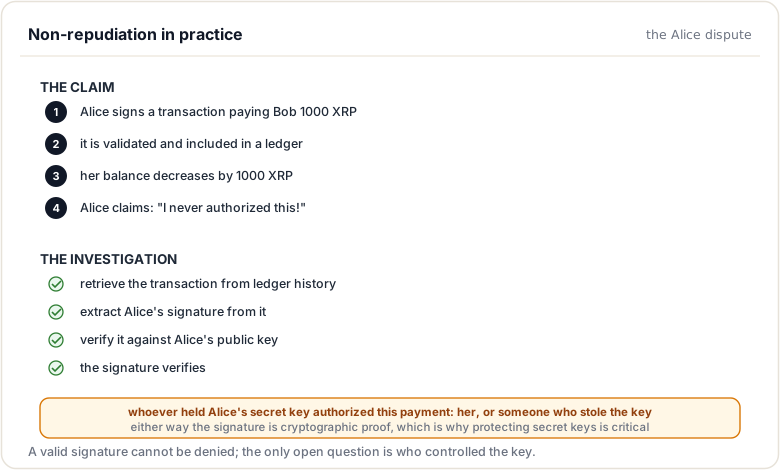
4. Non-Repudiation
Non-repudiation means that once you've signed something, you can't later deny you signed it. The mathematics of digital signatures make this guarantee absolute: if your private key created a signature, there's no ambiguity, no room for doubt.
In XRPL Context
This property is crucial for a financial system where disputes might arise and proof of authorization is essential. If you signed a payment, that signature is irrefutable proof that you authorized it.
How It Works
Digital signatures create an undeniable link between:
- The signer (proved by possession of the secret key)
- The message (what was signed)
- The time (when it was signed, via timestamps or ledger sequence)
// Alice signs a payment
auto [alicePubKey, aliceSecKey] = generateKeyPair(KeyType::ed25519);
Buffer sig = sign(alicePubKey, aliceSecKey, payment);

// Later, Alice claims: "I never authorized that payment!"
// But the signature proves otherwise:
bool proofOfAuthorization = verify(alicePubKey, payment, sig);
// Returns true - irrefutable proof Alice signed this
Why It Matters
Without non-repudiation:
- Senders could deny authorizing payments after they complete
- Dispute resolution would be impossible
- Legal accountability for transactions wouldn't exist
- Financial systems couldn't function reliably
Real-World Scenario
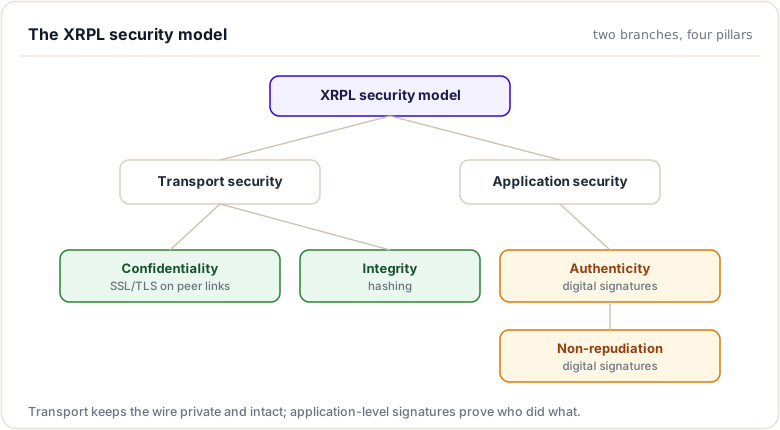
Key idea. Signatures give you authenticity and non-repudiation; hashing gives you integrity. Keep those two pairings straight and the rest of the cryptography phase falls into place.
How These Pillars Work Together
These four properties aren't independent, they work together to create a complete security system:
Example: A Complete Transaction
Let's see all four pillars in action:
// 1. AUTHENTICITY - Alice creates and signs a transaction
auto tx = Payment{
    .account = alice.address,
    .destination = bob.address,
    .amount = XRP(100)
};

Buffer signature = sign(alice.publicKey, alice.secretKey, tx);
// Only Alice's secret key can create this valid signature

// 2. INTEGRITY - Transaction is serialized and hashed
auto serialized = serialize(tx, signature);
uint256 txID = sha512Half(serialized);
// Any tampering changes the hash completely

// 3. NON-REPUDIATION - Signature proves Alice authorized this
bool authorized = verify(alice.publicKey, tx, signature);
// Alice cannot later deny signing this transaction

// 4. CONFIDENTIALITY - Transaction is sent to peers via encrypted connection
sslStream.write(serialized);  // Protected by TLS encryption
// Network observers can't read transaction details
Mathematical Foundations
In brief: the hard problems (discrete logarithm, collision resistance) those guarantees rest on.
The four pillars rest on hard mathematical problems:
For Authenticity and Non-Repudiation: The Discrete Logarithm Problem
Given: PublicKey = SecretKey × G (where G is a generator point)
Hard Problem: Find SecretKey given only PublicKey

Computing PublicKey from SecretKey: microseconds
Computing SecretKey from PublicKey: longer than age of universe
This asymmetry enables public-key cryptography. You can freely share your public key, and no one can derive your secret key from it.
For Integrity: Collision Resistance
Given: hash = SHA512Half(data)
Hard Problems:
1. Find different data' where SHA512Half(data') = hash (preimage)
2. Find data and data' where SHA512Half(data) = SHA512Half(data') (collision)

Computing hash from data: microseconds
Finding data from hash: computationally infeasible
This one-way property makes hashes perfect for integrity checking.
For Confidentiality: Symmetric Key Security
Given: Encrypted = AES_Encrypt(key, plaintext)
Hard Problem: Find plaintext without key

With key: decryption in microseconds
Without key: trying all 2^256 possible keys
TLS negotiates shared secret keys that both parties know but attackers don't.
Trust Model
In brief: who and what you have to trust, and what you do not.
These four pillars enable a trust model where:
You don't have to trust:
- Network operators
- Node operators
- Other validators
- Anyone else
You only have to trust:
- Mathematics (that the cryptographic problems are actually hard)
- Your ability to protect your own secret keys
- The open-source implementation (which you can audit)
This is the fundamental shift blockchain enables: from institutional trust to mathematical trust.
Security in Depth
Rippled doesn't rely on one cryptographic technique, it uses multiple layers:
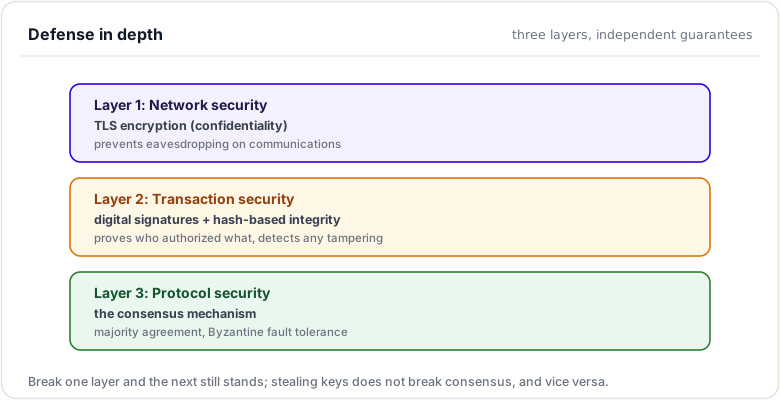
Even if one layer has a vulnerability, others provide protection.
Practical Implications
Understanding these four pillars helps you:
When reading code:
- Recognize which security property a function provides
- Understand why certain checks are performed
- Identify what would break if a step is skipped
When writing code:
- Choose appropriate cryptographic primitives
- Implement proper error handling
- Avoid introducing vulnerabilities
When debugging:
- Identify which security property is failing
- Trace the cryptographic operation responsible
- Understand what went wrong and why
Appendix: Codebase Navigation Guide
Introduction
This appendix provides a comprehensive guide to navigating rippled's cryptographic code. You'll learn where to find specific implementations, how files are organized, and which functions are most important to understand.
Directory Structure
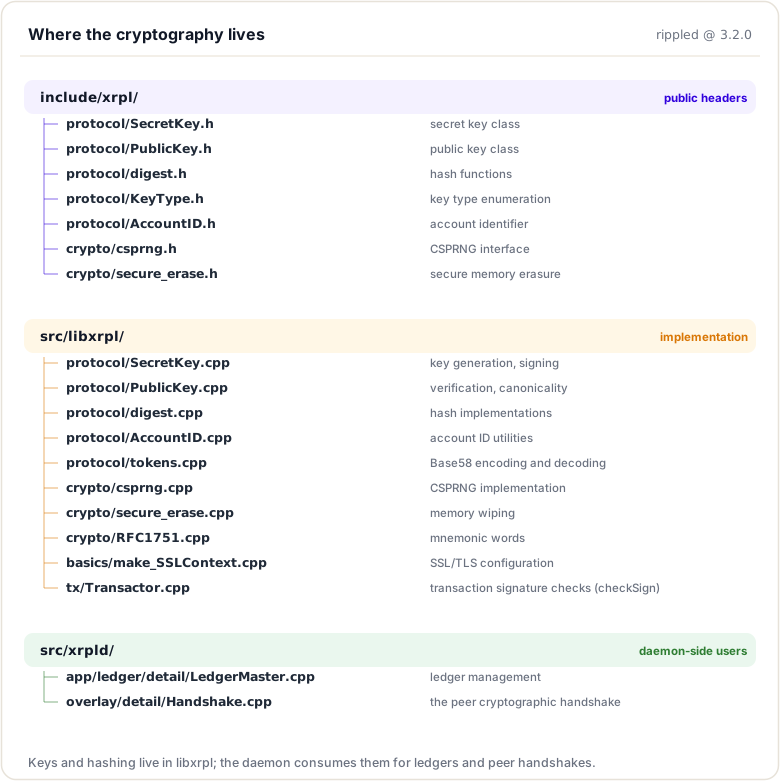
The
ed25519-donnaandlibsecp256k1implementations are external dependencies fetched via Conan (they are not in thesrc/tree).
Core Cryptographic Files
1. SecretKey.cpp (404 lines)
Location: src/libxrpl/protocol/SecretKey.cpp
Key functions:
// Random key generation
SecretKey randomSecretKey();

// Deterministic key generation
SecretKey generateSecretKey(KeyType type, Seed const& seed);
std::pair<PublicKey, SecretKey> generateKeyPair(KeyType type, Seed const& seed);

// Public key derivation
PublicKey derivePublicKey(KeyType type, SecretKey const& sk);

// Signing
Buffer sign(PublicKey const& pk, SecretKey const& sk, Slice const& m);
// Why does sign() take the PUBLIC key too? Key-type detection: the public
// key's first byte says whether this is secp256k1 or ed25519, so sign()
// knows which algorithm to run without a separate parameter.
Buffer signDigest(PublicKey const& pk, SecretKey const& sk, uint256 const& digest);
Navigate to:
- Line ~50:
randomSecretKey()implementation - Line ~100:
generateKeyPair()for secp256k1 - Line ~150:
generateKeyPair()for ed25519 - Line ~200:
derivePublicKey()implementations - Line ~300:
sign()function
2. PublicKey.cpp (328 lines)
Location: src/libxrpl/protocol/PublicKey.cpp
Key functions:
// Verification
bool verify(PublicKey const& pk, Slice const& m, Slice const& sig, bool canonical);
bool verifyDigest(PublicKey const& pk, uint256 const& digest, Slice const& sig, bool canonical);

// Canonicality checking
std::optional<ECDSACanonicality> ecdsaCanonicality(Slice const& sig);
bool ed25519Canonical(Slice const& sig);

// Key type detection
std::optional<KeyType> publicKeyType(Slice const& slice);
Navigate to:
- Line ~50:
verify()function - Line ~120:
verifyDigest()for secp256k1 - Line ~180: Ed25519 verification
- Line ~240:
ecdsaCanonicality()implementation
3. digest.cpp (109 lines)
Location: src/libxrpl/protocol/digest.cpp
Key implementations:
// SHA-512-Half hasher
class sha512_half_hasher { /* ... */ };

// RIPESHA hasher
class ripesha_hasher { /* ... */ };

// Helper functions
uint256 sha512Half(Args const&... args);
uint256 sha512Half_s(Slice const& data);  // Secure variant
Navigate to:
- Line ~20:
sha512_half_hasherclass - Line ~50:
ripesha_hasherclass - Line ~80: Utility functions
4. csprng.cpp (110 lines)
Location: src/libxrpl/crypto/csprng.cpp
Key implementation:
class csprng_engine {
    // Constructor: Initialize entropy
    // operator(): Generate random bytes
    // mix_entropy(): Add additional entropy
};

csprng_engine& crypto_prng();  // Global singleton
Navigate to:
- Line ~30:
csprng_engineclass definition - Line ~50: Constructor (entropy initialization)
- Line ~70:
operator()(random byte generation) - Line ~90:
mix_entropy()(additional entropy)
5. tokens.cpp
Location: src/libxrpl/protocol/tokens.cpp
Key functions:
// Base58Check encoding
std::string encodeBase58Token(TokenType type, void const* token, std::size_t size);

// Base58Check decoding
std::string decodeBase58Token(std::string const& s, TokenType type);

// Helpers
std::string toBase58(AccountID const& id);
std::optional<AccountID> parseBase58(std::string const& s);
Finding Specific Functionality
"Where is...?"
Key generation:
src/libxrpl/protocol/SecretKey.cpp
  → randomSecretKey()          // Random generation
  → generateKeyPair()          // Deterministic from seed
Signing:
src/libxrpl/protocol/SecretKey.cpp
  → sign()                     // Sign message
  → signDigest()               // Sign pre-hashed message
Verification:
src/libxrpl/protocol/PublicKey.cpp
  → verify()                   // Verify signature
  → verifyDigest()             // Verify digest signature
Hashing:
src/libxrpl/protocol/digest.cpp
  → sha512Half()               // SHA-512-Half hash
  → sha512Half_s()             // Secure variant

include/xrpl/protocol/digest.h
  → Hash function interfaces
Random numbers:
src/libxrpl/crypto/csprng.cpp
  → crypto_prng()              // Get CSPRNG instance
  → csprng_engine::operator()  // Generate random bytes
Address encoding:
src/libxrpl/protocol/tokens.cpp
  → encodeBase58Token()        // Encode to Base58Check
  → decodeBase58Token()        // Decode from Base58Check
Transaction signing:
src/libxrpl/protocol/STTx.cpp
  → STTx::sign()               // Sign transaction
  → STTx::checkSign()          // Verify transaction signature
Peer handshake:
src/xrpld/overlay/detail/Handshake.cpp
  → makeSharedValue()          // Derive session value
  → buildHandshake()           // Create handshake headers
  → verifyHandshake()          // Verify peer handshake
Navigation by Task
Task: Understanding Ed25519 Signing
- Start at
src/libxrpl/protocol/SecretKey.cpp:sign() - Find Ed25519 case in switch statement
- See call to
ed25519_sign() - Note: External library (ed25519-donna)
- External dependency (ed25519-donna), fetched via Conan
Task: Understanding Secp256k1 Verification
- Start at
src/libxrpl/protocol/PublicKey.cpp:verify() - Find secp256k1 case
- Follow to
verifyDigest() - See canonicality check:
ecdsaCanonicality() - See secp256k1 library calls:
secp256k1_ecdsa_verify() - External dependency (libsecp256k1), fetched via Conan
Task: Understanding Address Generation
- Start at
src/libxrpl/protocol/AccountID.cpp:calcAccountID() - See RIPESHA hash:
ripesha_hasher - Implementation in
src/libxrpl/protocol/digest.cpp - Double hash: SHA-256 then RIPEMD-160
- Encoding:
src/libxrpl/protocol/tokens.cpp:encodeBase58Token()
Header vs Implementation
When to read headers:
// Headers show:
// - Function declarations
// - Class interfaces
// - Documentation comments
// - Public API

// Good for:
// - Understanding what's available
// - API reference
// - Quick lookup
When to read implementation:
// Implementation shows:
// - Actual algorithms
// - Error handling
// - Edge cases
// - Performance optimizations

// Good for:
// - Understanding how it works
// - Debugging
// - Learning
// - Contributing
Search Patterns
Using grep to find code:
# Find all signing functions
grep -r "Buffer sign" src/libxrpl/protocol/

# Find CSPRNG usage
grep -r "crypto_prng()" src/

# Find signature verification
grep -r "verify.*signature" src/

# Find Base58 encoding
grep -r "encodeBase58" src/

# Find hash function usage
grep -r "sha512Half" src/
Using git blame:
# See who wrote/modified code and why
git blame src/libxrpl/protocol/SecretKey.cpp

# See commit that introduced a function
git log -S "randomSecretKey" --source --all
Using tags/symbols:
# Generate ctags for symbol navigation
ctags -R src/ include/

# Jump to definition in vim
# Position cursor on function name, press Ctrl-]
Common Code Patterns
RAII Pattern:
// Look for:
class SomeKey {
    ~SomeKey() {
        secure_erase(/* ... */);
    }
};
Error Handling Pattern:
// Look for:
if (operation_failed()) {
    Throw<std::runtime_error>("Operation failed");
}
Key Type Detection Pattern:
// Look for:
switch (publicKeyType(pk)) {
    case KeyType::secp256k1:
        // ...
    case KeyType::ed25519:
        // ...
}
Tips for Code Reading
- Start with tests: Look in
src/testfor usage examples - Follow the data: Track how data flows through functions
- Read comments: rippled has good documentation in code
- Use a debugger: Step through code to understand flow
- Check git history: See why code was written that way
- Ask questions: rippled has active developer community
The Lifecycle of a Cryptographic Key
In brief: how one key travels from raw entropy to a usable account address.
Introduction
Let's follow the lifecycle of a cryptographic key in rippled, from its creation as random noise to its role as the foundation of an account's identity. This journey touches every aspect of rippled's cryptographic system and shows how the pieces fit together.
Understanding this lifecycle is crucial because keys are the foundation of everything in XRPL. Every account, every transaction, every validator message, all depend on the proper generation, handling, and use of cryptographic keys.
The Journey Begins: Birth Through Randomness
Everything begins with randomness. Not the pseudo-randomness of Math.random() or std::rand(), but true cryptographic randomness, numbers that are fundamentally unpredictable.
Why Randomness Matters
If an attacker can predict your random numbers, they can predict your keys. If they can predict your keys, they own your account. The stakes couldn't be higher.
// ❌ WRONG - Predictable and insecure
void generateWeakKey() {
    std::srand(std::time(nullptr));  // Predictable seed!
    std::uint8_t buf[32];
    for (auto& byte : buf)
        byte = std::rand() % 256;  // NOT cryptographically secure
}

// ✅ CORRECT - Cryptographically secure
SecretKey generateStrongKey() {
    std::uint8_t buf[32];
    beast::rngfill(buf, sizeof(buf), crypto_prng());  // CSPRNG
    SecretKey sk{Slice{buf, sizeof(buf)}};
    secure_erase(buf, sizeof(buf));  // Clean up
    return sk;
}
The Birth of a Secret Key
In rippled, randomness comes from the crypto_prng() function, which wraps OpenSSL's RAND_bytes:
// From src/libxrpl/protocol/SecretKey.cpp
SecretKey randomSecretKey()
{
    std::uint8_t buf[32];
    beast::rngfill(buf, sizeof(buf), crypto_prng());
    SecretKey sk(Slice{buf, sizeof(buf)});
    secure_erase(buf, sizeof(buf));
    return sk;
}
What happens here:
- Allocate buffer: A 32-byte buffer is created on the stack
- Fill with randomness:
crypto_prng()fills it with cryptographically secure random bytes from OpenSSL - Create SecretKey: The buffer is wrapped in a
SecretKeyobject - Secure cleanup: The temporary buffer is securely erased to prevent key material from lingering in memory
Where Randomness Comes From
When you call crypto_prng(), OpenSSL pulls entropy from multiple sources:
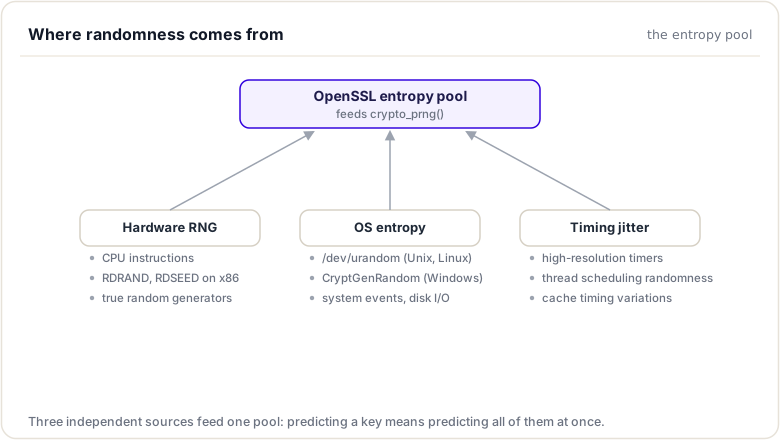
This multi-source approach ensures that even if one entropy source is weak, others provide backup security.
Growth: From Secret to Public
With a secret key in hand, we need to derive its public key, the identity we can share with the world. This derivation is one of the beautiful ideas in modern cryptography: a mathematical function that's easy to compute in one direction but effectively impossible to reverse.
The One-Way Function
// Easy direction: secret → public (microseconds)
PublicKey publicKey = derivePublicKey(KeyType::ed25519, secretKey);

// Impossible direction: public → secret (longer than age of universe)
// There is NO function: secretKey = deriveSecretKey(publicKey);
This asymmetry is what makes public-key cryptography possible.
Two Algorithms, Two Approaches
XRPL supports two cryptographic algorithms, each with its own derivation process:
secp256k1: Elliptic Curve Point Multiplication
// From src/libxrpl/protocol/SecretKey.cpp
case KeyType::secp256k1: {
    secp256k1_pubkey pubkey_imp;

    // Multiply the generator point G by the secret key
    secp256k1_ec_pubkey_create(
        secp256k1Context(),
        &pubkey_imp,
        reinterpret_cast<unsigned char const*>(sk.data()));

    // Serialize to compressed format (33 bytes)
    unsigned char pubkey[33];
    std::size_t len = sizeof(pubkey);
    secp256k1_ec_pubkey_serialize(
        secp256k1Context(),
        pubkey,
        &len,
        &pubkey_imp,
        SECP256K1_EC_COMPRESSED);  // Compressed format

    return PublicKey{Slice{pubkey, len}};
}
How it works:
- Elliptic curve has a special "generator" point G
- Public key = Secret key × G (point multiplication on the curve)
- Result is a point with X and Y coordinates
- Compressed format stores X coordinate + one bit for Y (33 bytes total)
- Prefix byte: 0x02 or 0x03 (indicates Y parity)
- X coordinate: 32 bytes
Why it's secure:
- Computing
Public = Secret × Gis fast - Computing
SecretfromPublicrequires solving the discrete logarithm problem - No known efficient algorithm exists for this problem
ed25519: Curve25519 Operations
case KeyType::ed25519: {
    unsigned char buf[33];
    buf[0] = 0xED;  // Type prefix
    ed25519_publickey(sk.data(), &buf[1]);
    return PublicKey(Slice{buf, sizeof(buf)});
}
How it works:
- Uses Ed25519 curve operations (optimized variant of Curve25519)
- Derives public key through curve arithmetic
- Adds 0xED prefix byte to identify key type
- Total 33 bytes (1 prefix + 32 public key)
Why it's secure:
- Based on different curve with different security proofs
- Specifically designed for signing (not encryption)
- More resistant to implementation errors
The Beauty of One-Way Functions
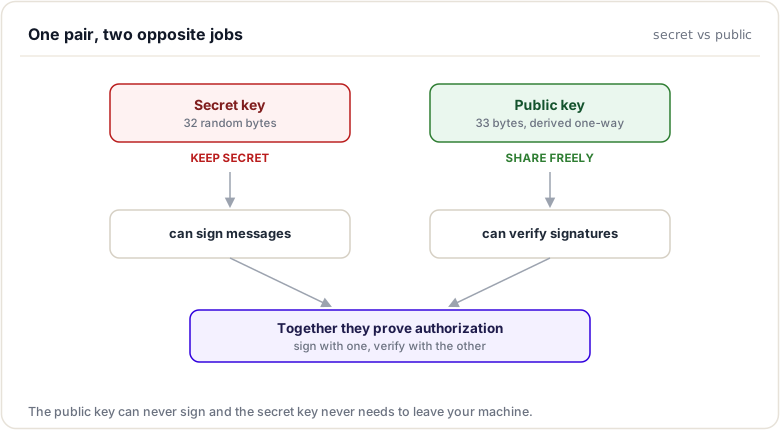
The public key can be:
- Posted on websites
- Included in transactions
- Sent to strangers
- Stored in public databases
No matter who has it or what they do with it, they can't derive your secret key. Your private identity remains private.
Alternative Path: Deterministic Generation
Sometimes we don't want pure randomness. Sometimes we want to be able to recreate the exact same key pair from a remembered or stored value. This is where seed-based deterministic key generation comes in.
Why Deterministic Keys?
Problem with pure randomness:
Generate Key1 → Secret1, Public1
Generate Key2 → Secret2, Public2
Generate Key3 → Secret3, Public3

To backup: Must save Secret1, Secret2, Secret3, ...
Solution with seeds:
Remember one seed → Can regenerate all keys

Seed → Key1 (ordinal 0)
    → Key2 (ordinal 1)
    → Key3 (ordinal 2)
    → ...
How Seeds Work
A seed is a small piece of data, typically 16 bytes, that serves as the "master secret" for an entire family of keys:
// From src/libxrpl/protocol/SecretKey.cpp
std::pair<PublicKey, SecretKey>
generateKeyPair(KeyType type, Seed const& seed)
{
    switch (type)
    {
        case KeyType::secp256k1: {
            detail::Generator g(seed);
            return g(0);  // Generate the 0th key pair
        }
        case KeyType::ed25519: {
            auto const sk = generateSecretKey(type, seed);
            return {derivePublicKey(type, sk), sk};
        }
    }
}
For ed25519: Simple and Direct
// Hash the seed to get the secret key
SecretKey generateSecretKey(KeyType::ed25519, Seed const& seed)
{
    auto const secret = sha512Half_s(makeSlice(seed));  // Secure hash
    return SecretKey{secret};
}
Simple, deterministic, and secure. Same seed always produces same key.
For secp256k1: Handling Edge Cases
// Must ensure result is valid secret key
SecretKey deriveDeterministicRootKey(Seed const& seed)
{
    std::uint32_t ordinal = 0;

    // Try up to 128 times to find valid key
    for (int i = 0; i < 128; ++i)
    {
        // Create buffer with seed + ordinal
        std::array<std::uint8_t, 20> buf;
        std::copy(seed.data(), seed.data() + 16, buf.begin());
        buf[16] = (ordinal >> 24) & 0xFF;
        buf[17] = (ordinal >> 16) & 0xFF;
        buf[18] = (ordinal >>  8) & 0xFF;
        buf[19] = (ordinal >>  0) & 0xFF;

        // Hash it
        auto const secret = sha512Half(makeSlice(buf));

        // Check if it's a valid secret key
        if (isValidSecretKey(secret))
            return SecretKey{secret};

        // If not valid, try next ordinal
        ++ordinal;
    }

    // Should never happen (probability ~ 1 in 2^128)
    Throw<std::runtime_error>("Failed to generate key from seed");
}
Why the loop?
Not all 32-byte values are valid secret keys for secp256k1. The value must be less than the curve's "order" (a large prime number). If the hash result is too large, increment a counter and try again.
The odds of needing more than one attempt are vanishingly small (roughly 1 in 2^128), but the code handles it correctly.
The Generator Pattern
The Generator class enables creating multiple independent keys from one seed:
detail::Generator g(seed);

auto [pub0, sec0] = g(0);  // First key pair
auto [pub1, sec1] = g(1);  // Second key pair
auto [pub2, sec2] = g(2);  // Third key pair
Each ordinal produces a cryptographically independent key pair. This enables powerful features like:
- Hierarchical wallets: One seed, many accounts
- Key rotation: Generate new keys without remembering multiple seeds
- Backup simplicity: One seed backs up everything
From Key to Identity: Account IDs
A public key isn't an address. To get the human-readable XRPL address (starting with 'r'), we need one more transformation:
// From src/libxrpl/protocol/AccountID.cpp
AccountID calcAccountID(PublicKey const& pk)
{
    ripesha_hasher h;
    h(pk.data(), pk.size());
    return AccountID{static_cast<ripesha_hasher::result_type>(h)};
}
The RIPESHA Double Hash
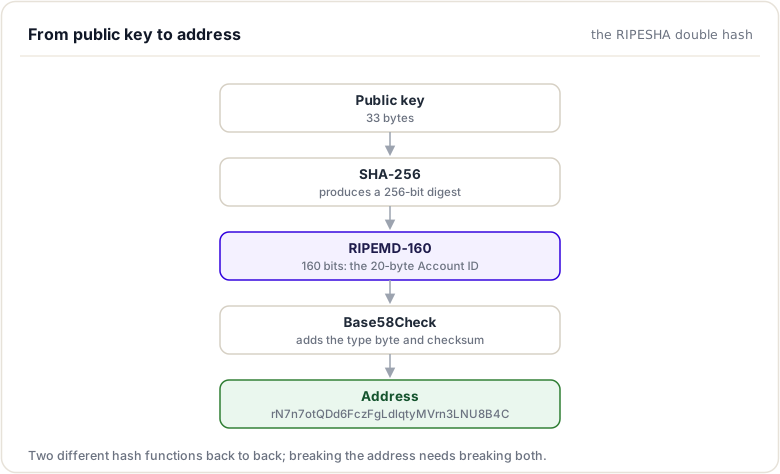
Why two hash functions?
- Compactness: 20 bytes instead of 33 bytes
- Defense in depth: If SHA-256 is broken, RIPEMD-160 provides protection; if RIPEMD-160 is broken, SHA-256 does
- Compatibility: Same scheme used by other blockchain systems
Why hash at all?
- Shorter addresses are easier to use
- Provides a level of indirection (can't derive public key from address)
- Quantum-resistant: even if quantum computers break elliptic curve crypto, they can't derive the public key from the address alone
The Complete Lifecycle
Let's trace a key from birth to address:
// 1. BIRTH: Generate random secret key
SecretKey secretKey = randomSecretKey();
// Result: 32 random bytes
// Example: 0x1a2b3c4d...

// 2. GROWTH: Derive public key
PublicKey publicKey = derivePublicKey(KeyType::ed25519, secretKey);
// Result: 33 bytes (0xED prefix + 32 bytes)
// Example: 0xED9434799226374926EDA3B54B1B461B4ABF7237962EEB1144C10A7CA6A9D32C64

// 3. IDENTITY: Calculate account ID
AccountID accountID = calcAccountID(publicKey);
// Result: 20 bytes
// Example: 0x8B8A6C533F09CA0E5E00E7C32AA7EC323485ED3F

// 4. PRESENTATION: Encode as address
std::string address = toBase58(accountID);
// Result: Human-readable address
// Example: rN7n7otQDd6FczFgLdlqtyMVrn3LNU8B4C
Each step is irreversible:
- Can't derive secret from public
- Can't derive public from account ID
- Can't derive account ID from address (but can decode)
Lifecycle Management: RAII and Secure Cleanup
The SecretKey class demonstrates proper lifecycle management:
class SecretKey
{
private:
    std::uint8_t buf_[32];

public:
    SecretKey(Slice const& slice)
    {
        std::memcpy(buf_, slice.data(), sizeof(buf_));
    }

    ~SecretKey()
    {
        // Automatically called when SecretKey goes out of scope
        secure_erase(buf_, sizeof(buf_));
    }

    // Prevent copying to avoid multiple erasures
    SecretKey(SecretKey const&) = delete;
    SecretKey& operator=(SecretKey const&) = delete;

    // Allow moving (transfers ownership)
    SecretKey(SecretKey&&) noexcept = default;
    SecretKey& operator=(SecretKey&&) noexcept = default;
};
RAII (Resource Acquisition Is Initialization):
- Constructor acquires resource (the secret key)
- Destructor releases resource (securely erases key)
- No manual cleanup needed
- Automatic cleanup even if exceptions occur
Usage pattern:
void signTransaction(Transaction const& tx)
{
    SecretKey sk = loadKeyFromSecureStorage();

    auto signature = sign(pk, sk, tx);

    // sk destructor automatically called here
    // Key material is securely erased
}
Even if sign() throws an exception, the destructor still runs and the key is erased. This is defensive programming, making it impossible to forget cleanup.
Key Type Detection
How does rippled know which algorithm a key uses? The first byte:
std::optional<KeyType> publicKeyType(Slice const& slice)
{
    if (slice.size() != 33)
        return std::nullopt;

    switch (slice[0])
    {
        case 0x02:
        case 0x03:
            return KeyType::secp256k1;
        case 0xED:
            return KeyType::ed25519;
        default:
            return std::nullopt;
    }
}
This automatic detection means higher-level code doesn't need to track key types, the keys themselves carry the information.
secp256k1 public key: 0x02[32 bytes] or 0x03[32 bytes]
ed25519 public key:   0xED[32 bytes]
Summary: The Key Lifecycle
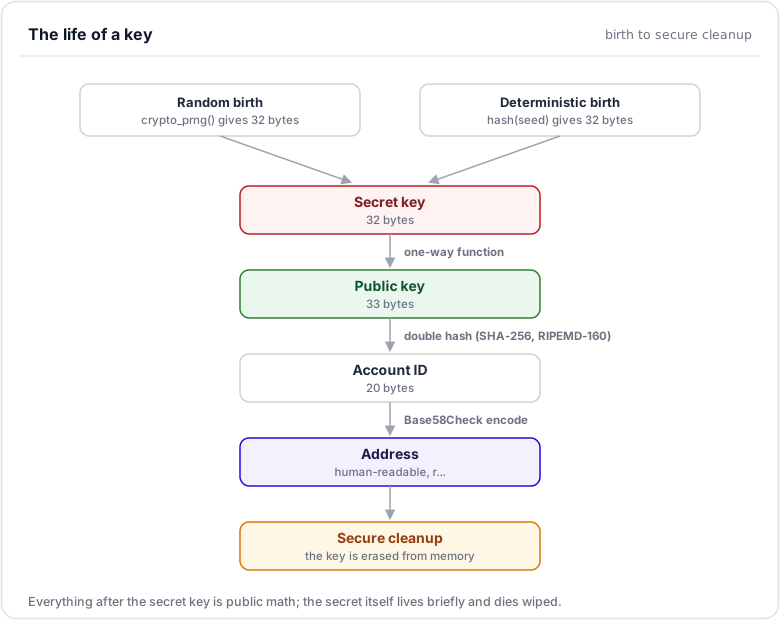
Summary
This module laid the cryptographic groundwork. You learned the four pillars, confidentiality, integrity, authenticity, and non-repudiation, the hard mathematical problems they rest on (the discrete logarithm problem for signatures, collision resistance for hashing), and how a single key travels from raw entropy to an account address. Signatures give you authenticity and non-repudiation; hashing gives you integrity.
To remember:
- Four pillars: confidentiality, integrity, authenticity, non-repudiation
- Signatures give authenticity + non-repudiation; hashes give integrity
- Hard problems underneath: the discrete logarithm (signatures) and collision resistance (hashing)
- Key lifecycle: entropy, seed, key pair, public key, account ID, address
- The seed is the root secret: everything else derives from it deterministically
- Key code:
include/xrpl/protocol/SecretKey.handPublicKey.h wallet_proposegenerates keys; treat its output as radioactive on shared machines- Watch out: authenticity of a message is not authorization for an account; regular keys and signer lists separate the two
Next up. You know what the crypto must guarantee. Next, the tool that does most of the work: XRPL's hash functions, and why SHA-512-Half is everywhere.
Resources
Assignments
0 of 2 complete