
Phase overview: Communication (RPC)
Your map of the Communication (RPC) phase: how the outside world talks to a node, and how to build, harden, and test your own command, in six modules.
Introduction
≈2 min · Phase overview · read this before diving in
Peers talk to peers on the overlay; everyone else, wallets, explorers, your own scripts, talks to a node through RPC. This phase follows a request from the HTTP or WebSocket port all the way to a handler and back, then has you build your own command.
First, understanding the path: the RPC architecture and request flow (ports, the handler table, contexts), then authentication, roles, and the error-handling contract every response follows. Then building your own: implement a custom handler from scratch, absorb the best practices that separate working code from production code, test it with the jtx framework, and finish with the advanced machinery, subscriptions, streaming, and the gRPC path.
The road through this phase
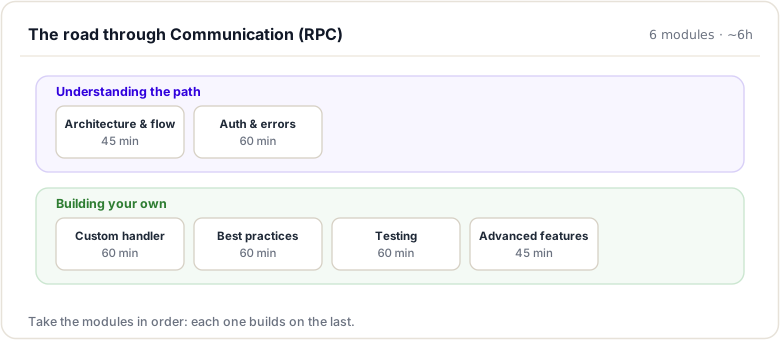
| Module | Duration | What it covers |
|---|---|---|
| Understanding the path | ||
| RPC architecture & request flow | 45 min | How rippled's RPC layer dispatches JSON-RPC / WebSocket / gRPC requests to handlers |
| RPC authentication & error handling | 60 min | Role-based access control and the RPC error-code system |
| Building your own | ||
| Building a custom RPC handler | 60 min | Implement a new RPC command end-to-end — the handler function, registration and conditions |
| RPC handler best practices | 60 min | Patterns and helpers for robust, consistent RPC handlers |
| Testing RPC handlers | 60 min | How to test RPC handlers with the jtx framework and debug them |
| Advanced RPC features | 45 min | Subscriptions, WebSocket streams and gRPC — beyond simple request / response |
Total: about 6 hours of module time, plus your own exploration. The modules are ordered so each builds on the previous one; resist the temptation to skip ahead.
Where you will land
By the end of this phase you can trace any RPC command through the codebase, and you will have designed, hardened, and tested a command of your own, exactly the skill the capstone's RPC requirement calls for. Next, the heart of the system: consensus.
Unlocks
Finishing this module opens up: