
Voting & network coordination
How validators vote on amendments and how the network coordinates activation.
What you'll learn
- Configure amendment voting (`VoteBehavior`).
- Explain how votes are tallied across the network.
- Understand coordination and backward-compatibility concerns.
Introduction
≈90 min · Intermediate · builds on The amendment lifecycle
Amendments live or die by how validators vote and how the network coordinates the switch. In this module you'll learn to configure voting with VoteBehavior, how votes are tallied across the network, and the real-world concerns (backward compatibility, non-updated nodes, contingency plans) of flipping a protocol change on safely. It's the operational side of governance.
Communication via the Overlay Network
In brief: votes ride along with validations over the overlay.
Validation Propagation
The primary coordination mechanism for amendments is the propagation of validations across the overlay network.
Network structure:
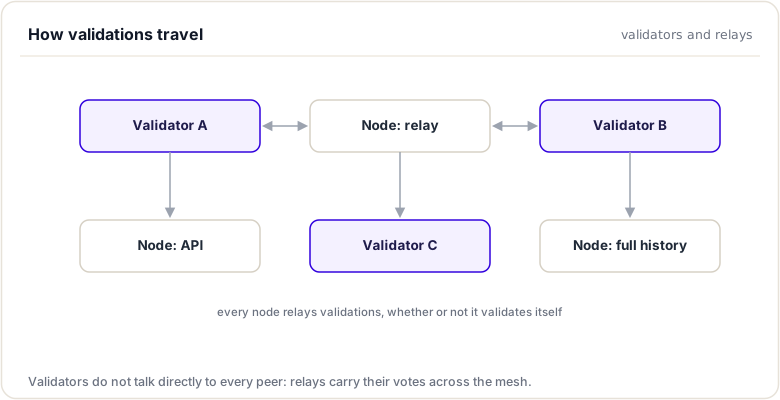
Propagation flow:
- A validator publishes a validation containing its list of supported amendments
- The validation is broadcast to all connected peers
- Each peer propagates the validation to its own peers (flood protocol)
- Within seconds, all nodes in the network have received the validation
- Each node extracts the amendment list and updates its counters
Validation Broadcast Protocol
Validations are broadcast via XRPL's Peer Protocol:
TMValidation Message:
message TMValidation {
    required bytes validation = 1;    // Serialized and signed validation
    optional bytes cookie = 2;        // Tracking cookie
}
Processing by receiving node:
void PeerImp::onValidation(
    std::shared_ptr<protocol::TMValidation> const& m)
{
    // Deserialize the validation
    auto validation = std::make_shared<STValidation>(
        SerialIter{m->validation().data(), m->validation().size()},
        [](PublicKey const& pk) { return calcNodeID(pk); });

    // Verify signature
    if (!validation->isValid())
        return;

    // Extract amendments
    auto const amendments = validation->getAmendments();

    // Pass to validation handler
    app_.getValidations().addValidation(validation);

    // Relay to other peers (except sender)
    overlay_.relay(m, validation->getNodeID());
}
Duplicate Suppression and Optimization
To avoid message flooding, the overlay network suppresses duplicates (and, separately, squelches redundant validator-message senders via TMSquelch):
Principle: A node only propagates a message if it hasn't seen it yet
bool Overlay::relay(
    std::shared_ptr<Message> const& m,
    NodeID const& source)
{
    // Calculate message hash
    auto const hash = sha512Half(m->SerializeAsString());

    std::lock_guard lock(dedupMutex_);

    // Check if already seen
    if (seenMessages_.count(hash))
        return false;  // Don't propagate

    // Mark as seen
    seenMessages_.insert(hash);

    // Propagate to all peers except source
    for (auto const& peer : peers_) {
        if (peer->getNodeID() != source)
            peer->send(m);
    }

    return true;
}
Entry expiration: suppression entries expire after a few minutes to free memory.
Deployment Strategies
In brief: how a protocol change is rolled out safely across the network.
Phase 1: Pre-Release Communication
6-8 weeks before release: Public announcement of the proposed amendment
- Publication of an XLS (XRPL Standard) detailing the amendment
- Public code review on GitHub
- Discussions on community forums
- Technical webinars and presentations
Communication channels:
- XRPL.org blog
- GitHub (XLS repository)
- XRPL Dev Forum
- Discord XRPL Developers
- Official Twitter/X
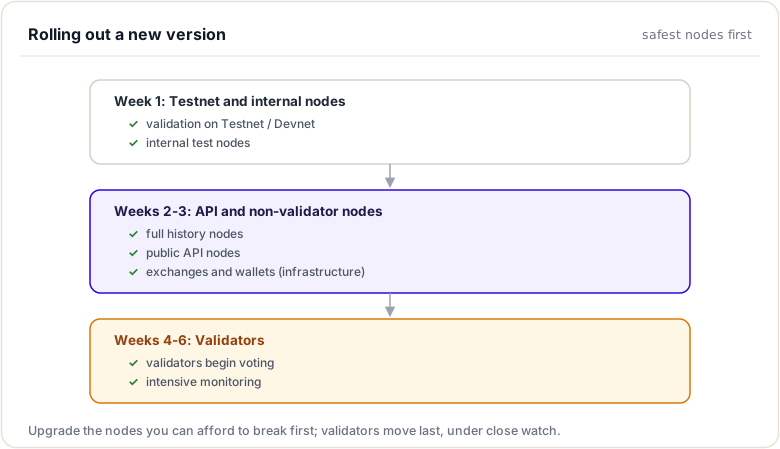
Phase 2: Code Release
Objective: Distribute code before voting begins
Typical timeline:
- T+0: Release of rippled with the new amendment (e.g., 1.12.0)
- T+1 week: First non-validator nodes update
- T+2 weeks: ~30% of nodes updated
- T+4 weeks: ~60% of nodes updated
Progressive deployment strategy:
Phase 3: Vote Activation
Communication to validators:
Validators receive notifications to activate their vote:
Note. The "Subscriptions" amendment used in the examples below is a hypothetical running example (not a real XRPL amendment); the notification and command output are illustrative of the process, not real records.
# Email/notification to validator operators
Subject: Ready to vote for Subscriptions amendment

The Subscriptions amendment (XLS-0078) is ready for voting.
Release: rippled 1.12.0
Amendment hash: 7B73B9E8D8E6E8E8A8B8C8D8E8F8A8B8C8D8E8F8A8B8C8D8E8F8A8B8C8D8E8F8

To activate your vote:
xrpld feature 7B73B9E8D8E6E8E8A8B8C8D8E8F8A8B8C8D8E8F8A8B8C8D8E8F8A8B8C8D8E8F8 accept

Or add to xrpld.cfg:
[amendments]
7B73B9E8D8E6E8E8A8B8C8D8E8F8A8B8C8D8E8F8A8B8C8D8E8F8A8B8C8D8E8F8
Informal coordination: Validators communicate via:
- Private validator mailing list
- Private Slack/Discord channels
- Regular coordination meetings
Phase 4: Majority Period
2 weeks of final preparation:
Once the 80% threshold is exceeded, node operators receive alerts:
[WARNING] Amendment 7B73B9E8... (Subscriptions) has reached majority.
It will activate in approximately 14 days (on 2025-05-04 14:32:15 UTC).

If your node does not support this amendment, please upgrade to rippled 1.12.0 or later immediately.

Current version: 1.11.0
Amendment support: NO
Upgrade urgency: CRITICAL
Required actions:
- All non-updated nodes must upgrade
- Exchanges and wallets must finalize their integrations
- Final tests on staging environments
Phase 5: Activation
Moment of truth: The activation day
- 24/7 monitoring by technical teams
- Emergency communication channels open
- Ready to coordinate response if issue detected
Managing Non-Updated Nodes
In brief: what happens to nodes that have not upgraded in time.
Early Detection
Nodes can detect that they will soon be blocked:
void NetworkOPsImp::checkAmendmentStatus() {
    auto const expected = app_.getAmendmentTable().firstUnsupportedExpected();

    if (expected) {
        auto const now = app_.timeKeeper().closeTime();
        auto const timeUntil = *expected - now;

        if (timeUntil < 24h) {
            // CRITICAL: Less than 24h
            JLOG(j_.fatal())
                << "CRITICAL: Unsupported amendment will activate in "
                << timeUntil.count() << " seconds. UPGRADE NOW!";

            // Send alert to operator
            sendOperatorAlert("CRITICAL_AMENDMENT_WARNING");
        }
        else if (timeUntil < 7days) {
            // ERROR: Less than a week
            JLOG(j_.error())
                << "ERROR: Unsupported amendment will activate in "
                << std::chrono::duration_cast<std::chrono::days>(timeUntil).count()
                << " days. Please upgrade soon.";
        }
        else if (timeUntil < 14days) {
            // WARNING: In majority window
            JLOG(j_.warn())
                << "WARNING: Unsupported amendment will activate in "
                << std::chrono::duration_cast<std::chrono::days>(timeUntil).count()
                << " days.";
        }
    }
}
Emergency Migration Strategies
For validators:
If a validator doesn't have time to update before activation:
// Option 1: Withdraw vote to delay activation
xrpld feature 7B73B9E8... reject

// Option 2: Temporarily withdraw from UNL
// (requires coordination with other validators)
For API nodes/Exchanges:
- Plan A: Quick upgrade (few hours of maintenance)
- Plan B: Route traffic to already-updated backup nodes
- Plan C: Degraded mode (read-only via third-party nodes)
Crisis Communication
In case of major problem detected during majority period:
Channel #xrpl-validators (private):
[URGENT] Issue detected with Subscriptions amendment.
Potential impact: [description]
Recommendation: All validators please REJECT the amendment immediately.

Command:
xrpld feature 7B73B9E8... reject
Quick coordination: Validators can withdraw their votes to drop support below 80% and avoid automatic activation.
Watch out. When an amendment activates, a node that does not understand it becomes amendment-blocked and stops validating. Operators must upgrade before activation, not after.
Contingency Plans
Scenario 1: Critical Bug Discovered After Activation
Cannot disable an amendment: There is no rollback mechanism.
Response strategies:
- Emergency patch: Develop and deploy a fix quickly
// In doApply(), add temporary guard
TER RecurringPaymentClaim::doApply() {
    // EMERGENCY FIX: Disable temporarily until proper fix
    if (view().info().seq < EMERGENCY_DISABLE_LEDGER) {
        return temDISABLED;
    }

    // Normal logic...
}
- Corrective amendment: Develop an amendment that fixes the bug
XRPL_FIX(fixSubscriptionsBug, Supported::yes, VoteBehavior::DefaultYes)
- Out-of-band coordination: If the bug is catastrophic, manual coordination for an emergency hard fork (extreme scenario never used on XRPL)
Scenario 2: Network Partition During Activation
Symptom: Two parts of the network activate the amendment at different times or with different results.
Detection:
// Monitoring for forks
void LedgerMaster::checkForFork() {
    auto const ourLedger = getValidatedLedger();
    auto const peerLedgers = getPeerLedgerHashes();

    int matchingCount = 0;
    for (auto const& peerHash : peerLedgers) {
        if (peerHash == ourLedger->getHash())
            matchingCount++;
    }

    if (matchingCount < peerLedgers.size() * 0.5) {
        JLOG(j_.fatal())
            << "Potential network fork detected! "
            << "Our ledger does not match majority of peers.";
    }
}
Resolution:
- Normal consensus will resolve the partition
- The minority chain will abandon its progress and adopt the majority chain
- Unconfirmed transactions will need to be resubmitted
Scenario 3: Validators Divided on Vote
Symptom: Support oscillates around 80%, amendment gains and loses majority multiple times.
Impact:
- Multiple
tfGotMajorityandtfLostMajoritypseudo-transactions - Confusion for node operators
- Delay in final activation
Prevention:
- Clear validator communication before activating votes
- Informal consensus reached before formal vote
- Avoid "surprise" votes
Monitoring and Observability
Key Metrics
Operators monitor several metrics during the activation process:
1. Vote Count: Number of validators voting for the amendment
# Regular query
watch -n 60 'xrpld feature 3B95AC15... | jq ".result.count"'
2. Network Consensus: Consensus percentage achieved
xrpld server_info | jq ".info.server_state"
# States: proposing, validating, full, connected
3. Peer Count: Number of connected peers
xrpld peers | jq ".result.peers | length"
4. Ledger Progress: Verify ledgers are progressing normally
watch -n 10 'xrpld server_info | jq ".info.validated_ledger.seq"'
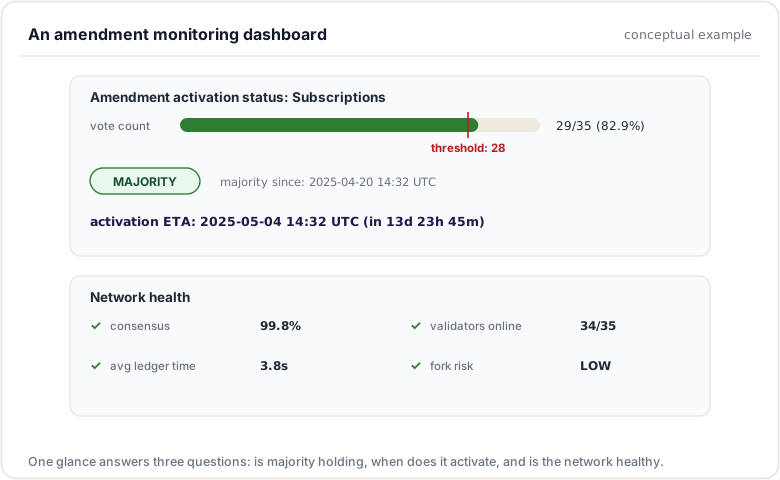
Monitoring Dashboards
XRPL Metrics Dashboard (conceptual example):
Alerting
Automatic alert configuration:
# alerts.yml
alerts:
  - name: amendment_majority_reached
    condition: amendment.status == "MAJORITY"
    action: notify_operators
    channels: [email, slack, pagerduty]

  - name: amendment_activation_imminent
    condition: amendment.activation_eta < "24h"
    action: critical_alert
    channels: [pagerduty, sms]

  - name: unsupported_amendment_warning
    condition: node.unsupported_amendment_active == true
    action: block_node
    channels: [email, slack, pagerduty]
Ecosystem Coordination
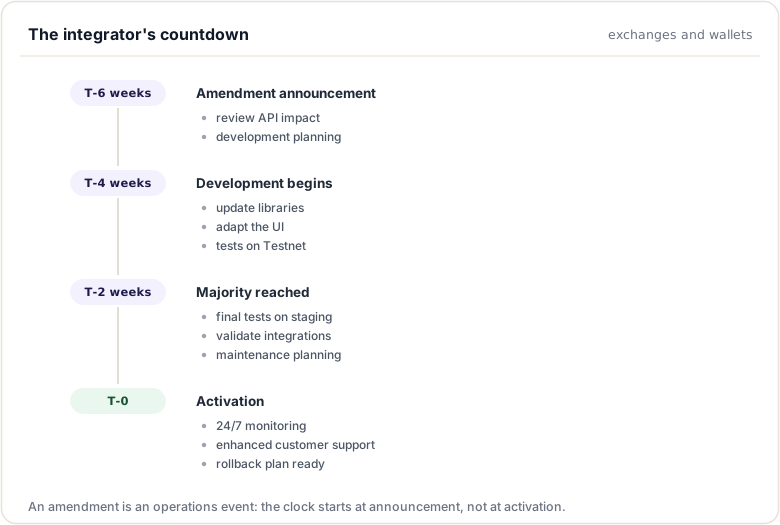
Exchanges and Services
Exchanges receive notifications and must coordinate:
Typical timeline for an exchange:
Application Developers
Client libraries must be updated before activation:
xrpl.js:
// Version 2.12.0 (with Subscriptions)
export const TRANSACTION_TYPES = {
  // ... existing types
  SubscriptionSet: 'SubscriptionSet',
  SubscriptionClaim: 'SubscriptionClaim',
  SubscriptionCancel: 'SubscriptionCancel',
};
xrpl-py:
# Version 2.8.0
class TransactionType(str, Enum):
    # ... existing types
    SUBSCRIPTION_SET = "SubscriptionSet"
    SUBSCRIPTION_CLAIM = "SubscriptionClaim"
    SUBSCRIPTION_CANCEL = "SubscriptionCancel"
Documentation and Communication
Documentation updates:
- XRPL.org: New pages for RecurringPayment transactions
- GitHub: Updated README and guides
- API docs: New endpoints and fields documented
Public announcements:
# Subscriptions Amendment Activated

Date: 2025-05-04 14:32:15 UTC
Ledger: 86652345

The Subscriptions amendment (XLS-0078) has been successfully activated on the XRPL Mainnet.

## What's New:
- New transaction types: SubscriptionSet, SubscriptionClaim, SubscriptionCancel
- New ledger object: ltSUBSCRIPTION (0x0055)
- Programmable recurring payment subscriptions with XRP, IOUs, and MPTs

## For Developers:
- Update to rippled 1.12.0+
- Update xrpl.js to 2.12.0+
- Update xrpl-py to 2.8.0+

## Documentation:
- [Subscriptions Standard (XLS-0078)](https://github.com/XRPLF/XRPL-Standards/tree/master/XLS-0078-subscriptions)
- [API Reference](https://xrpl.org/api-reference.html)
Lessons Learned: Historical Cases
fixAmendmentMajorityCalc (2021)
Problem: Asymmetry in threshold calculation (rounding up instead of down).
Impact: In certain cases, the effective threshold was slightly higher than 80%.
Resolution: New amendment to correct the calculation.
Lesson: Even simple mathematical calculations must be rigorously tested.
MultiSign (2016)
Success: First major amendment adding significant functionality.
Timeline:
- Development: 6 months
- Testing on Testnet: 3 months
- Deployment: 2 months
- Activation: Without incident
Lesson: Extensive preparation and rigorous testing are essential for complex amendments.
Voting and Activation
Introduction
The voting and activation mechanism for amendments is at the heart of XRPL's decentralized governance. This system allows the network to make collective decisions on protocol changes without a central authority, while ensuring a high level of consensus before any modification.
In this section, we will dive into the technical details of the voting process: how validators express their preferences, how these votes are collected and aggregated, how the threshold (over 80%) is calculated and verified, and finally how the network automatically activates amendments once consensus is reached.
We will continue to follow the example of Subscriptions (XLS-0078) to concretely illustrate each mechanism.
Validator Voting Mechanism
In brief: how a validator configures and casts its vote.
Vote Expression
A validator expresses their vote for an amendment in several ways:
1. Static configuration: Via the xrpld.cfg configuration file:
[amendments]
# Vote for Subscriptions
7B73B9E8D8E6E8E8A8B8C8D8E8F8A8B8C8D8E8F8A8B8C8D8E8F8A8B8C8D8E8F8

# Vote against (or remove vote) by commenting out or removing the line
# 7B73B9E8D8E6E8E8A8B8C8D8E8F8A8B8C8D8E8F8A8B8C8D8E8F8A8B8C8D8E8F8
2. Dynamic RPC command: Via the admin interface:
# Enable voting
xrpld feature 7B73B9E8D8E6E8E8A8B8C8D8E8F8A8B8C8D8E8F8A8B8C8D8E8F8A8B8C8D8E8F8 accept

# Disable voting
xrpld feature 7B73B9E8D8E6E8E8A8B8C8D8E8F8A8B8C8D8E8F8A8B8C8D8E8F8A8B8C8D8E8F8 reject
3. Default vote: If no explicit configuration is provided, the default behavior defined in features.macro applies:
// Automatically vote for
XRPL_FEATURE(Tickets, Supported::yes, VoteBehavior::DefaultYes)

// Don't vote by default (requires explicit activation)
XRPL_FEATURE(Subscriptions, Supported::yes, VoteBehavior::DefaultNo)

// Never vote (obsolete)
XRPL_FEATURE(OldFeature, Supported::yes, VoteBehavior::Obsolete)
Inclusion in Validations
A validator's vote is communicated to the network via the validation messages they publish after validating each ledger.
Structure of a validation message:
class STValidation {
    // Identification of validated ledger
    uint256 ledgerHash_;
    uint32 ledgerSeq_;
    NetClock::time_point signTime_;

    // List of supported/desired amendments
    std::optional<std::vector<uint256>> amendments_;

    // Validator's public key
    PublicKey publicKey_;

    // Cryptographic signature
    Buffer signature_;
};
Generation of amendments list: This list is generated by the doValidation() function of AmendmentTable:
std::vector<uint256>
AmendmentTableImpl::doValidation(std::set<uint256> const& enabled) const
{
    // Get the list of amendments we support and do not
    // veto, but that are not already enabled
    std::vector<uint256> amendments;

    {
        std::lock_guard lock(mutex_);
        amendments.reserve(amendmentMap_.size());
        for (auto const& e : amendmentMap_)
        {
            // Include only if:
            // 1. Amendment is supported by this node
            // 2. Node votes "up" for the amendment
            // 3. Amendment is not already enabled
            if (e.second.supported && e.second.vote == AmendmentVote::up &&
                (enabled.count(e.first) == 0))
            {
                amendments.push_back(e.first);
                JLOG(j_.info()) << "Voting for amendment " << e.second.name;
            }
        }
    }

    if (!amendments.empty())
        // Sort to ensure deterministic order
        std::sort(amendments.begin(), amendments.end());

    return amendments;
}
Network broadcast: The signed validation message is broadcast via the overlay network to all connected peers. Each node that receives this validation extracts and stores the list of voted amendments.
Vote Collection and Aggregation
TrustedVotes Structure
The TrustedVotes class maintains a real-time count of amendment votes from trusted validators.
Internal structure:
class TrustedVotes {
    // per-validator cached amendment votes, refreshed by each validation
    // and expired after 24h of silence (expiresAfter = 24h)
    hash_map<PublicKey, UpvotesAndTimeout> recordedVotes_;
};
The cache-and-expire rationale (no vote flapping, offline validators stop counting) is covered in the Amendments, overview & architecture module; this module focuses on how those votes travel the wire.
Expiration mechanism: Votes are considered "fresh" for 5 minutes. If a validator doesn't publish a new validation within this time, their vote is removed from the count. This ensures counts reflect the current state of active validators.
AmendmentSet: Calculating the Threshold
The AmendmentSet class calculates which amendments have exceeded the required threshold for activation.
Construction:
class AmendmentSet {
    hash_map<uint256, int> votes_;   // tally per amendment
    int trustedValidations_;         // how many validators we heard from
    int threshold_;                  // max(1, floor(80% of trusted))
    // passes(): votes > threshold_ (>= when only 1 trusted validator)
};
Construction, rounding, and the exact passes() semantics are detailed in the Amendments, overview & architecture module.
Threshold calculation (over 80%):
The displayed threshold is calculated as floor(validations * 0.8), but the comparison uses votes > threshold (strictly greater), which ensures over 80% of validators vote for the amendment.
Examples with Subscriptions:
25 trusted validators:
threshold = floor(25 * 0.8) = floor(20.0) = 20
To pass: votes > 20, so minimum 21 votes required
Actual percentage: 21/25 = 84% > 80% ✓
26 validators:
threshold = floor(26 * 0.8) = floor(20.8) = 20
To pass: votes > 20, so minimum 21 votes required
Actual percentage: 21/26 = 80.77% > 80% ✓
35 validators:
threshold = floor(35 * 0.8) = floor(28.0) = 28
To pass: votes > 28, so minimum 29 votes required
Actual percentage: 29/35 = 82.86% > 80% ✓
Special case - 1 validator: With a single validator (test networks), the comparison becomes votes >= threshold instead of votes > threshold, allowing the single validator to activate the amendment.
doVoting Function: Vote Orchestration
The doVoting() function is called at each consensus round (before each flag ledger) to determine what actions to take for amendments.
Complete Algorithm
std::map<uint256, std::uint32_t>
AmendmentTableImpl::doVoting(Rules const& rules, /* validations, majorities */)
{
    // 1. update TrustedVotes from the latest validations (24h expiry)
    // 2. build an AmendmentSet and compute the 80% threshold
    // 3. for each amendment not yet enabled, compare tally vs sfMajorities:
    //      newly passing  -> action = tfGotMajority
    //      newly failing  -> action = tfLostMajority
    //      2 weeks held   -> action = 0 (enable)
    return actions;   // consumed by the flag ledger's pseudo-transactions
}
(The step-by-step version of this algorithm is in the Amendments, overview & architecture module.)
Returned Action Codes
The returned map associates each amendment with an action code:
tfGotMajority(0x00010000): Amendment exceeded the 80% thresholdtfLostMajority(0x00020000): Amendment fell below the threshold0: Amendment must be activated (stability period elapsed)
These codes are used to generate appropriate pseudo-transactions.
EnableAmendment Pseudo-transactions
Pseudo-transaction Generation
Pseudo-transactions are generated by the consensus engine in RCLConsensus::onAccept() after a ledger has been accepted.
Process:
RCLConsensus::Adaptor::onAccept(
    Result const& result,
    RCLCxLedger const& prevLedger,
    NetClock::duration const& closeResolution,
    ConsensusCloseTimes const& rawCloseTimes,
    ConsensusMode const& mode,
    Json::Value&& consensusJson,
    bool const validating)
{
    app_.getJobQueue().addJob(
        jtACCEPT,
        "acceptLedger",
        [=, this, cj = std::move(consensusJson)]() mutable {
            // Note that no lock is held or acquired during this job.
            // This is because generic Consensus guarantees that once a ledger
            // is accepted, the consensus results and capture by reference state
            // will not change until startRound is called (which happens via
            // endConsensus).
            RclConsensusLogger clog("onAccept", validating, j_);
            this->doAccept(
                result,
                prevLedger,
                closeResolution,
                rawCloseTimes,
                mode,
                std::move(cj));
            this->app_.getOPs().endConsensus(clog.ss());
        });
}
Pseudo-transaction properties:
- Type:
ttAMENDMENT - Account:
rrrrrrrrrrrrrrrrrrrrrhoLvTp(special account = AccountID(0)) - No signature: Pseudo-transactions are not signed
- No fees: No fee is deducted
- TransactionIndex: Generally 0 (first transaction in ledger)
- Automatically injected: Generated by the network, not submitted by a user
Processing by Change::applyAmendment
EnableAmendment pseudo-transactions are processed by a specialized function in Change.cpp:
TER Change::applyAmendment()
{
    // 1. tfGotMajority  -> record the amendment + close time in sfMajorities
    // 2. tfLostMajority -> remove it from sfMajorities
    // 3. no flag        -> two weeks have passed: move the hash into
    //                      sfAmendments, run any activation handler, and
    //                      notify the AmendmentTable (unsupported -> blocked)
    // Duplicate activation returns tefALREADY.
}
The full walkthrough of this function lives in the Amendments, overview & architecture module; here what matters is the operational effect: the flag ledger's pseudo-transaction is what actually flips the switch.
Modified Ledger Fields
Ledger Amendments Object:
{
  "LedgerEntryType": "Amendments",
  "Amendments": [
    "42426C4D4F1009EE67080A9B7965B44656D7714D104A72F9B4369F97ABF044EE",
    // ... other enabled amendments ...
    "7B73B9E8D8E6E8E8A8B8C8D8E8F8A8B8C8D8E8F8A8B8C8D8E8F8A8B8C8D8E8F8"  // Subscriptions
  ],
  "Majorities": [
    {
      "Majority": {
        "Amendment": "AAAA...",  // Another amendment pending
        "CloseTime": 805500000
      }
    }
  ],
  "Flags": 0,
  "index": "7DB0788C020F02780A673DC74757F23823FA3014C1866E72CC4CD8B226CD6EF4"
}
Modification during GotMajority: Amendment is added to sfMajorities with its CloseTime.
Modification during Activation: Amendment is moved from sfMajorities to sfAmendments.
Detailed Timeline: Subscriptions
Let's review the complete timeline with voting details:
2025-04-20 14:30:00 UTC (Ledger 86245750)
State before:
{
  "count": 27,              // 27/35 validators = 77%
  "threshold": 28,          // threshold = floor(35 * 0.8) = 28
  "enabled": false,
  "majority": null          // Not yet in majority
}
2025-04-20 14:32:15 UTC (Ledger 86245789)
A 29th validator activates their vote. The next flag ledger detects the threshold crossing.
Votes collected by TrustedVotes:
trustedValidations = 35
votes[Subscriptions] = 29  // Exceeds threshold of 28
threshold = max(1, (35 * 4) / 5) = 28
Verification: votes > threshold → 29 > 28 (82.9% > 80%)
doVoting() returns:
actions[Subscriptions] = tfGotMajority
Injected pseudo-transaction:
{
  "TransactionType": "EnableAmendment",
  "Account": "rrrrrrrrrrrrrrrrrrrrrhoLvTp",
  "Amendment": "7B73B9E8D8E6E8E8A8B8C8D8E8F8A8B8C8D8E8F8A8B8C8D8E8F8A8B8C8D8E8F8",
  "Flags": 65536,
  "LedgerSequence": 86245789,
  "hash": "ABC123..."
}
State after:
{
  "count": 29,              // 29/35 = 82.9% > 80% ✓
  "threshold": 28,          // floor(35 * 0.8) = 28
  "enabled": false,
  "majority": 806021535,    // ← CloseTime of ledger 86245789
  "name": "Subscriptions"
}
2025-04-20 → 2025-05-04
Stability period. At each flag ledger, doVoting() checks:
if (closeTime >= (majorityTime + 2weeks)) {
    // Ready for activation
} else {
    // Wait longer
}
2025-05-04 14:32:15 UTC (Ledger 86652345)
Exactly 2 weeks after majorityTime. The next flag ledger activates the amendment.
doVoting() returns:
actions[Subscriptions] = 0 // Code 0 = activate
Injected pseudo-transaction:
{
  "TransactionType": "EnableAmendment",
  "Account": "rrrrrrrrrrrrrrrrrrrrrhoLvTp",
  "Amendment": "7B73B9E8D8E6E8E8A8B8C8D8E8F8A8B8C8D8E8F8A8B8C8D8E8F8A8B8C8D8E8F8",
  "Flags": 0,               // ← No flag = activation
  "LedgerSequence": 86652345,
  "hash": "DEF456..."
}
Change::applyAmendment() adds Subscriptions to sfAmendments.
Final state:
{
  "enabled": true,
  "name": "Subscriptions",
  "supported": true
}
Synchronization and Consistency
doValidatedLedger: Post-Validation Update
After each validated ledger, doValidatedLedger() synchronizes the internal state:
void
AmendmentTableImpl::doValidatedLedger(
    LedgerIndex ledgerSeq,
    std::set<uint256> const& enabled,
    majorityAmendments_t const& majority)
{
    for (auto& e : enabled)
        enable(e);

    std::lock_guard lock(mutex_);

    // Remember the ledger sequence of this update.
    lastUpdateSeq_ = ledgerSeq;

    // Since we have the whole list in `majority`, reset the time flag, even
    // if it's currently set. If it's not set when the loop is done, then any
    // prior unknown amendments have lost majority.
    firstUnsupportedExpected_.reset();
    for (auto const& [hash, time] : majority)
    {
        AmendmentState& s = add(hash, lock);

        if (s.enabled)
            continue;

        if (!s.supported)
        {
            JLOG(j_.info()) << "Unsupported amendment " << hash
                            << " reached majority at " << to_string(time);
            if (!firstUnsupportedExpected_ || firstUnsupportedExpected_ > time)
                firstUnsupportedExpected_ = time;
        }
    }
    if (firstUnsupportedExpected_)
        firstUnsupportedExpected_ = *firstUnsupportedExpected_ + majorityTime_;
}
This function ensures that even if a node temporarily misses receiving a ledger, it will resynchronize correctly when it receives the validated ledger.
Protection Against Unsupported Amendments
If an amendment is enabled but the node does not support it, the system enters "amendment blocked" mode to protect network integrity.
Detection:
    if (app_.getAmendmentTable().hasUnsupportedEnabled())
    {
        JLOG(m_journal.error()) << "One or more unsupported amendments "
                                    "activated: server blocked.";
        app_.getOPs().setAmendmentBlocked();
    }
Consequences:
- Node ceases to participate in consensus
- Node ceases to validate new ledgers
- API remains accessible but signals "amendment blocked" state
- Node must be updated to resume operations
Notification: A warning is displayed in logs and via the server_info API:
{
  "info": {
    "amendment_blocked": true,
    "build_version": "1.11.0"
  }
}
Summary
This module covered the operational side of governance: how validators cast their vote (configured with VoteBehavior), how votes are tallied per ledger from validations, and how a protocol change is rolled out safely across the network. The recurring risk is the non-updated node, which becomes amendment-blocked when a change it does not understand activates, so operators must upgrade before activation, not after.
To remember:
- A validator's stance:
feature <hash> accept|reject(admin) or the config, on top of the code'sVoteBehaviordefault - Votes are tallied per ledger from trusted validations (
TrustedVotes) - Threshold math:
floor(validations * 0.8), compared strictly greater, so support must EXCEED 80% - Amendment accounting happens at flag ledgers: every 256 ledgers
doVotingorchestrates the pseudo-transaction injection- Rollout order: announce, release, operators upgrade, validators vote, majority window, activation
- Operator rule: upgrade BEFORE activation or drop off the network
- Watch out: an amendment-blocked node stops advancing silently; monitor
amendment_blockedinserver_info
Next up. The rollout succeeded; now keep it observable. Next: amendment impact and monitoring, the operator's view of an activation.
Resources
Assignments
0 of 2 complete