
Protocols & wire messages
How rippled nodes talk on the wire — the peer protocol, protobuf message types, and where message handling lives.
What you'll learn
- Understand the peer protocol and the protobuf definitions (`xrpl.proto`).
- Identify message types (mtTRANSACTION, mtVALIDATION…) and how they're dispatched.
- Locate protocol and overlay message-handling code.
Introduction
≈60 min · Advanced · builds on Development & debugging techniques
Watch this short video by XRPL Commons first, then dive into the details below.
Nodes don't speak JSON to each other, they speak a compact binary protocol. In this module you'll learn how peers talk on the wire: the Protocol Buffers definitions in xrpl.proto, the message types that carry transactions, proposals and validations (tmTRANSACTION, tmVALIDATION…), and where that message handling lives in the code. It's the vocabulary behind everything the network does.
Peer-to-Peer Networking Fundamentals
In brief: how peers connect and form the overlay that carries all traffic.
The Overlay Network Architecture
The XRP Ledger operates as a decentralized network of Rippled servers (nodes) that communicate through peer-to-peer connections. Each node maintains connections with multiple peers, forming an overlay network on top of the internet infrastructure. This architecture ensures no single point of failure and enables the network to remain operational even if individual nodes go offline.
Unlike traditional client-server architectures where clients connect to centralized servers, the XRP Ledger uses a mesh topology where every node can communicate with multiple other nodes. This design provides:
- Resilience: No single point of failure
- Scalability: Network can grow organically as new nodes join
- Censorship Resistance: No central authority can block transactions
- Redundancy: Multiple paths exist for information propagation
Peer Discovery Mechanisms
Nodes discover peers through several complementary mechanisms, ensuring robust network connectivity:
1. Configured Peer Lists
Administrators can specify fixed peers in the xrpld.cfg configuration file:
[ips_fixed]
r.ripple.com 51235
s1.ripple.com 51235
s2.ripple.com 51235
These peers are trusted connections that the node will always attempt to maintain. Fixed peers are particularly important for validators and high-availability servers.
2. DNS Seeds
Rippled uses DNS to discover bootstrap nodes:
- DNS seeds provide a list of currently active nodes
- Useful for initial network entry
- Regularly updated to reflect network state
- Multiple DNS providers ensure availability
3. Peer Gossip
Once connected, nodes share information about other available peers:
- Nodes exchange lists of known peers
- Information about peer quality and reliability is shared
- Network topology naturally adapts to node availability
- Helps discover new nodes joining the network
This multi-layered approach ensures that even if some discovery mechanisms fail, nodes can still find and connect to peers, maintaining network connectivity.
Connection Management
Each Rippled node actively manages its peer connections:
Connection Limits: Nodes maintain a configured number of active connections (typically 10-20 peers) to balance network visibility with resource usage.
Peer Quality Assessment: Nodes continuously evaluate peer behavior:
- Response times
- Message accuracy
- Protocol compliance
- Uptime and reliability
Connection Pruning: Poor-quality peers are disconnected and replaced with better alternatives.
Connection Diversity: Nodes prefer geographically and administratively diverse peers to improve network resilience.
Protocol Messages
In brief: every peer message is a Protocol Buffers type defined in xrpl.proto.
Protocol Buffers (Protobuf)
Rippled uses Protocol Buffers (protobuf) for efficient binary serialization of messages exchanged between nodes. This choice provides several advantages:
Compact Message Sizes: Binary encoding is more efficient than text-based formats like JSON, reducing bandwidth usage.
Fast Serialization: Protobuf libraries provide high-performance encoding and decoding, critical for high-throughput systems.
Forward/Backward Compatibility: Protocol Buffers support schema evolution, allowing the protocol to evolve without breaking existing nodes.
Strong Typing: Protocol definitions provide clear contracts for message formats, reducing errors.
Cross-Language Support: Protobuf supports multiple languages, facilitating development of diverse XRPL tools.
Message Definition
Protocol messages are defined in .proto files located in the Rippled codebase. These definitions are compiled into C++ classes used throughout the application.
Example Structure:
message TMTransaction {
    required bytes raw_transaction = 1;
    required uint32 status = 2;
    optional bytes signature = 3;
}
The compiled classes provide methods for:
- Creating messages
- Serializing to binary
- Deserializing from binary
- Accessing fields with type safety
Key idea. Peers do not exchange JSON. Every message is a compact protobuf defined in
xrpl.proto, which is the single source of truth for the wire format.
Critical Message Types
In brief: the handful of messages that matter most: transactions, proposals, validations, ledger data.
Understanding message types is essential for debugging network issues and implementing protocol improvements. Each message type serves a specific purpose in maintaining network consensus and ledger synchronization.
tmMANIFESTS
Purpose: Validator key rotation and identity verification
Validators use manifests to announce their identity and key rotation information. This allows validators to change their signing keys without losing their identity, improving security by enabling regular key rotation.
Key Information:
- Validator's master public key (long-term identity)
- Current ephemeral signing key (used for validations)
- Key rotation sequence number
- Signature proving authorization
When Sent:
- When a validator starts up
- When a validator rotates keys
- Periodically to ensure all peers have current information
tmTRANSACTION
Purpose: Transaction propagation across the network
When a transaction is submitted to any node, it needs to reach all validators to be considered for inclusion in the next ledger. The tmTRANSACTION message broadcasts transactions throughout the network.
Key Information:
- Serialized transaction data
- Transaction signature
- Account information
- Fee and sequence number
Routing Logic:
- Nodes verify transaction validity before relaying
- Already-seen transactions are not re-broadcast (deduplication)
- Invalid transactions are dropped without propagation
tmPROPOSE_LEDGER
Purpose: Consensus proposals from validators
During the consensus process, validators broadcast their proposed transaction sets. These proposals inform other validators about which transactions should be included in the next ledger.
Key Information:
- Validator's public key
- Proposed ledger close time
- Transaction set hash
- Previous ledger hash
- Validation signature
Consensus Flow:
- Validators collect transactions from the open ledger
- Each validator creates a proposal of transactions to include
- Proposals are broadcast to other validators
- Validators adjust their proposals based on what others propose
- Consensus converges on a common transaction set
tmVALIDATION
Purpose: Ledger validations signaling agreement
After a ledger closes, validators broadcast validations confirming their agreement on the ledger state. A ledger becomes fully validated when it receives validations from a supermajority of trusted validators.
Key Information:
- Ledger hash being validated
- Ledger sequence number
- Ledger close time
- Validator's signature
- Flag indicating full/partial validation
Validation Process:
- Validator applies consensus transaction set
- Computes resulting ledger hash
- Broadcasts validation message
- Other nodes collect validations
- Ledger is considered validated when quorum is reached
tmGET_LEDGER / tmLEDGER_DATA
Purpose: Request and response for ledger synchronization
When a node is behind or missing ledger data, it requests information from peers. These messages enable ledger history synchronization.
tmGET_LEDGER Fields:
- Ledger hash or sequence number
- Type of data requested (transactions, state tree, etc.)
- Specific nodes or ranges requested
tmLEDGER_DATA Fields:
- Requested ledger data
- Merkle proofs for verification
- Metadata about the ledger
Use Cases:
- Node startup (catching up to current ledger)
- Network partition recovery
- Historical ledger retrieval
- Filling gaps in ledger history
tmSTATUS_CHANGE
Purpose: Notifications about ledger close events
Nodes broadcast status changes to inform peers about important events, particularly ledger closures. This helps the network stay synchronized on the current ledger state.
Key Information:
- New ledger sequence number
- Ledger close time
- Flags indicating network status
- Previous ledger hash
Message Propagation and Routing
In brief: how a message spreads across the mesh without flooding it.
Intelligent Message Routing
When a node receives a message, it must decide whether to relay it to other peers. Rippled implements intelligent routing to prevent message flooding while ensuring necessary information reaches all relevant nodes.
Routing Techniques
1. Duplicate Suppression (Echo Prevention)
Problem: Without duplicate suppression, messages would bounce back to their sender, creating infinite loops. (Note: "squelching" is a different, specific mechanism, the reduce-relay muting of redundant validator-message senders via TMSquelch; see the Handshake & message relaying module.)
Solution: When node A sends a message to node B, node B remembers that A already has this message and won't send it back to A.
Implementation: Each message carries an originator identifier, and nodes track which peers already have which messages.
2. Deduplication
Problem: The same message might arrive from multiple peers, wasting processing resources.
Solution: Nodes track recently seen messages using a hash-based cache. If a message hash is already in the cache, it's discarded without reprocessing.
Cache Management:
- Time-based expiration (messages older than X seconds are removed)
- Size limits (oldest entries removed when cache is full)
- Hash collisions handled safely
3. Selective Relay
Problem: Not all peers need all messages. Broadcasting everything wastes bandwidth.
Solution: Messages are only relayed to peers that are likely to need them based on:
- Message type (validators need proposals, regular nodes may not)
- Peer capabilities (what protocol versions and features they support)
- Network topology (avoid sending to peers who likely already have it)
4. Priority Queuing
Problem: Under high load, important messages might be delayed behind less critical ones.
Solution: Messages are categorized by importance and processed in priority order:
High Priority:
- Validations (needed for ledger finalization)
- Consensus proposals (time-sensitive for consensus)
- Status changes (network coordination)
Medium Priority:
- Transactions (should be processed promptly)
- Ledger data responses (nodes are waiting for this)
Low Priority:
- Peer discovery announcements
- Historical data requests
Message Flow Example
Let's trace how a transaction propagates through the network:
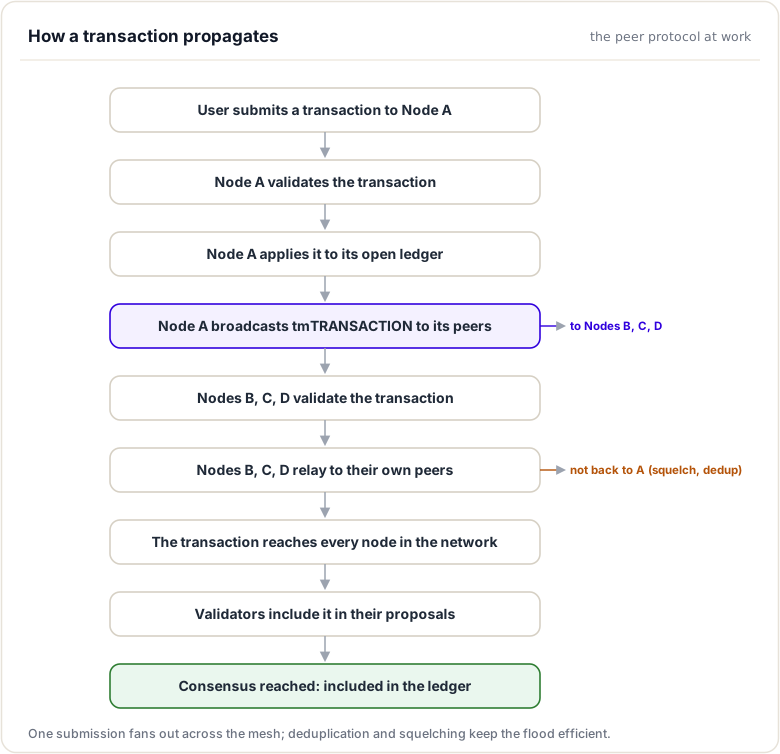
Total time: Typically 3-5 seconds from submission to ledger inclusion.
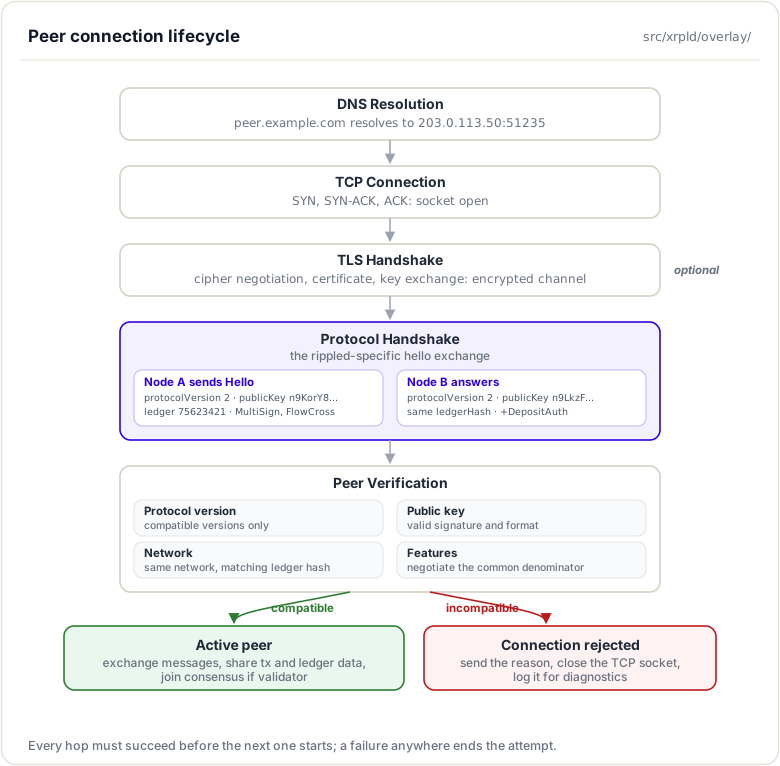
Connection Lifecycle
Establishing a Peer Connection
The process of two Rippled nodes establishing a connection involves multiple steps, each verifying compatibility and authenticity:
Codebase Deep Dive
Key Files and Directories
The protocol implementation is primarily located in src/xrpld/overlay. Understanding this directory structure is essential for working with networking code.
Primary Files
- Main interface for the overlay network
- Defines public API for network operations
- Used by other subsystems to access network functionality
src/xrpld/overlay/detail/OverlayImpl.h and .cpp
- Core implementation of overlay network
- Manages peer connections
- Handles message routing
- Implements connection lifecycle
- Interface for individual peer connections
- Defines peer state and capabilities
- Methods for sending messages to specific peers
src/xrpld/overlay/detail/PeerImp.h and .cpp
- Implementation of peer connections
- State machine for connection lifecycle
- Message parsing and serialization
- Protocol message definitions
- Message type enumeration
- Message handling interfaces
- Protocol Buffer definitions
- Defines structure of all network messages
- Compiled into C++ classes
Code Navigation Tips
Finding Message Handlers:
// Look in PeerImp.cpp for message processing
void PeerImp::onMessage(std::shared_ptr<Message> const& m)
{
    switch(m->getType())
    {
        case protocol::mtTRANSACTION:
            onTransaction(m);
            break;
        case protocol::mtVALIDATION:
            onValidation(m);
            break;
        // ... other message types
    }
}
Understanding Peer Connection State:
// Peer states (simplified)
enum class State
{
    connecting,  // TCP connection in progress
    connected,   // TCP connected, handshake in progress
    active,      // Fully connected and operational
    closing,     // Graceful shutdown in progress
    closed       // Connection terminated
};
Message Creation Example:
// Creating and sending a transaction message
protocol::TMTransaction tx;
tx.set_rawtransaction(serializedTx);
tx.set_status(protocol::tsCURRENT);
send(std::make_shared<Message>(tx, protocol::mtTRANSACTION));
In xrpld.cfg or via RPC
xrpld log_level Overlay trace
This will produce very detailed logs showing every message sent and received.

**Step 2**: Set up two Rippled instances in standalone mode

```bash
# Terminal 1 - Node A
xrpld --conf=/path/to/rippled-node1.cfg --standalone

# Terminal 2 - Node B
xrpld --conf=/path/to/rippled-node2.cfg --standalone
Step 3: Configure nodes to peer with each other
In rippled-node1.cfg:
[ips_fixed]
127.0.0.1 51236
In rippled-node2.cfg:
[port_peer]
port = 51236
ip = 127.0.0.1

[ips_fixed]
127.0.0.1 51235
Observation Tasks
Task 1: Observe connection establishment
Watch the logs as the nodes connect. You should see:
- TCP connection establishment
- Hello message exchange
- Peer verification
- Connection acceptance
Task 2: Submit a transaction
# Submit to Node A
xrpld submit <signed_transaction>
Watch the logs to see:
tmTRANSACTIONmessage created on Node A- Message sent to Node B
- Node B receives and processes transaction
- Node B adds to its open ledger
Task 3: Trigger a ledger close
# In standalone mode
xrpld ledger_accept
Observe:
- Status change messages
- Ledger close coordination
- State synchronization
Analysis Questions
Answer these questions based on your observations:
- What messages are exchanged during peer connection establishment?
- List the message types in order
- Note any authentication or verification steps
- How is a transaction propagated from one node to another?
- Trace the message flow
- Identify any validation or filtering
- What happens when a ledger closes?
- What messages are exchanged?
- How do nodes coordinate?
- How does deduplication work?
- Try submitting the same transaction twice
- Observe how the second submission is handled
- What is the average message propagation time?
- Timestamp when transaction is submitted to Node A
- Timestamp when Node B logs receiving it
- Calculate the latency
Expected Outcomes
You should gain practical understanding of:
- How protocol messages flow through the network
- The purpose of different message types
- Network latency and performance characteristics
- How nodes maintain synchronized state
Additional Resources
Official Documentation
- XRP Ledger Dev Portal: xrpl.org/docs
- Rippled Overlay Network: xrpl.org/peer-protocol
- Rippled Repository: github.com/XRPLF/rippled
Codebase References
src/xrpld/overlay- Overlay network implementationinclude/xrpl/proto/xrpl.proto- Protocol Buffer message definitionssrc/xrpld/overlay/detail/OverlayImpl.cpp- Core networking logicsrc/xrpld/overlay/detail/PeerImp.cpp- Peer connection handling
Related Topics
- Transactors - How transactions are processed after propagation
- Consensus Engine - How validators use protocol messages to reach consensus
- Overlay Network - Deeper dive into P2P networking architecture
Summary
This module covered how nodes talk on the wire. Peers exchange compact Protocol Buffers messages defined in xrpl.proto, each type (tmTRANSACTION, tmVALIDATION, tmPROPOSE_LEDGER, and so on) serving a specific role, and those messages spread across the mesh through intelligent routing rather than naive flooding. You also saw where message handling lives in the overlay code.
To remember:
- Every peer message is Protocol Buffers, defined in
include/xrpl/proto/xrpl.proto - Key types:
tmTRANSACTION,tmVALIDATION,tmPROPOSE_LEDGER,tmGET_LEDGER/tmLEDGER_DATA,tmMANIFESTS,tmSTATUS_CHANGE - In code the protobuf classes are
protocol::TMTransactionetc.; dispatch lives inPeerImp(src/xrpld/overlay) - A peer session starts as an HTTP Upgrade on the peer port, then switches to the binary protocol
- Messages spread with duplicate suppression (HashRouter) and squelching (validator reduce-relay), not blind flooding
- Client RPC (JSON, port 51234) and the peer protocol (protobuf, port 51235) are entirely separate surfaces
- The wire format is versioned; compatibility is negotiated at handshake
- Watch out: never assume a peer message maps 1:1 to an RPC call; the two protocols evolved independently
Next up. Nodes exchange messages about state; but what IS that state, exactly? Next you meet the ideas behind XRPL's state management, and the tree that makes tampering impossible.
Resources
Assignments
0 of 2 complete