
Key generation & derivation
How rippled turns randomness (or a seed) into secp256k1 / ed25519 key pairs and account IDs.
What you'll learn
- Generate random and deterministic key pairs (secp256k1, ed25519).
- Derive public keys and account IDs (RIPEMD160∘SHA256).
- Understand seeds and multi-account derivation.
Introduction
≈45 min · Advanced · builds on Hash functions in XRPL
Where does an XRPL account actually come from? In this module you'll follow the path from randomness (or a seed) to a full key pair (for both secp256k1 and ed25519) and on to an account ID and address. You'll see how a seed makes the whole thing reproducible, and why the two signature schemes derive their keys so differently.
The Two Paths to Key Generation
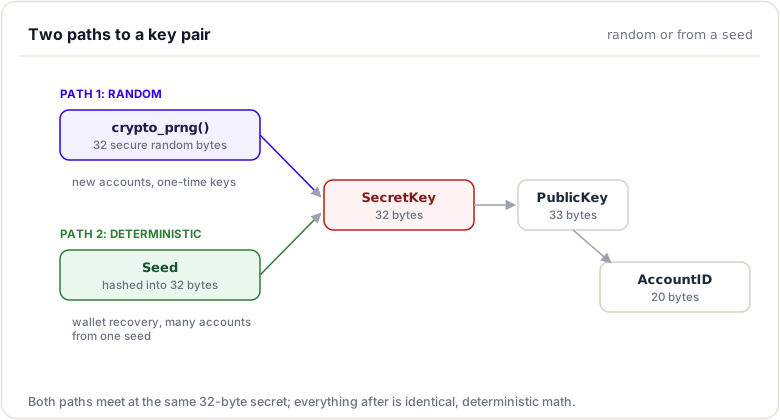
Rippled supports two approaches to key generation:
Random Key Generation
In brief: make a fresh key pair from cryptographically secure randomness.
The Simple Case: randomSecretKey()
// From src/libxrpl/protocol/SecretKey.cpp
SecretKey randomSecretKey()
{
    std::uint8_t buf[32];
    beast::rngfill(buf, sizeof(buf), crypto_prng());
    SecretKey sk(Slice{buf, sizeof(buf)});
    secure_erase(buf, sizeof(buf));
    return sk;
}
Step-by-step breakdown:
- Allocate buffer: Create 32-byte buffer on stack
- Fill with randomness: Use
crypto_prng()to fill with random bytes - Construct SecretKey: Wrap bytes in
SecretKeyobject - Secure cleanup: Erase temporary buffer from memory
- Return:
SecretKeyobject (move semantics, no copy)
Why 32 Bytes?
// 32 bytes = 256 bits
std::uint8_t buf[32];

// This provides 2^256 possible keys
// That's approximately 10^77 combinations
// More than atoms in the observable universe!
Security level:
- 128-bit security requires 2^128 operations to break
- 256 bits provides 2^256 operations (overkill, but standard)
- Quantum computers reduce security by half (2^256 → 2^128)
- So 256 bits ensures long-term security even against quantum attacks
Generating a Complete Key Pair
std::pair<PublicKey, SecretKey> randomKeyPair(KeyType type)
{
    // Generate random secret key
    SecretKey sk = randomSecretKey();

    // Derive public key from secret
    PublicKey pk = derivePublicKey(type, sk);

    return {pk, sk};
}
Deterministic Key Generation from Seeds
In brief: regenerate the same key pair from a seed, every time.
What is a Seed?
A seed is a compact representation (typically 16 bytes) from which many keys can be derived:
// Seed structure
class Seed
{
private:
    std::array<std::uint8_t, 16> buf_;  // 128 bits

public:
    // Construction, access, etc.
};
Why seeds matter:
- Backup: Remember one seed → recover all keys
- Portability: Move keys between wallets
- Hierarchy: Generate multiple accounts from one seed
Generating Keys from Seeds: The Interface
std::pair<PublicKey, SecretKey>
generateKeyPair(KeyType type, Seed const& seed)
{
    switch (type)
    {
        case KeyType::secp256k1:
            return generateSecp256k1KeyPair(seed);

        case KeyType::ed25519:
            return generateEd25519KeyPair(seed);
    }
}
Ed25519: Simple Derivation
// For ed25519, derivation is straightforward
case KeyType::ed25519: {
    // Hash the seed to get secret key
    auto const sk = generateSecretKey(type, seed);

    // Derive public key from secret
    return {derivePublicKey(type, sk), sk};
}

SecretKey generateSecretKey(KeyType::ed25519, Seed const& seed)
{
    // Simply hash the seed
    auto const secret = sha512Half_s(makeSlice(seed));
    return SecretKey{secret};
}
Why this works:
- SHA-512-Half is a one-way function
- Same seed always produces same secret key
- Different seeds produce uncorrelated secret keys
- No special validation needed (all 32-byte values are valid ed25519 keys)
Secp256k1: Complex Derivation
// For secp256k1, need to handle curve order constraint
case KeyType::secp256k1: {
    detail::Generator g(seed);
    return g(0);  // Generate the 0th key pair
}
Why more complex?
Not all 32-byte values are valid secp256k1 secret keys. The value must be:
- Greater than 0
- Less than the curve order (a large prime number)
// secp256k1 curve order
// Any secret key must be: 0 < key < order
static const uint256 CURVE_ORDER =
    "0xFFFFFFFFFFFFFFFFFFFFFFFFFFFFFFFEBAAEDCE6AF48A03BBFD25E8CD0364141";
The Generator Class
class Generator
{
private:
    Seed seed_;

public:
    explicit Generator(Seed const& seed) : seed_(seed) {}

    // Generate the n-th key pair
    std::pair<PublicKey, SecretKey> operator()(std::uint32_t ordinal)
    {
        // Derive root key from seed
        SecretKey rootKey = deriveRootKey(seed_, ordinal);

        // Derive public key
        PublicKey publicKey = derivePublicKey(KeyType::secp256k1, rootKey);

        return {publicKey, rootKey};
    }
};
Deriving the Root Key
SecretKey deriveRootKey(Seed const& seed, std::uint32_t ordinal)
{
    // Try up to 128 times to find valid key
    for (int i = 0; i < 128; ++i)
    {
        // Create buffer: seed (16 bytes) + ordinal (4 bytes)
        std::array<std::uint8_t, 20> buf;

        // Copy seed
        std::copy(seed.data(), seed.data() + 16, buf.begin());

        // Append ordinal (big-endian)
        buf[16] = (ordinal >> 24) & 0xFF;
        buf[17] = (ordinal >> 16) & 0xFF;
        buf[18] = (ordinal >>  8) & 0xFF;
        buf[19] = (ordinal >>  0) & 0xFF;

        // Hash it
        auto const candidate = sha512Half(makeSlice(buf));

        // Check if valid secp256k1 secret key
        if (isValidSecretKey(candidate))
            return SecretKey{candidate};

        // Not valid, increment ordinal and try again
        ++ordinal;
    }

    // Should never reach here (probability ~ 1 in 2^128)
    Throw<std::runtime_error>("Failed to derive key from seed");
}

bool isValidSecretKey(uint256 const& candidate)
{
    // Must be in range: 0 < candidate < CURVE_ORDER
    return candidate > 0 && candidate < CURVE_ORDER;
}
Why this loop?
The probability that a random 256-bit value is >= CURVE_ORDER is approximately 1 in 2^128.
This is so unlikely that we almost never need a second try, but the code handles it correctly.
Incrementing ordinal:
If the first hash isn't valid, we increment the ordinal and try again. This ensures:
- Deterministic behavior (same seed always produces same result)
- Eventually finds a valid key (extremely high probability on first try)
- No bias in the resulting key distribution
Key idea. The seed is the real secret: it deterministically regenerates the key pair, which is why backing up the seed is the same as backing up the account.
Public Key Derivation
In brief: derive the public key from the private key (differently for secp256k1 and ed25519).
For Secp256k1
PublicKey derivePublicKey(KeyType::secp256k1, SecretKey const& sk)
{
    secp256k1_pubkey pubkey_imp;

    // Perform elliptic curve point multiplication: PublicKey = SecretKey × G
    secp256k1_ec_pubkey_create(
        secp256k1Context(),
        &pubkey_imp,
        reinterpret_cast<unsigned char const*>(sk.data()));

    // Serialize to compressed format
    unsigned char pubkey[33];
    std::size_t len = sizeof(pubkey);
    secp256k1_ec_pubkey_serialize(
        secp256k1Context(),
        pubkey,
        &len,
        &pubkey_imp,
        SECP256K1_EC_COMPRESSED);  // 33 bytes: prefix + X coordinate

    return PublicKey{Slice{pubkey, len}};
}
Compressed vs Uncompressed:
Uncompressed: 0x04 | X (32 bytes) | Y (32 bytes) = 65 bytes
Compressed:   0x02/0x03 | X (32 bytes) = 33 bytes

Prefix byte indicates Y parity:
- 0x02: Y is even
- 0x03: Y is odd
Why compress?
- Saves 32 bytes per public key
- Given X, only two possible Y values exist
- Prefix bit tells us which one
For Ed25519
PublicKey derivePublicKey(KeyType::ed25519, SecretKey const& sk)
{
    unsigned char buf[33];
    buf[0] = 0xED;  // Type prefix marker

    // Derive public key using Ed25519 algorithm
    ed25519_publickey(sk.data(), &buf[1]);

    return PublicKey(Slice{buf, sizeof(buf)});
}
Simpler than secp256k1:
- No compression needed (Ed25519 public keys are naturally 32 bytes)
- No serialization complexity
- Just prepend type marker (0xED)
Account ID Generation
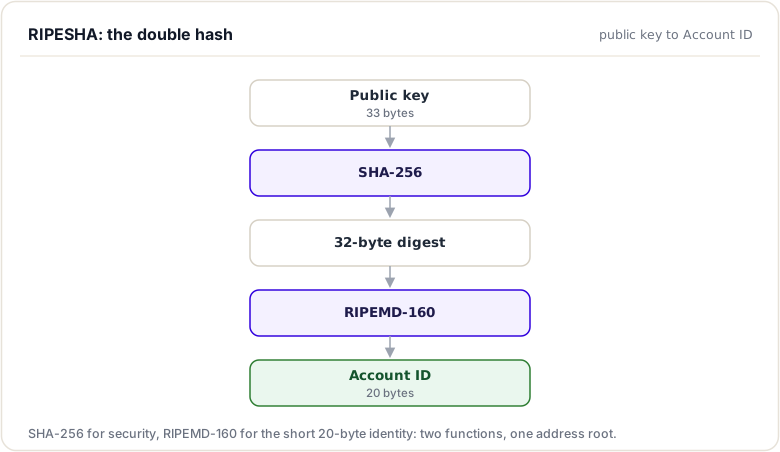
In brief: hash the public key (RIPEMD160 of SHA-256) to get the account ID.
Once we have a public key, we derive the account ID:
AccountID calcAccountID(PublicKey const& pk)
{
    ripesha_hasher h;
    h(pk.data(), pk.size());
    return AccountID{static_cast<ripesha_hasher::result_type>(h)};
}
RIPESHA: Double Hashing
class ripesha_hasher
{
private:
    openssl_sha256_hasher sha_;

public:
    void operator()(void const* data, std::size_t size)
    {
        // First: SHA-256
        sha_(data, size);
    }

    operator result_type()
    {
        // Get SHA-256 result
        auto const sha256_result =
            static_cast<openssl_sha256_hasher::result_type>(sha_);

        // Second: RIPEMD-160 of SHA-256
        ripemd160_hasher ripe;
        ripe(sha256_result.data(), sha256_result.size());
        return static_cast<result_type>(ripe);
    }
};
The pipeline:
Why double hash?
- Defense in depth: If one hash is broken, the other provides protection
- Compactness: 20 bytes is shorter than 32 bytes
- Quantum resistance: Even if quantum computers break elliptic curve crypto, they can't reverse the hash to get the public key
Address Encoding
The final step is encoding the account ID as a human-readable address:
std::string toBase58(AccountID const& accountID)
{
    return encodeBase58Token(
        TokenType::AccountID,
        accountID.data(),
        accountID.size());
}
Result:
Account ID (20 bytes): 0x8B8A6C533F09CA0E5E00E7C32AA7EC323485ED3F
Address:               rN7n7otQDd6FczFgLdlqtyMVrn3LNU8B4C
We'll explore Base58Check encoding in detail in the Base58Check encoding module.
Complete Key Generation Examples
Example 1: Random Ed25519 Key
// Generate random ed25519 key pair
auto [publicKey, secretKey] = randomKeyPair(KeyType::ed25519);

// Derive account ID
AccountID accountID = calcAccountID(publicKey);

// Encode as address
std::string address = toBase58(accountID);

std::cout << "Public Key: " << strHex(publicKey) << "\n";
std::cout << "Account ID: " << strHex(accountID) << "\n";
std::cout << "Address:    " << address << "\n";
Example 2: Deterministic Secp256k1 Key
// Create seed from passphrase (EXAMPLE ONLY - don't do this in production!)
Seed seed = generateSeedFromPassphrase("my secret passphrase");

// Generate deterministic key pair
auto [publicKey, secretKey] = generateKeyPair(KeyType::secp256k1, seed);

// Same seed always produces same keys
auto [publicKey2, secretKey2] = generateKeyPair(KeyType::secp256k1, seed);
assert(publicKey == publicKey2);
assert(secretKey == secretKey2);

// Derive account
AccountID accountID = calcAccountID(publicKey);
std::string address = toBase58(accountID);

std::cout << "Address: " << address << "\n";
Example 3: Multiple Accounts from One Seed
Seed seed = /* ... */;

// Create generator
detail::Generator gen(seed);

// Generate multiple accounts
auto [pub0, sec0] = gen(0);
auto [pub1, sec1] = gen(1);
auto [pub2, sec2] = gen(2);

// Each has different address
AccountID acc0 = calcAccountID(pub0);
AccountID acc1 = calcAccountID(pub1);
AccountID acc2 = calcAccountID(pub2);

std::cout << "Account 0: " << toBase58(acc0) << "\n";
std::cout << "Account 1: " << toBase58(acc1) << "\n";
std::cout << "Account 2: " << toBase58(acc2) << "\n";
Key Type Detection
Public Key Type Detection
std::optional<KeyType> publicKeyType(Slice const& slice)
{
    if (slice.size() != 33)
        return std::nullopt;

    // Check first byte
    switch (slice[0])
    {
        case 0x02:
        case 0x03:
            return KeyType::secp256k1;
        case 0xED:
            return KeyType::ed25519;
        default:
            return std::nullopt;
    }
}
Automatic Algorithm Selection
Buffer sign(PublicKey const& pk, SecretKey const& sk, Slice const& m)
{
    // Automatically detect which algorithm to use
    auto const type = publicKeyType(pk.slice());

    switch (*type)
    {
        case KeyType::ed25519:
            return signEd25519(pk, sk, m);
        case KeyType::secp256k1:
            return signSecp256k1(pk, sk, m);
    }
}
The secp256k1 Context
secp256k1_context const* secp256k1Context()
{
    // Thread-local context for performance
    static thread_local std::unique_ptr<
        secp256k1_context,
        decltype(&secp256k1_context_destroy)>
    context{
        secp256k1_context_create(
            SECP256K1_CONTEXT_SIGN | SECP256K1_CONTEXT_VERIFY),
        &secp256k1_context_destroy
    };

    return context.get();
}
Security Considerations
Secret Key Storage
// ❌ WRONG
void badExample() {
    SecretKey sk = randomSecretKey();
}

// ✅ CORRECT
void goodExample() {
    SecretKey sk = randomSecretKey();
}
Key Validation
bool validateKeys(PublicKey const& pk, SecretKey const& sk)
{
    auto derived = derivePublicKey(publicKeyType(pk).value(), sk);
    return derived == pk;
}
Seed Protection
class Seed {
    ~Seed() {
        secure_erase(buf_.data(), buf_.size());
    }
};
Performance Characteristics
Key Generation Speed
Ed25519:
- Secret key generation: ~50 µs
- Public key derivation:  ~50 µs
- Total: ~100 µs

Secp256k1:
- Secret key generation:  ~50 µs
- Public key derivation:  ~100 µs
- Total: ~150 µs
Caching Considerations
std::vector<std::pair<PublicKey, SecretKey>> generateKeys(int count)
{
    std::vector<std::pair<PublicKey, SecretKey>> keys;
    keys.reserve(count);

    for (int i = 0; i < count; ++i) {
        keys.push_back(randomKeyPair(KeyType::ed25519));
    }

    return keys;
}
Summary
This module followed an account from randomness to address. You generated key pairs both randomly and deterministically from a seed, for secp256k1 and ed25519, derived public keys and then account IDs (RIPEMD160 of SHA-256), and saw why the two schemes derive their keys differently. The seed is the real secret: it regenerates the whole key pair, which is why backing up the seed is backing up the account.
To remember:
- Two schemes: secp256k1 (historical default) and ed25519 (public key starts with
ED, 33 bytes) - Random path:
randomSecretKey()pulls 32 bytes from the CSPRNG - Deterministic path: seed to key pair; ed25519 derives directly, secp256k1 goes through the Generator (root + derived keys)
- Account ID = RIPEMD160(SHA256(pubkey)); the address is its Base58Check encoding
wallet_proposewith"key_type"picks the algorithm- Same seed always regenerates the same account: backing up the seed IS backing up the account
- Code:
src/libxrpl/protocol/SecretKey.cpp,PublicKey.cpp - Watch out: key-type detection reads the public key prefix; treat a 0xED-prefixed key as secp256k1 and verification breaks
Next up. You can create secrets; can you keep them? Next: secure memory handling, or how rippled makes sure keys never outlive their use.
Resources
Assignments
0 of 2 complete