
Handshake & message relaying
The protocol handshake and how messages (proposals, validations, transactions) are relayed and squelched — plus a look at proposed protocol extensions.
What you'll learn
- Understand the HTTP-upgrade protocol handshake.
- Explain message relaying and the squelch mechanism.
- See how reduce-relay limits redundant traffic.
Introduction
≈30 min · Advanced · builds on Peer discovery & connection lifecycle
Now let's watch messages actually move. In this module you'll learn the HTTP-upgrade handshake that starts a peer session, how proposals, validations and transactions are relayed across the mesh, and how squelching and reduce-relay cut the redundant traffic that would otherwise drown a large network. You'll also get a glimpse of where the protocol is heading next.
Handshake Objectives
In brief: what the protocol handshake has to establish before two peers exchange data.
The handshake accomplishes several essential goals:
Authentication: Each node proves its identity using cryptographic signatures. This prevents impersonation attacks where a malicious node pretends to be a trusted validator.
Protocol Negotiation: Nodes agree on the protocol version and features they will use for communication. This enables the network to evolve while maintaining backward compatibility.
Trust Establishment: Both parties verify that the other is a legitimate participant running compatible software. This ensures network integrity.
Capability Exchange: Nodes share information about their supported features, enabling peers to optimize their communication strategies.
HTTP Upgrade and Handshake
In brief: a peer session starts as an HTTP Upgrade request, then switches to the peer protocol.
(README)
- Outbound peer initiates a TLS connection, then sends an HTTP/1.1 request with URI "/" and uses the HTTP/1.1 Upgrade mechanism with custom headers.
- Both sides verify the provided signature against the session's unique fingerprint.
- If signature check fails, the link is dropped.
Key idea. Relaying uses squelching and reduce-relay so a node does not forward the same proposal or validation from every peer. That is what keeps a large network's traffic manageable.
PeerImp::run and doAccept
In brief: the code that accepts a connection and starts relaying messages.
PeerImp::run (PeerImp.cpp):
- Ensures execution on the correct strand for thread safety.
- Parses handshake headers ("Closed-Ledger", "Previous-Ledger").
- Stores parsed ledger hashes in peer state.
- If inbound, calls
doAccept(). If outbound, callsdoProtocolStart().
PeerImp::doAccept (PeerImp.cpp):
- Asserts read buffer is empty.
- Logs the accept event.
- Generates shared value for session.
- Logs protocol and public key.
- Checks for cluster membership and assigns name if present.
- Calls
overlay_.activate(shared_from_this())to register the peer as active. - Prepares and sends handshake response.
- On successful write, calls
doProtocolStart().
Conclusion
The handshake protocol establishes secure, authenticated connections between XRP Ledger nodes. Through TLS encryption, cryptographic signatures, and careful protocol negotiation, it ensures that only legitimate nodes can participate in the network while maintaining compatibility across different software versions. Understanding this process is essential for diagnosing connection issues and implementing protocol enhancements.
XLS-??d Quantum-Resistant Signatures
Title: Quantum-Resistant Signatures
Revision: 1 (2025-07-08)
Type: Draft
Author:
    Atharva Lele, Trinity College Dublin
    Denis Angell, XRPL Labs
Abstract
This proposal introduces quantum-resistant digital signatures to the XRP Ledger (XRPL) using the Dilithium post-quantum cryptographic algorithm. The amendment provides accounts with the ability to use quantum-resistant signatures for enhanced security against future quantum computing threats while maintaining backward compatibility with existing signature schemes.
Motivation and Rationale
As quantum computing advances, current cryptographic signatures (secp256k1, ed25519) may become vulnerable to quantum attacks. This proposal adds support for Dilithium, a NIST-standardized post-quantum signature algorithm, ensuring long-term security for XRPL accounts.
Amendment
This feature enables accounts to use quantum-resistant signatures with an optional enforcement mechanism.
The amendment adds:
- Support for Dilithium signature algorithm (
KeyType::dilithium = 2) - New account flag
lsfForceQuantumto enforce quantum-resistant signatures - Updated key generation, encoding, and verification systems
Development Branch
Implementation Repository
The quantum-resistant signatures implementation is currently under active development in the following branch:
Repository: Transia-RnD/rippled
Branch: dilithium-full
Development Status
This branch contains the working implementation of the quantum-resistant signature system, including:
- Core Dilithium Integration: Implementation of the Dilithium post-quantum signature algorithm
- Key Management Updates: Modified key generation, storage, and retrieval systems
- Signature Verification: Updated transaction signing and verification processes
- Account Flag Implementation:
lsfForceQuantumflag enforcement mechanisms - Backward Compatibility: Maintained support for existing signature schemes
Testing and Validation
The dilithium-full branch includes:
- Unit tests for Dilithium key operations
- Integration tests for quantum-resistant transaction processing
- Performance benchmarks comparing signature verification times
- Compatibility tests ensuring existing functionality remains intact
Contributing
Developers interested in contributing to the quantum-resistant signatures implementation should:
- Fork the repository and checkout the
dilithium-fullbranch - Review the existing implementation and test coverage
- Submit pull requests against the
dilithium-fullbranch - Ensure all tests pass and maintain backward compatibility
Implementation Details
Key Specifications
| Aspect | secp256k1 | ed25519 | Dilithium |
|---|---|---|---|
| Public Key Size | 33 bytes | 33 bytes | 1312 bytes |
| Secret Key Size | 32 bytes | 32 bytes | 2528 bytes |
| Signature Size | ~70 bytes | 64 bytes | ~2420 bytes |
| Security Level | 128-bit | 128-bit | 128-bit (quantum-resistant) |
Key Generation
// Generate quantum-resistant keys
auto keyPair = generateKeyPair(KeyType::dilithium, seed);
auto secretKey = randomSecretKey(KeyType::dilithium);
Public Key Detection
std::optional<KeyType> publicKeyType(Slice const& slice) {
    if (slice.size() == 33) {
        if (slice[0] == 0xED) return KeyType::ed25519;
        if (slice[0] == 0x02 || slice[0] == 0x03) return KeyType::secp256k1;
    }
    else if (slice.size() == CRYPTO_PUBLICKEYBYTES) {
        return KeyType::dilithium;  // 1312 bytes
    }
    return std::nullopt;
}
Account Flag: Force Quantum Signatures
lsfForceQuantum Flag
| Field | Value | Description |
|---|---|---|
lsfForceQuantum |
0x02000000 |
When set, account requires quantum-resistant signatures |
asfForceQuantum |
11 |
AccountSet flag to enable/disable quantum requirement |
Usage
{
  "TransactionType": "AccountSet",
  "Account": "rAccount...",
  "SetFlag": 11  // Enable quantum-only signatures
}
Enforcement
if (account.isFlag(lsfForceQuantum) && publicKey.size() != DILITHIUM_PK_SIZE)
    return telBAD_PUBLIC_KEY;
Signature Operations
Signature Generation
case KeyType::dilithium: {
    uint8_t sig[CRYPTO_BYTES];
    size_t len;
    crypto_sign_signature(sig, &len, message.data(), message.size(), secretKey.data());
    return Buffer{sig, len};
}
Signature Verification
if (keyType == KeyType::dilithium) {
    return crypto_sign_verify(
        sig.data(), sig.size(),
        message.data(), message.size(),
        publicKey.data()) == 0;
}
Migration Strategy
Gradual Adoption
- Optional Phase: Quantum signatures available but not required
- Account Choice: Individual accounts can enable
lsfForceQuantum - Network Transition: Networks can mandate quantum signatures over time
Backward Compatibility
- Existing accounts continue using current signature types
- No breaking changes to existing functionality
- Smooth upgrade path for enhanced security
Error Codes
| Error Code | Description |
|---|---|
telBAD_PUBLIC_KEY |
Non-quantum signature used with lsfForceQuantum account |
Future Requirements
Validator Infrastructure Updates
As quantum-resistant signatures become standard, several validator-related components will require updates:
Validator Code Updates
- rippled: Core validator software must support quantum-resistant key generation and signature verification
- Consensus Algorithm: Ensure quantum-resistant signatures are properly validated during consensus
- Peer Communication: Update peer-to-peer communication to handle larger quantum signatures
UNL (Unique Node List) Generation
- UNL Tools: Update UNL generation tools to support quantum-resistant validator keys
- Key Format: Modify UNL file format to accommodate larger Dilithium public keys (1312 bytes)
- Validation: Ensure UNL validation processes can verify quantum-resistant signatures
validator-keys Repository
- Key Generation: Update validator-keys tool to generate Dilithium key pairs
- Key Management: Modify key storage and management for larger quantum keys
- Migration Tools: Provide utilities for existing validators to transition to quantum-resistant keys
- Documentation: Update validator setup guides for quantum key generation
Network Transition Considerations
- Phased Rollout: Gradual migration of validators to quantum-resistant keys
- Backward Compatibility: Maintain support for existing validator keys during transition
- Performance Impact: Account for increased signature verification time and bandwidth usage
Dependencies
- Dilithium Library: pq-crystals/dilithium reference implementation
Example Usage
Generate Quantum-Resistant Keys
// From seed
auto seed = generateSeed("masterpassphrase");
auto keyPair = generateKeyPair(KeyType::dilithium, seed);

// Random generation
auto secretKey = randomSecretKey(KeyType::dilithium);
auto publicKey = derivePublicKey(KeyType::dilithium, secretKey);
Enable Quantum-Only Account
{
  "TransactionType": "AccountSet",
  "Account": "rQuantumAccount...",
  "SetFlag": 11
}
Sign Transaction with Quantum Key
auto signature = sign(publicKey, secretKey, transactionData);
bool isValid = verify(publicKey, transactionData, signature);
Message Relaying
Introduction
Efficient message propagation is essential for a decentralized ledger. Transactions must reach validators quickly, proposals must spread to enable consensus, and validations must propagate to finalize ledgers. The overlay network's message relaying system ensures information flows efficiently while preventing network overload through intelligent squelching.
This lesson explores how messages propagate through the network and how Rippled optimizes this process to handle high-throughput scenarios.
OverlayImpl::relay
OverlayImpl::relay(protocol::TMProposeSet& m, uint256 const& uid, PublicKey const& validator) (OverlayImpl.cpp):
- Calls
app_.getHashRouter().shouldRelay(uid)to determine if the proposal should be relayed. - If not, returns an empty set.
- If yes:
- Creates a shared pointer to a Message object containing the proposal.
- Iterates over all active peers.
- For each peer not in the skip set, sends the proposal message.
- Returns the set of peer IDs that were skipped.
Slot::update and Squelch Mechanism
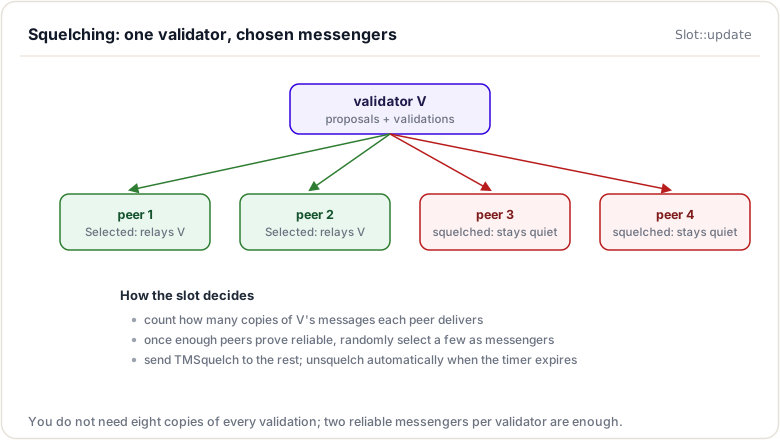
Slot::update (Slot.h):
- Tracks peer activity for a validator, incrementing message counts and considering peers for selection.
- When enough peers reach the message threshold, randomly selects a subset to be "Selected" and squelches the rest (temporarily mutes them).
- Squelched peers are unsquelched after expiration.
- Handles all state transitions, logging, and squelch/unsquelch notifications via the SquelchHandler interface.
OverlayImpl::unsquelch (OverlayImpl.cpp):
- Looks up the peer by short ID.
- If found, constructs a TMSquelch message with
squelch=falsefor the validator. - Sends the message to the peer, instructing it to stop squelching messages from the validator.
Summary
This module showed messages actually moving across the mesh. A peer session begins as an HTTP Upgrade request, then proposals, validations, and transactions are relayed between peers, and squelching and reduce-relay suppress redundant duplicates so a large network's traffic stays manageable. You also glimpsed a proposed protocol extension for quantum-resistant signatures.
To remember:
- A peer session starts life as an HTTP Upgrade request (
PeerImp::run/doAccept) - Relaying is deduplicated: a node forwards a message once, not once per peer
- Squelching tells redundant senders to stop; reduce-relay trims proposal/validation duplication
- Suppression is per-source, not censorship: content still arrives via other peers
- The quantum-resistant signature material (Dilithium) is a forward-looking proposal, not shipped protocol
- Code:
src/xrpld/overlay/detail - Watch out: when debugging "missing" messages, check squelch state before suspecting the network
Next up. Peers talk to peers; everyone else knocks on a different door. New phase: the RPC architecture, from port to handler and back.
Resources
Assignments
0 of 2 complete