
Consensus validations
How validators sign ledgers, how validations are collected, and how a ledger becomes fully validated.
What you'll learn
- Explain STValidation and RCLValidations.
- Understand validation quorum and full validation.
- See how validations drive the validated ledger.
Introduction
≈75 min · Advanced · builds on Ledger acquisition & the tx lifecycle
Watch this short video by XRPL Commons first, then dive into the details below.
Agreement isn't final until validators sign off. In this module you'll learn what a validation (STValidation) is, how validations are collected and counted, and how a quorum of them turns a merely-built ledger into a fully validated one. This is the step that makes a ledger official.
Validation Message Structure
In brief: what a validator signs to vouch for a specific ledger (an STValidation).
STValidation: The Core Message Format
Location: rippled/include/xrpl/protocol/STValidation.h and rippled/src/libxrpl/protocol/STValidation.cpp
Purpose: Represents a validation message in the XRP Ledger consensus protocol.
Components:
Signed Statements:
- Cryptographically signed declarations of ledger consensus
- Digital signatures prevent message tampering
- Ensures validation authenticity
Ledger Identification:
- Ledger hash: Identifies the specific ledger state being validated
- Sequence number: Provides ordering and prevents replay attacks
- Signing time: Enables freshness checks and temporal validation
Validator Identity:
- Public key: Establishes validator identity
- Node ID: Derived from public key for efficient lookup
- Master key: Links signing key to validator's master identity
Consensus Data:
- Transaction set hash: Optional, from the proposal phase
- Amendment votes: Indicates support for protocol amendments
- Fee votes: Proposes changes to base reserve and transaction fees
- Negative UNL data: Supports validator reliability tracking
Message Fields
Required fields include:
sfLedgerHash- The hash of the ledger being validatedsfLedgerSequence- The sequence number of the ledgersfSigningTime- When the validation was signedsfSigningPubKey- Validator's public signing keysfSignature- Cryptographic signature
Optional fields may include:
sfConsensusHash- Transaction set hash agreed uponsfAmendments- Amendment votessfBaseFee/sfReserveBase/sfReserveIncrement- Fee votes
Why This Structure?
Cryptographic Integrity:
- Digital signatures prevent tampering
- Only the validator with the private key can create valid signatures
- Impossible to forge validations
Temporal Ordering:
- Timestamps enable proper sequencing
- Freshness validation prevents replay attacks
- Allows detection of stale validations
Unique Identification:
- Ledger hashes ensure precise ledger reference
- Prevents ambiguity about which ledger is being validated
- Enables efficient lookup and matching
Extensibility:
- Structure allows for additional consensus-related data
- Can add new fields without breaking compatibility
- Supports evolving protocol requirements
Key idea. A ledger is only "fully validated" once a quorum of trusted validations agree on it. Until then, it is merely built.
Timing Parameters and Network Stability
In brief: the timing rules that keep validations orderly.
ValidationParms: The Timing Framework
Location: rippled/src/xrpld/consensus/Validations.h
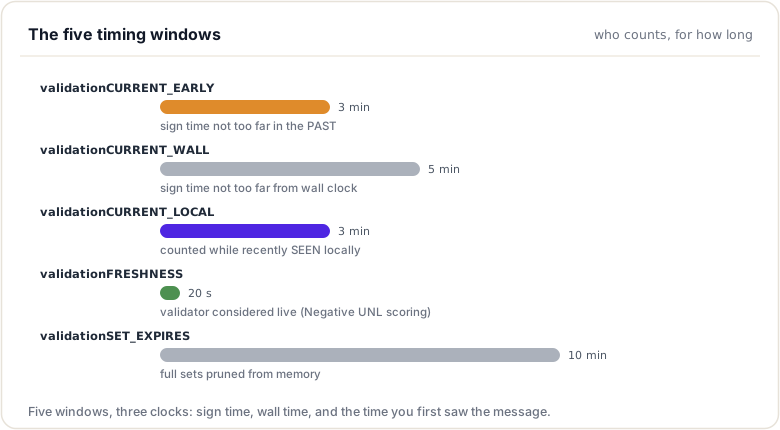
The ValidationParms struct defines critical timing parameters:
struct ValidationParms
{
    std::chrono::seconds validationCURRENT_WALL = std::chrono::minutes{5};
    std::chrono::seconds validationCURRENT_LOCAL = std::chrono::minutes{3};
    std::chrono::seconds validationCURRENT_EARLY = std::chrono::minutes{3};
    std::chrono::seconds validationSET_EXPIRES = std::chrono::minutes{10};
    std::chrono::seconds validationFRESHNESS = std::chrono::seconds{20};
};
Parameter Explanations
validationCURRENT_WALL (5 minutes):
- Maximum time window around current time that a validation's sign time is acceptable
- Based on validation's sign time vs. current network time
- Formula:
signTime < (now + validationCURRENT_WALL) - Protects against very old validations
- Accounts for close time accuracy window adjustments
validationCURRENT_LOCAL (3 minutes):
- Maximum time after we first saw a validation that it remains current
- Based on local observation time (seenTime), not validator's sign time
- Formula:
seenTime < (now + validationCURRENT_LOCAL) - Provides faster recovery when network produces fewer validations than normal
- Helps handle late-arriving but still useful validations
- Prevents rejecting useful validations due to propagation delays
validationCURRENT_EARLY (3 minutes):
- Earliest acceptable sign time relative to current time
- Formula:
signTime > (now - validationCURRENT_EARLY) - Prevents accepting validations with timestamps too far in the past
- Protects against extreme clock errors and timestamp manipulation
- Ensures validation is reasonably recent
validationSET_EXPIRES (10 minutes):
- Duration before validation sets for a specific ledger hash expire
- Keeps recent ledger validations available for reasonable interval
- Allows pruning old validations from memory
- Prevents memory exhaustion from historical validation accumulation
- Applied to both byLedger_ and bySequence_ data structures
validationFRESHNESS (20 seconds):
- Time window since validation was seen to consider validator "live"
- Formula:
now < (seenTime + validationFRESHNESS) - Used for validator participation scoring and Negative UNL decisions
- Must be significantly > ledgerMaxConsensus (15s)
- Prevents marking validators as offline when they're waiting for laggards
- Measured from seenTime (when we observed it), not signTime
Critical Distinction:
- signTime: When the validator signed the validation (validator's timestamp)
- seenTime: When we first observed the validation (local observation time)
- Different parameters check different times for different purposes
- This separation handles network delays and clock skew independently
Why These Specific Timeframes?
Network Latency Accommodation:
- Accounts for message propagation delays across global network
- Ensures validators on different continents can participate
- Tolerates typical internet latency variations
Clock Skew Tolerance:
- Handles minor time differences between servers
- Prevents rejection due to small synchronization errors
- More lenient than strict NTP requirements
Stale Data Prevention:
- Ensures validations remain relevant and current
- Prevents interference from old validation messages
- Maintains consensus on recent ledger state
Consensus Window Management:
- Balances speed with reliability
- Fast enough for quick finality
- Slow enough to accommodate network conditions
Impact on Network Stability
Prevents Fragmentation:
- Keeps validators synchronized within reasonable time bounds
- Ensures all validators consider the same validation set
- Maintains network-wide consensus view
Handles Network Partitions:
- Allows recovery from temporary connectivity issues
- Validators can rejoin consensus after brief disconnects
- Maintains network stability during transient failures
Maintains Liveness:
- Ensures consensus can progress despite timing variations
- Accommodates validators with varying network conditions
- Prevents stalls from timing mismatches
Security Boundaries:
- Prevents attacks based on timestamp manipulation
- Makes it difficult to influence consensus with stale data
- Provides clear boundaries for validation acceptance
Core Data Structures
Validations Template Class
Location: rippled/src/xrpld/consensus/Validations.h
Purpose: Manages current and historical validations, enforces sequence rules, tracks trusted/untrusted validators, and maintains a ledger trie for efficient consensus operations.
Key Data Structures:
current_ Map:
- Type:
hash_map<NodeID, Validation> - Purpose: Stores the latest validation from each node
- Usage: Quickly lookup most recent validation per validator
byLedger_ Map:
- Type:
AgedUnorderedMap<LedgerID, (NodeID, Validation) pairs> - Purpose: Index validations by ledger hash
- Usage: Find all validators who validated a specific ledger
- Auto-expiry: Old entries automatically removed based on age
bySequence_ Map:
- Type:
AgedUnorderedMap<SequenceNumber, (NodeID, Validation) pairs> - Purpose: Index validations by ledger sequence
- Usage: Find all validators who validated a specific sequence
- Auto-expiry: Prevents memory growth from historical data
Why These Structures?
- Scalability: Handle thousands of validators efficiently with O(1) lookups
- Consistency: Maintain data integrity under concurrent access
- Performance: Enable fast consensus decisions without scanning all validations
- Memory Management: Auto-expiry prevents unbounded growth
SeqEnforcer: Sequence Validation
Location: rippled/src/xrpld/consensus/Validations.h
Purpose: Ensures validation sequences increase properly, prevents replay attacks, and identifies Byzantine validators.
Functionality:
- Monotonic Ordering: Ensures validation sequence numbers strictly increase per validator
- Duplicate Prevention: Blocks replay attacks and duplicate submissions
- Per-Validator Tracking: Maintains sequence state for each validator independently
- Byzantine Detection: Identifies validators submitting invalid sequences
How it Works:
- Tracks the highest sequence number seen from each validator
- When a new validation arrives, checks if sequence number is greater than previous
- If sequence is not greater, rejects validation with
ValStatus::badSeq - Updates tracking on successful validation acceptance
Why SeqEnforcer Matters:
- Prevents validators from rewinding to earlier ledgers
- Detects malicious validators attempting to fork the chain
- Ensures temporal progression of validations
- Provides clear evidence of misbehavior
LedgerTrie: Hierarchical Ledger Organization
Purpose: Organizes ledgers in parent-child relationships for efficient ancestry tracking
Key Features:
Tree Structure:
- Organizes ledgers based on parent-child relationships
- Each ledger points to its parent ledger
- Forms a tree of possible ledger chains
Branch Support:
- Tracks which validators support each ledger branch
- Counts number of validations per branch
- Enables efficient preferred ledger calculation
Preferred Ledger Logic:
- Determines the most supported ledger chain
- Follows the branch with most trusted validator support
- Resolves forks automatically
Memory Efficiency:
- Compact representation of ledger relationships
- Shared storage for common ancestors
- Automatic pruning of old branches
Validation Lifecycle and Trust Management
In brief: how validations are collected and weighed by trust.
Validation Journey
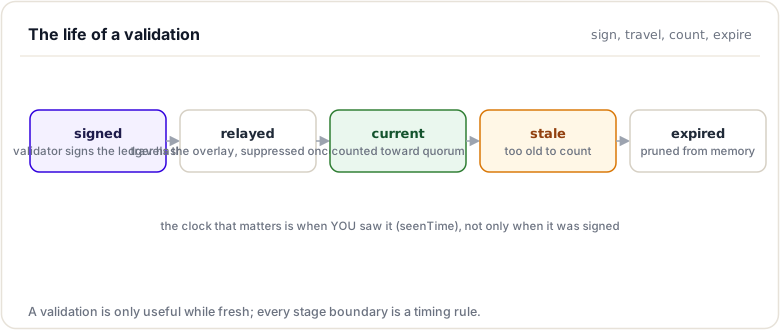
The lifecycle of a validation message involves several stages:
1. Creation and Broadcasting: RCLConsensus::Adaptor::validate
Location: rippled/src/xrpld/app/consensus/RCLConsensus.cpp
Process:
- Create Validation: Constructs an
STValidationobject for the newly built ledger - Set Fields: Fills in ledger hash, sequence, signing time, and optional fields
- Ensure Monotonic Time: Signing time must be strictly increasing
- Sign Message: Applies cryptographic signature using validator's private key
- Add to Hash Router: Registers for suppression (prevents duplicate relaying)
- Process Locally: Calls
handleNewValidationto process own validation - Broadcast: Sends to network peers via overlay network
- Publish: Notifies local subscribers (RPC clients, monitoring tools)
Important Notes:
- Only operates if node is configured as a validator
- Signing time must strictly increase to prevent replay attacks
- Includes amendment and fee votes if applicable
2. Reception and Authentication
When a validation message arrives from the network:
- Receive Message: Validation arrives via overlay network
- Deserialize: Parse the validation from wire format
- Extract Key Information: Ledger hash, sequence, signing key
- Signature Verification: Cryptographically verify the signature
- Trust Assessment: Check if validator is in trusted UNL
3. Validation Handling: handleNewValidation
Location: rippled/src/xrpld/app/consensus/RCLValidations.cpp
Process:
- Extract Signer Public Key: Get the public key from the validation
- Lookup Master Key: Find the master key for the signing key in the trusted validator list
- Mark as Trusted: If master key is found and validation not already trusted, mark it as trusted
- Add to Validations Set: Call
Validations::add()and receive aValStatus - Check Ledger Acceptance: If validation is "current" and from a trusted validator, call
LedgerMaster::checkAcceptto see if the ledger should be accepted as validated - Handle Non-Current Status: If validation is not "current" (stale, badSeq, multiple, or conflicting), log Byzantine behavior including:
- Conflicting validations (same sequence, different hash)
- Multiple validations (duplicate submissions)
- Bad sequence numbers
- Raw serialized validation for forensic analysis
4. Adding to Validation Set: Validations::add()
Returns: ValStatus enum indicating the result
Possible Return Values:
enum class ValStatus {
    current,      // Validation accepted and current
    stale,        // Validation too old or not timely
    badSeq,       // Sequence number invalid for this node
    multiple,     // Node submitted multiple validations for same ledger
    conflicting   // Node submitted conflicting validations for same sequence
};
Process:
- Acquire Lock: Ensure thread-safe access to validation data structures
- Check Sequence: Use
SeqEnforcerto verify sequence number is valid - Check Timing: Use
ValidationParmsto verify validation is current (not stale or too early) - Check for Duplicates: Ensure validator hasn't already submitted a validation for this sequence
- Update Data Structures:
- Update
current_with latest validation for this node - Add to
byLedger_index - Add to
bySequence_index
- Return Status: Indicate success or reason for rejection
5. Ledger Acceptance Checking
If a validation is current and trusted, the system checks if enough validations exist to accept the ledger:
LedgerMaster::checkAccept Process:
- Count Trusted Validations: Query
Validations::getTrustedForLedger(hash, seq) - Check Quorum: Determine if number of validations meets quorum requirement
- Accept Ledger: If quorum is met, mark ledger as validated and advance
- Update State: Set the validated ledger as the new Last Validated Ledger (LVL)
6. Expiration and Cleanup
Automatic Cleanup:
- Aged unordered maps automatically expire old entries
- Based on
validationSET_EXPIRESparameter (10 minutes) - Prevents memory exhaustion
- Maintains only relevant validation data
Trust Management Philosophy
Explicit Trust Lists:
- UNL (Unique Node List) defines trusted validators for each node
- Only trusted validators' opinions count for consensus
- Each operator independently chooses their UNL
Reputation Tracking:
- Historical behavior influences trust levels
- Validators can be added to Negative UNL for poor performance
- Trust is not binary but can have gradations
Dynamic Adjustment:
- Trust can change based on validator performance
- Negative UNL automatically adjusts participation
- System adapts to changing network conditions
Byzantine Tolerance:
- System functions even with some untrustworthy validators
- Up to 20% of UNL validators can be Byzantine
- Quorum requirement (80%) provides safety margin
Trusted Validation Queries
currentTrusted():
- Returns: Vector of all current, trusted, and full validations
- Purpose: Get snapshot of all trusted validators' current positions
- Usage: Calculate overall network validation state
getTrustedForLedger(hash, seq):
- Returns: Vector of trusted, full validations for specific ledger and sequence
- Purpose: Determine if a specific ledger has enough validation support
- Usage: Check if ledger meets quorum for acceptance
Validation Flags and Enums
Validation Flags
vfFullValidation:
- Indicates validation is a full validation (not a partial/proposal)
- Required for validation to count toward ledger acceptance
- Set after consensus is fully reached
vfFullyCanonicalSig:
- Indicates signature is fully canonical
- Ensures signature follows strict encoding rules
- Prevents signature malleability
ValStatus Enum
Usage: Returned by the add() method in Validations to indicate result of adding a validation
Values and Meanings:
current:
- Validation is accepted and current
- Will be counted for consensus
- From a validator in good standing
stale:
- Validation is too old or not timely
- Outside
validationCURRENT_WALLorvalidationCURRENT_LOCALwindows - Ignored for consensus
badSeq:
- Sequence number is invalid for this node
- Either regressed, duplicate, or out of order
- Indicates potential Byzantine behavior
multiple:
- Node submitted multiple validations for same ledger/sequence
- All after the first are rejected
- May indicate misconfiguration or attack
conflicting:
- Node submitted conflicting validations for same sequence
- Different ledger hashes for same sequence number
- Strong indicator of Byzantine behavior
BypassAccept Enum
enum class BypassAccept : bool { no = false, yes };
Usage: Indicates whether to bypass certain acceptance checks when processing a validation
Purpose: Allows special operational modes or testing scenarios
Byzantine Behavior Detection
In brief: catching validators that sign conflicting ledgers.
The validation system detects and rejects Byzantine behavior through multiple mechanisms:
1. Sequence Violation Detection
SeqEnforcer Class (Validations.h:73-107)
Enforces monotonically increasing sequence numbers per validator:
bool operator()(time_point now, Seq s, ValidationParms const& p)
{
    if (now > (when_ + p.validationSET_EXPIRES))
        seq_ = Seq{0};  // Reset after expiration
    if (s <= seq_)
        return false;   // Reject non-increasing sequence
    seq_ = s;
    return true;
}
Detects:
- Sequence numbers that regress (older than previous)
- Duplicate sequences from same validator
- Returns
ValStatus::badSeqon violation
2. Conflicting Validation Detection
Code: Validations.h:600-640
Tracks multiple validations per sequence and detects conflicts:
// If same sequence but different ledger hash → conflict
if (seqit->second.ledgerID() != val.ledgerID())
    return ValStatus::conflicting;
Detects:
- Validator proposing different ledgers for same sequence
- Evidence of attempted chain fork
- Strongest indicator of malicious behavior
3. Timestamp Validation
isCurrent() Function (Validations.h:129-147)
Validates timing using three parameters:
return (signTime > (now - p.validationCURRENT_EARLY)) &&
       (signTime < (now + p.validationCURRENT_WALL)) &&
       (seenTime < (now + p.validationCURRENT_LOCAL));
Detects:
- Sign times too far in past (>3 min before now)
- Sign times too far in future (>5 min after now)
- Observations too old (>3 min since first seen)
- Returns
ValStatus::staleon violation
4. Signature Verification
Built into validation processing (before reaching Validations class)
Detects:
- Invalid cryptographic signatures
- Signature doesn't match claimed validator key
- Rejected immediately at protocol layer
5. Duplicate Detection
Code: Validations.h:640-650
Prevents same validation from being processed multiple times:
if (byLedger_.find(val.ledgerID()) != byLedger_.end())
{
    if (existing validation found)
        return ValStatus::multiple;
}
Detects:
- Duplicate submissions of identical validation
- Spam/DOS attempts
- Returns
ValStatus::multiple
Byzantine Response Chain
- Immediate Rejection: Invalid validations never stored or propagated
- Status Reporting:
ValStatusenum provides rejection reason - Logging: All rejections logged for operator analysis
- Negative UNL Integration: Persistent misbehavior tracked via
validationFRESHNESS - Operator Action: UNL managers can remove consistently Byzantine validators
Response Strategies
Automatic Filtering:
- Reject validations from detected Byzantine validators
- Prevent misbehaving validators from affecting consensus
- Immediate response to detected attacks
Reputation Penalties:
- Reduce trust scores for misbehaving validators
- Feed into Negative UNL calculation
- Gradual response to consistent issues
Network Alerts:
- Log Byzantine behavior for operator awareness
- Include raw validation data for forensic analysis
- Enable manual intervention if needed
UNL Updates:
- Remove consistently Byzantine validators from trust lists
- Validators can update their UNL configuration
- Maintains network health over time
Thread Safety and Concurrency
Multi-Threading Challenges
Concurrent Access:
- Multiple threads reading/writing validation data
- Network thread receiving validations
- Consensus thread checking validation status
Data Consistency:
- Ensuring atomic operations on shared state
- Preventing race conditions in validation tracking
- Maintaining consistency across indices
Performance:
- Minimizing lock contention for high throughput
- Allowing concurrent reads where possible
- Optimizing critical paths
Deadlock Prevention:
- Careful lock ordering to avoid circular dependencies
- Avoiding nested locks where possible
- Using lock guards for exception safety
Thread Safety Mechanisms
Mutex Protection:
- All shared data structures in
Validationsprotected by mutexes - Critical sections guarded by appropriate locks
- Ensures exclusive access when modifying state
Atomic Operations:
- Lock-free operations where possible for performance
- Cached signature verification results
- Immutable validation objects after creation
Immutable Data:
STValidationobjects are immutable after creation- Reduces mutable shared state
- Enables safe sharing between threads
Lock Guards:
- RAII-style lock management
- Automatic unlock on exception
- Prevents lock leaks
Thread-Safe Operations
All public methods in Validations class:
- Acquire appropriate lock before accessing shared data
- Release lock before returning
- Exception-safe through RAII
Iterator Safety:
- Iteration over validation sets performed under lock
- Prevents modifications during iteration
- Avoids iterator invalidation
Cached Results:
isValid()inSTValidationcaches its result- Safe for repeated calls from multiple threads
- No lock needed for cached reads
Why Thread Safety Matters:
Consensus Speed:
- Parallel processing accelerates validation handling
- Multiple validations can be processed simultaneously
- Reduces latency in consensus rounds
System Reliability:
- Prevents data corruption and crashes
- Maintains consistency across threads
- Ensures correct consensus operation
Scalability:
- Efficient use of multi-core systems
- Enables high validation throughput
- Supports large numbers of validators
Real-Time Requirements:
- Consensus has strict timing constraints
- Thread safety cannot compromise performance
- Must maintain low latency
Integration Patterns
Adaptor Pattern Implementation
RCLValidationsAdaptor:
Location: rippled/src/xrpld/app/consensus/RCLValidations.h
Purpose: Adapts the generic validation handling framework to XRPL-specific types
Key Responsibilities:
Interface Abstraction:
- Generic validation handling regardless of specific types
- Bridges
STValidationto genericValidationtemplate - Provides XRPL-specific logic to generic framework
Type Safety:
- Template-based design ensures compile-time correctness
- No runtime type checking needed
- Enforces proper type usage
Flexibility:
- Easy integration with different consensus algorithms
- Can adapt to future validation formats
- Supports protocol evolution
Testability:
- Mock implementations for unit testing
- Can test validation logic independently
- Simplifies test scenarios
Consensus System Integration
Event-Driven Architecture:
- Validations trigger consensus state changes
- New validations cause ledger acceptance checks
- System reacts to validation events
Callback Mechanisms:
- Notifications when validation state changes
- Alerts when quorum is reached
- Integration with ledger master
Data Flow:
- Seamless integration with proposal and consensus phases
- Validations follow proposals in consensus lifecycle
- Clear handoffs between components
State Synchronization:
- Keeps validation state aligned with consensus state
- Ensures all components have consistent view
- Coordinates state transitions
Integration Benefits
Loose Coupling:
- Components can evolve independently
- Validation logic separate from consensus logic
- Clear interfaces between modules
Testing:
- Individual components can be tested in isolation
- Mock adaptors for unit tests
- Simplified debugging
Performance:
- Optimized data flow between components
- Minimal overhead from abstraction
- Efficient memory usage
Reliability:
- Well-defined interfaces reduce integration bugs
- Clear contracts between components
- Easier to maintain and extend
Inter-Module Relationships
The validation subsystem interacts with several other key modules:
Validations Module:
- Central repository for all received validations
- Manages timing, status, and scoring
- Provides queries for consensus logic
RCLValidationsAdaptor:
- Adapts generic validation logic to XRPL specifics
- Handles ledger structure and transaction sets
- Bridges protocol and consensus layers
LedgerTrie:
- Organizes and traverses set of validated ledgers
- Supports efficient lookup and ancestry queries
- Determines preferred ledger chain
LedgerMaster:
- Coordinates current ledger state
- Tracks the validated ledger
- Uses validations to determine consensus
- Advances ledger when quorum reached
ValidatorList:
- Maintains list of trusted validators
- Provides public keys and associated metadata
- Filters and scores incoming validations
- Tracks validator performance for Negative UNL
Consensus Process Flow:
- Validators submit signed validations after reaching consensus locally
- Validations module receives and verifies them using signature checks
- LedgerTrie organizes the validated ledgers into a tree structure
- LedgerMaster uses the results to determine if ledger has enough support
- ValidatorList scores and tracks validator participation for reliability
References to Source Code
rippled/src/xrpld/consensus/Validations.h- Core validation data structures and logicrippled/src/xrpld/app/consensus/RCLValidations.h- XRPL-specific validation handlingrippled/src/xrpld/app/consensus/RCLValidations.cpp- Validation processing implementationrippled/src/libxrpl/protocol/STValidation.cpp- Validation message implementationrippled/include/xrpl/protocol/STValidation.h- Validation message structurerippled/src/xrpld/app/ledger/detail/LedgerMaster.cpp- Ledger acceptance logicrippled/src/xrpld/app/ledger/LedgerHistory.cpp- Historical ledger trackingrippled/src/xrpld/app/misc/ValidatorList.h- Trusted validator managementrippled/src/xrpld/app/misc/NegativeUNLVote.cpp- Validator reliability tracking
Summary
This module covered validations, the signed statements by which validators vouch for a specific ledger. You learned the STValidation message, how validations are collected and weighed by trust, and how a quorum of trusted validations turns a merely-built ledger into a fully validated, and irreversible, one. You also saw safeguards like sequence enforcement that catch a validator signing conflicting ledgers.
To remember:
- An
STValidation= a validator's signed statement: ledger hash + sequence (+ amendment votes and more) - Full validation = a quorum of TRUSTED validations agreeing on one ledger hash
- Engine:
src/xrpld/consensus/Validations.h+RCLValidationsinsrc/xrpld/app/consensus SeqEnforcercatches a validator signing two different ledgers at the same sequence (Byzantine guard)LedgerTrieorganizes candidate chains and picks the preferred branch- Validations expire: freshness windows keep counts current
- See it live:
subscribewith"streams": ["validations"]on any public node - Watch out: count validations per ledger HASH, not per sequence; two hashes at one sequence is exactly the disagreement you care about
Next up. Validations only count if you trust their authors. Next: the UNL and the negative UNL, the trust layer that decides whose voice matters.
Resources
Assignments
0 of 2 complete