The Academy, In Depth
A guided tour of how the academy is built, using the screens you already see. Learn to read a journey page and a module page, understand the four phases and what "done" means, and find where your future content will fit.
What you'll learn
- How the academy is organised: journeys contain ordered steps, each step points to a module, and modules contain assignments.
- How to read a journey page and a module page, and what each part of the interface is showing you.
- What the four phases (foundations, build, launch, grow) mean for a learner.
- What "done" means in the academy: a Check with a verifiable artifact, and the five verification methods.
- Where content lives (the Studio and the markdown source), and where you fit as an instructor versus an admin.
Overview
A learner only needs to know how to move through the academy. As a contributor you need to know how it is built, so the content you add fits in cleanly. The good news: you do not need to read any code. Everything about the structure is already visible on the screens you use every day. This module is a short tour of those screens, pointing out what each part is actually showing you. By the end you will be able to look at any journey and any module and see the model underneath, and you will know where your own content will go.
How the academy is organised
There are three things you will work with, and they nest in a simple way:
- A journey is an ordered path. It does not hold content itself; it lists steps, and each step points to a module.
- A module is one lesson: a written body, a few learning outcomes, some resources, and one or more assignments.
- An assignment is a task inside a module that a learner completes.
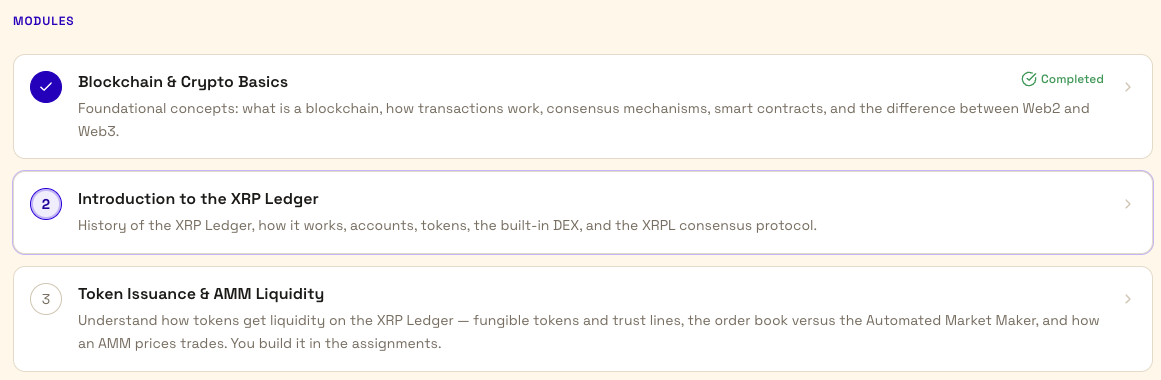
Open any journey and you see this directly: a list of steps, each one a module, in order. Open one of those modules and you see the lesson itself.
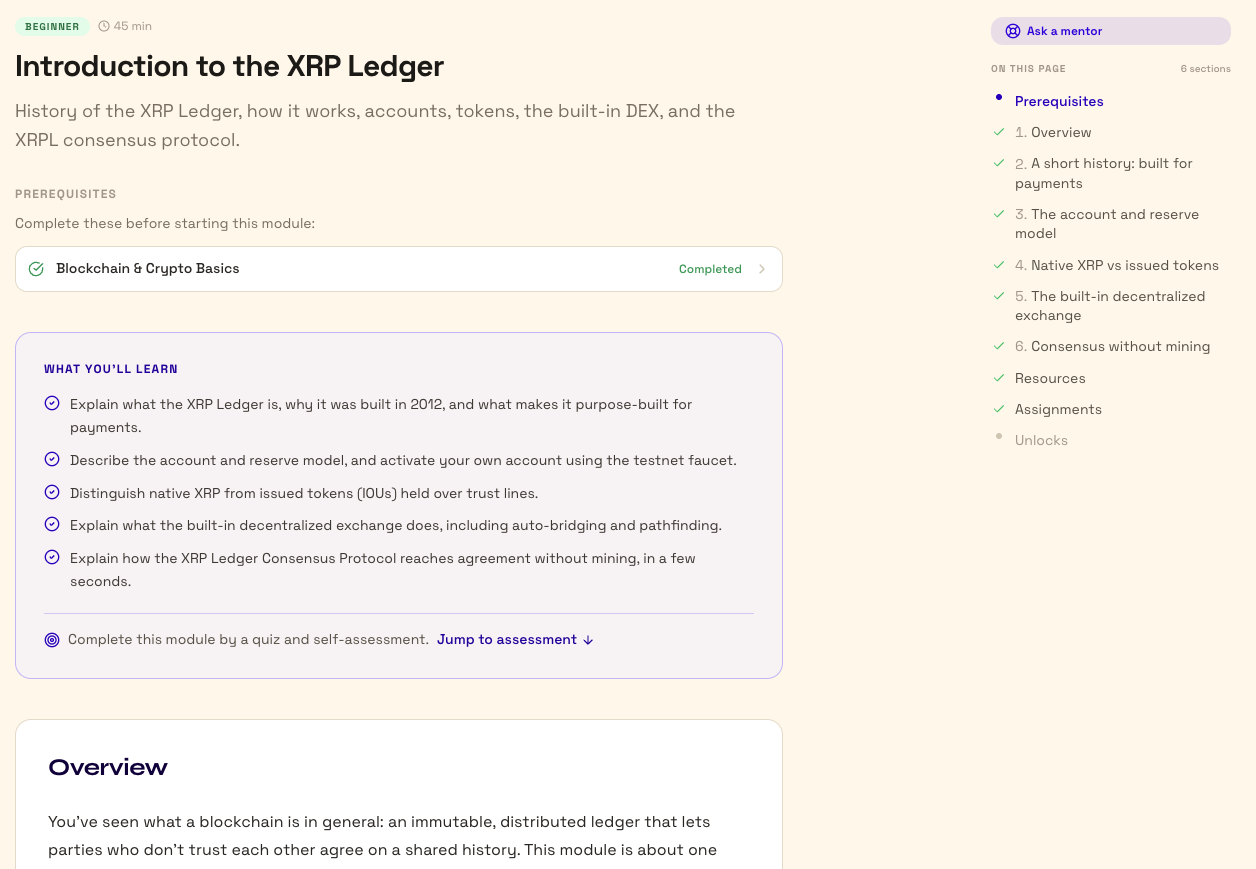
The important habit to build: a module is written once and can be reused in many journeys. So contributing is usually one of two separate jobs, writing a module (the lesson) or building a journey (the path). Keep them apart in your head and the rest is easy. There is no "chapter" below a module; a module's internal structure is just its headings.
What "done" means
The academy does not treat "watched the lesson" as finished. Every module ends with a Check: a short section that names the artifact a learner produces (a transaction hash, a screenshot, a short write-up, a piece of code, a lesson plan) and how it is verified.
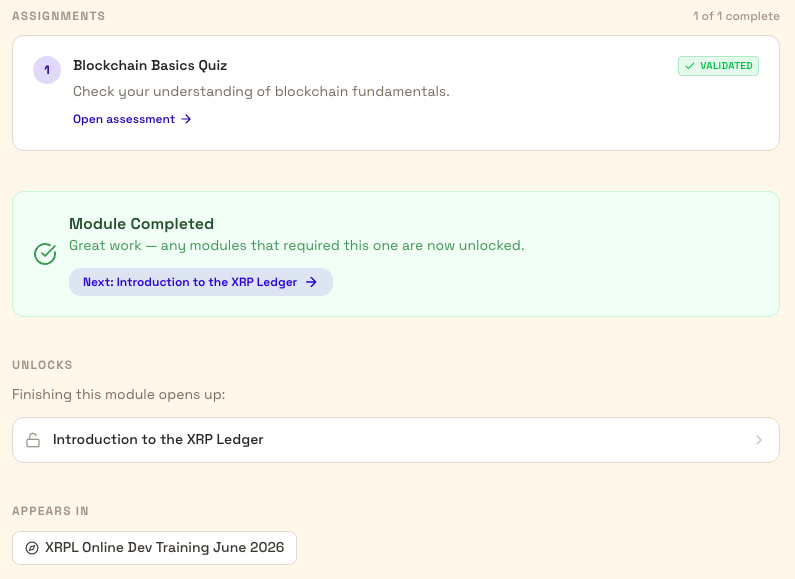
There are five verification methods, and you will choose one for every assignment you write:
- self: the learner confirms their own work against a clear standard.
- peer: a classmate reviews the artifact against your rubric.
- mentor: an instructor reviews it.
- external: the platform checks the learner's own on-ledger activity automatically.
- quiz: an auto-graded set of questions.
You can also see "done" on the module cards: a card shows whether a module is locked, unlocked, in progress, or completed.
Where content lives, and who can change it
Content lives in two places that stay in sync. You author and edit modules and journeys in the Studio (the next module is a full tour). The reviewed source of record is a set of markdown files kept in version control. Either way, everything refers to a module by its slug, a short stable name, never by an internal ID. That is why a slug is worth choosing carefully and keeping fixed.
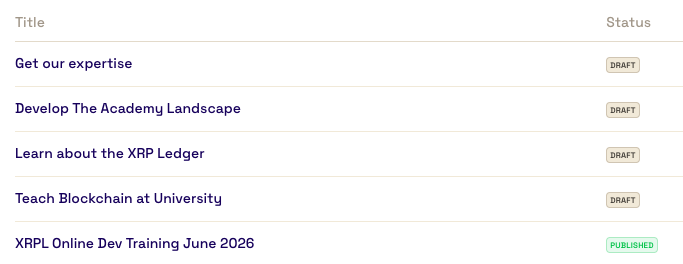
The academy has three roles. A learner consumes content and submits work. An instructor (you, once signed up) can create and edit their own drafts in the Studio. An admin reviews and publishes them. Content moves through clear states you can see on a status badge: draft, in-review, published, rejected. You propose; an admin approves; learners only ever see published work.
Check
You are done when you can read the academy's screens and place your own idea inside them. Open one journey and one module and, in a one-page note, do two things. First, describe what each screen is showing: how many steps the journey has and their phases, and for the module its outcomes, its Check, and how its assignment is verified. Second, take one piece of content you want to contribute and write where it fits: its journey and phase, its 3 to 5 outcomes, and its Check (the artifact a learner produces and who verifies it).
Hand the note to a peer. They should be able to confirm your idea fits: it sits in a sensible phase, it has observable outcomes, and its Check names a real artifact and a verifier.
Appears in