
Phase overview: Consensus
Your map of the Consensus phase: the ledger being agreed on, the agreement algorithm itself, staying in sync, and the trust layer, in seven modules.
Introduction
≈2 min · Phase overview · read this before diving in
Every few seconds, hundreds of independent nodes agree on the exact same ledger without a leader and without proof-of-work. This phase explains how, from the data being agreed on to the trust assumptions underneath.
It opens with the object of agreement: the Ledger class and its data structures, tying together everything you learned about SHAMaps. Then the algorithm: consensus fundamentals (proposals, disputes, the avalanche thresholds) and the full round lifecycle, open, establish, accepted, on its timers. Staying in sync covers what happens around the algorithm: acquiring missing ledgers, and the validations that make a ledger final. Finally trust and order: the UNL and negative UNL that define who you listen to, and the salted canonical ordering that decides transaction sequence inside a ledger.
The road through this phase
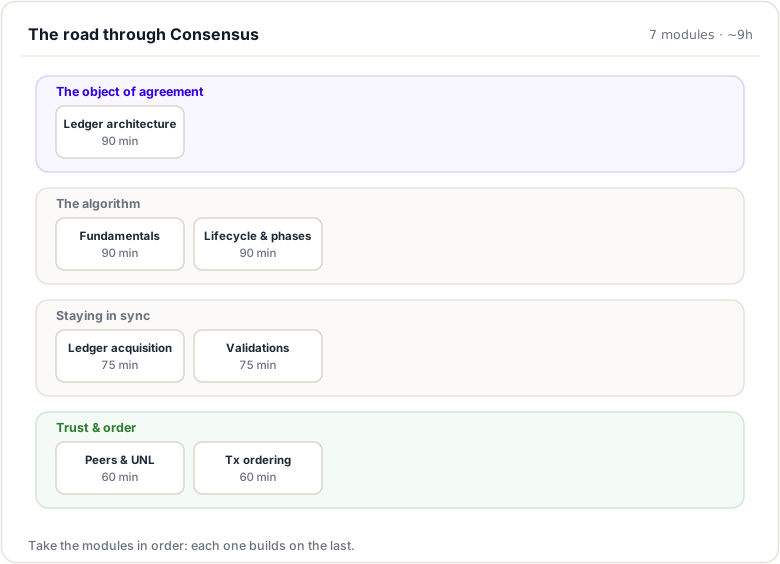
| Module | Duration | What it covers |
|---|---|---|
| The object of agreement | ||
| Ledger architecture & data structures | 90 min | The Ledger object and its data structures — LedgerHeader and the state and transaction trees |
| The algorithm | ||
| Consensus fundamentals | 90 min | The XRP Ledger Consensus Protocol — what it agrees on and the generic consensus engine |
| Consensus lifecycle & phases | 90 min | A consensus round in detail — modes, phases (open / establish / accepted) and timing |
| Staying in sync | ||
| Ledger acquisition & the tx lifecycle | 75 min | How a node acquires and validates ledgers, and the end-to-end path of a transaction across RPC, peers and c... |
| Consensus validations | 75 min | How validators sign ledgers, how validations are collected, and how a ledger becomes fully validated |
| Trust & order | ||
| Consensus peers & the UNL | 60 min | Trusted validators, the UNL and negative UNL, and how peers participate in consensus |
| Transaction ordering | 60 min | How the network agrees on a deterministic, salted canonical order for transactions in a ledger |
Total: about 9 hours of module time, plus your own exploration. The modules are ordered so each builds on the previous one; resist the temptation to skip ahead.
Where you will land
By the end of this phase you can narrate a consensus round tick by tick, explain how a node catches up after falling behind, and reason about the safety/liveness trade-offs of the UNL model. That understanding is what lets you change the protocol responsibly, which is exactly what the final phase is about.