
Transaction ordering
How the network agrees on a deterministic, salted canonical order for transactions in a ledger.
What you'll learn
- Explain the salted CanonicalTXSet ordering and its BFT role.
- Understand SeqProxy ordering and tie-breaking.
- Connect ordering to TxQ fee prioritisation.
Introduction
≈60 min · Advanced · builds on Consensus peers & the UNL
Watch this short video by XRPL Commons first, then dive into the details below.
If two nodes ordered transactions differently, they'd compute different ledgers, so order can't be left to chance. In this module you'll learn XRPL's salted canonical ordering, the sort key that combines account, sequence and transaction id, and how this deterministic order keeps every node in lockstep (and how it connects to fee-based TxQ prioritisation). A small idea with load-bearing consequences.
Canonical Transaction Ordering
In brief: a salted, deterministic order that every node computes identically.
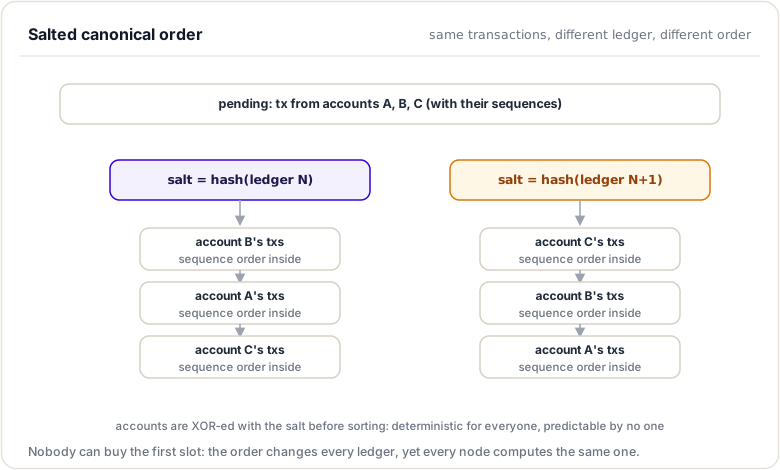
The CanonicalTXSet Class
Location: rippled/include/xrpl/ledger/CanonicalTXSet.h and rippled/src/libxrpl/ledger/CanonicalTXSet.cpp
Purpose: Maintains a set of transactions in a deterministic, canonical order for processing in the XRPL ledger.
The CanonicalTXSet class is central to transaction ordering, ensuring all validators arrive at the same transaction sequence.
Ordering Mechanism: Full Sort Key
Transactions are ordered using a composite key with the following precedence:
1. Salted Account Key (uint256) - Primary Sort
Purpose: Creates unpredictable but deterministic ordering
Mechanism:
uint256 CanonicalTXSet::accountKey(AccountID const& account)
{
    uint256 ret = beast::kZero;
    memcpy(ret.begin(), account.begin(), account.size());
    ret ^= salt_;  // XOR with ledger-specific salt
    return ret;
}
How Salt is Generated:
Why Salting is Necessary: The salt ensures that all honest validators produce identical transaction ordering (Byzantine Fault Tolerance) while making the ordering unpredictable to prevent gaming. The salt must be:
- Deterministic - All validators must compute the same salt
- Agreed-upon - Derived from data already established by consensus
- Unpredictable - Changes every ledger to prevent strategic ordering manipulation
- Fair - No account can consistently get priority across ledgers
To achieve these properties, the salt is derived from consensus-agreed data - specifically, hashes that all validators already agreed upon in previous rounds.
Two Contexts Where Salted Ordering is Used:
Context 1: TxQ (Transaction Queue Ordering)
Purpose: Orders transactions in the queue for selection into proposed transaction sets
Salt Source: Hash of the parent (previous) ledger
Location: rippled/src/xrpld/app/misc/detail/TxQ.cpp
LedgerHash const& parentHash = view.header().parentHash;
MaybeTx::parentHashComp = parentHash;  // Salt set to parent ledger hash
How it works:
- When building ledger N, salt = hash of ledger N-1
- Example: Building ledger #100 → salt = hash(ledger #99)
- All validators agreed on ledger N-1 in the previous consensus round
- Therefore, all validators have the same salt for ledger N
- Salt changes every ledger, preventing predictable ordering
Context 2: CanonicalTXSet (Retriable Transactions During Consensus)
Purpose: Orders transactions that failed to apply and can be retried in the next round
Salt Source: Hash of the transaction set itself (SHAMap hash)
Location: rippled/src/xrpld/app/consensus/RCLConsensus.cpp
CanonicalTXSet retriableTxs{result.txns.map_->getHash().as_uint256()};
How it works:
- Salt = hash of the agreed-upon transaction set
- All validators reach consensus on the transaction set during the current round
- Therefore, all validators compute the same transaction set hash
- This hash becomes the salt for ordering retriable transactions
- Salt changes per consensus round based on the agreed set
The BFT Guarantee:
Both salt sources derive from data that all validators have already agreed upon through consensus:
| Salt Source | When Agreed | BFT Property |
|---|---|---|
| Parent ledger hash | Previous consensus round | Fixed and identical across all honest validators |
| Transaction set hash | Current consensus round | Agreed upon during establish phase |
Result:
- All honest validators XOR the same salt with account IDs
- All honest validators compute identical salted keys
- All honest validators produce identical ordering
- Byzantine validators cannot use different salt (would create different ordering → rejected by network)
Why Salting Matters:
Anti-Gaming Measure:
- Prevents users from predicting their position in queue
- Account addresses chosen for strategic advantage become useless
- Cannot create accounts to get consistent priority
Fairness:
- No account can consistently get priority
- Each ledger randomizes ordering fairly
- All accounts have equal opportunity
Security:
- Prevents strategic manipulation of transaction timing
- Makes it impossible to game the fee market
- Protects against certain attack vectors
2. Sequence Proxy (SeqProxy) - Secondary Sort
Purpose: Orders transactions from the same account by their sequence number or ticket
Mechanism:
- Uses
SeqProxywhich handles both sequence numbers and tickets - Ensures proper ordering within a single account
- Maintains account transaction chronology
Why This Matters:
- Account transactions must execute in order
- Prevents later transactions from executing before earlier ones
- Maintains account state consistency
3. Transaction ID (uint256) - Tertiary Sort
Purpose: Final tie-breaker to ensure deterministic ordering
Mechanism:
- Uses transaction hash as last resort for ordering
- Guarantees unique, deterministic ordering even for identical sequence numbers
- Lexicographic comparison of transaction IDs
When Used:
- Identical salted account key and sequence proxy
- Ensures no ambiguity in final ordering
- Provides complete determinism
Transaction Insertion
Process:
void CanonicalTXSet::insert(std::shared_ptr<STTx const> const& txn)
{
    map_.insert(std::make_pair(
        Key(accountKey(txn->getAccountID(sfAccount)),
            txn->getSeqProxy(),
            txn->getTransactionID()),
        txn));
}
Steps:
- Extract account ID from transaction
- Calculate salted account key
- Get sequence proxy (sequence or ticket)
- Get transaction ID
- Create composite key
- Insert into ordered map
Result:
- Transaction placed in deterministic position
- Same transaction always placed in same position
- All validators arrive at identical ordering
Set Updates and Modifications
Replacement Logic:
- If transaction with same account and sequence exists, new transaction may replace old
- Replacement only valid if it meets criteria (e.g., higher fee)
- Enforced by external logic, not CanonicalTXSet itself
Removal Handling:
- When transaction is applied to ledger, it's removed from set
- Next valid transaction for account is promoted
- Set maintains proper ordering after removals
Salt Reset:
- Set can be reset with new salt value
- Used when starting new consensus round
- Prevents ordering manipulation across rounds
Benefits of Canonical Ordering
Determinism:
- Same inputs always produce same ordering
- Validators independently reach same result
- No coordination needed for ordering agreement
Efficiency:
- Reduces consensus rounds needed for agreement
- Validators propose similar transaction sets
- Fewer disputes to resolve
Security:
- Prevents strategic manipulation
- Fair treatment for all participants
- Resistant to various attack vectors
Predictability:
- Users can understand ordering logic
- Transparent and auditable process
- Reproducible results
Key idea. The order is salted per ledger so nobody can predict or game it, yet it is deterministic so every node applies the same transactions in the same sequence.
Transaction Set Construction and Proposal
In brief: how a node builds and proposes its transaction set.
Initial Transaction Collection
Validators collect transactions from multiple sources to build their proposed transaction sets:
Network Submissions:
- Transactions received from connected peers
- Relayed across the peer-to-peer network
- Arrive asynchronously from various sources
Local Submissions:
- Transactions submitted directly to this node
- From RPC clients or local applications
- Given same treatment as network transactions
Peer Relays:
- Transactions forwarded by other validators
- Help ensure transaction coverage across network
- Reduce transaction propagation delays
Proposal Set Building: RCLConsensus::Adaptor::onClose
Location: rippled/src/xrpld/app/consensus/RCLConsensus.cpp
Purpose: Prepares the initial transaction set and proposal for the next consensus round.
Process:
- Gather Open Transactions:
- Collect transactions from open ledger
- Pull from transaction queue (TxQ)
- Consider fee levels and priorities
- Validation Phase:
- Basic format and signature verification
- Check transaction well-formedness
- Verify cryptographic signatures
- Preliminary Filtering:
- Remove obviously invalid transactions
- Eliminate duplicates
- Apply business logic checks
- Apply Canonical Ordering:
- Create CanonicalTXSet with current salt
- Insert transactions in canonical order
- Generate deterministic transaction sequence
- Capacity Management:
- Respect ledger size limits
- Account for processing capacity
- Ensure ledger can be built and validated in time
- Fee Prioritization (TxQ only):
- Higher fee transactions more likely to be selected from queue
- Affects inclusion in proposed set, NOT execution order within ledger
- Once in ledger, canonical ordering determines sequence
- Account Limits:
- Enforce per-account transaction limits per ledger
- Prevent any account from monopolizing ledger space
- Maintain fairness across accounts
- Finalize Proposal:
- Generate transaction set hash
- Create proposal message
- Sign with validator private key
How Ordering Simplifies Consensus
In brief: why one shared order means every node reaches the same ledger.
** Reference:** For consensus mechanics (dispute resolution, avalanche, thresholds), see the Consensus lifecycle & phases module.
Ordering Reduces Dispute Complexity
The Core Benefit: Canonical ordering separates the consensus problem into two independent concerns:
- What to include (resolved by consensus voting)
- How to order (resolved by deterministic salt)
Impact on Disputes:
| Metric | Without Canonical Ordering | With Canonical Ordering |
|---|---|---|
| Dispute Types | Inclusion + Sequence | Inclusion only |
| Complexity | O(N²) potential disputes | O(N) potential disputes |
| Comparison | Compare sets AND orderings | Compare sets only |
| Resolution | Must agree on both | Ordering automatic from salt |
Code Reference: Consensus::createDisputes() at rippled/src/xrpld/consensus/Consensus.h
// Disputes created ONLY for set membership differences
auto differences = result_->txns.compare(o);
for (auto const& [txId, inThisSet] : differences) {
    // Dispute: Is txId IN or OUT? (not WHERE in the sequence)
    result_->disputes.emplace(txID, std::move(dtx));
}
Automatic Ordering Agreement
Once validators agree on which transactions to include (set membership), ordering is automatically identical:
Same Transaction Set + Same Salt → Identical Ordering

Example:
Validators A & B both agree: {TX1, TX2, TX3}
Salt (from previous ledger): 0xABCD...

Result:
Validator A: [TX2, TX1, TX3] ← Deterministic
Validator B: [TX2, TX1, TX3] ← Identical!
Why This Matters:
- Consensus only resolves one dimension (inclusion)
- Ordering automatically follows from agreed salt
- No additional rounds needed for sequencing
- Faster convergence to final ledger state
Transaction Queue (TxQ) Ordering
In brief: how queued transactions are prioritized by fee.
Fee Level Prioritization
Location: rippled/src/xrpld/app/misc/TxQ.h
OrderCandidates Comparator:
bool operator()(MaybeTx const& lhs, MaybeTx const& rhs) const {
    if (lhs.feeLevel == rhs.feeLevel)
        return (lhs.txID ^ MaybeTx::parentHashComp) < (rhs.txID ^ MaybeTx::parentHashComp);
    return lhs.feeLevel > rhs.feeLevel;
}
Fee Level Concept:
Base Fee:
- Minimum fee required for transaction inclusion
- Set by network consensus
- Varies based on network load
Fee Escalation:
- Higher fees increase transaction priority within queue
- Transactions sorted by fee level
- Market mechanism for prioritization
Dynamic Adjustment:
- Fee requirements change based on network load
- When ledger is full, higher fees needed
- Market finds equilibrium price
Tie-Breaking:
- When fee levels are equal, use transaction ID XOR parent hash
- Ensures deterministic ordering
- Prevents manipulation
Market Mechanism:
- Users compete through fee levels for inclusion
- Higher demand increases required fees
- Supply-demand equilibrium
Per-Account Transaction Limits
Sequence Enforcement:
- Transactions from same account must execute in sequence order
- Gaps in sequence numbers create blockers
- Ensures proper account state progression
Queue Depth Limits:
- Each account limited to
maximumTxnPerAccounttransactions in queue - Default: 10 transactions per account (configurable in
xrpld.cfg) - Prevents any account from monopolizing queue space
- Configurable per-node basis via
maximum_txn_per_accountsetting
Fairness Mechanism:
- Ensures equitable access across all accounts
- No single account can dominate queue
- Balanced resource allocation
Resource Protection:
- Prevents queue exhaustion attacks
- Limits memory consumption per account
- Protects node resources
Queue Management Strategies
Priority Ordering:
- Sort by fee level within canonical ordering constraints
- Higher fees get priority
- But still must respect account sequence
Capacity Planning:
- Balance queue size with processing capabilities
- Monitor queue depth
- Adjust acceptance criteria based on load
Aging Policies:
- Handle long-queued transactions appropriately
- May drop very old transactions
- Prevent unbounded queue growth
Overflow Handling:
- When queue full, drop lowest fee transactions
- Manage queue when demand exceeds capacity
- Clear space for higher value transactions
Transaction Blockers and Retries
Transaction Blocker Concepts
Location: rippled/src/xrpld/app/misc/detail/TxQ.cpp
Dependency Tracking:
What Is a Blocker?
- A transaction that prevents subsequent transactions from being processed
- Usually due to missing prior sequence number
- Creates dependency chain
Example:
- Account has sequence 100
- Receives transactions for sequences 101, 103, 104
- Transaction 101 must execute before 103 and 104
- If 101 is missing, 103 and 104 are "blocked"
Account State Requirements:
- Prerequisite conditions must be met
- Sufficient balance for fees and operations
- Proper sequence numbering
- Valid account state
Sequence Gap Handling:
- Detect missing sequence numbers in chains
- Hold later transactions until gaps filled
- Prevent out-of-order execution
Resource Availability:
- Verify sufficient account resources exist
- Check balance covers fees and reserves
- Ensure operations can complete
Retry Mechanisms
Temporary vs. Permanent Failures:
Temporary Failures:
- Insufficient fee (can be retried with higher fee)
- Sequence gaps (retry when gap filled)
- Temporary resource shortages
Permanent Failures:
- Invalid signature
- Malformed transaction
- Impossible operations
Backoff Strategies:
- Implement intelligent retry timing
- Don't retry immediately
- Exponential backoff for repeated failures
Retry Limits:
- Each transaction has
retriesAllowedcount - Default: 10 retries per transaction (
MaybeTx::retriesAllowed = 10) - Prevents infinite retry loops
- After exhausting retries, transaction is dropped from queue
- Account penalty flags may be set, reducing retries for other transactions from that account
Success Tracking:
- Monitor retry success rates
- Optimize retry policies
- Learn from patterns
Queue Maintenance
Periodic Cleanup:
- Remove expired or invalid transactions
- Free memory from old transactions
- Maintain queue health
State Synchronization:
- Keep queue consistent with ledger state
- Remove transactions that became invalid
- Update based on ledger changes
Memory Management:
- Prevent unbounded queue growth
- Enforce size limits
- Prioritize valuable transactions
Performance Monitoring:
- Track queue efficiency metrics
- Monitor fill rates
- Optimize parameters
Error Recovery
Graceful Degradation:
- Maintain service during partial failures
- Continue processing what's possible
- Degrade functionality rather than fail
State Recovery:
- Rebuild queue state after system restarts
- Recover from crashes
- Restore consistent state
Consistency Checks:
- Verify queue integrity periodically
- Detect and fix corruption
- Maintain data structure invariants
Fallback Procedures:
- Alternative processing when primary mechanisms fail
- Emergency modes for unusual conditions
- Ensure continuous operation
Supporting Classes and Utilities
RCLCxTx
Location: rippled/src/xrpld/app/consensus/RCLCxTx.h
Purpose: Adapts a SHAMapItem transaction for consensus
Functionality:
- Wraps transaction for consensus processing
- Provides common interface
- Handles XRPL-specific transaction details
RCLTxSet
Location: rippled/src/xrpld/app/consensus/RCLCxTx.h
Purpose: Adapts a SHAMap to represent a set of transactions
Functionality:
- Transaction set representation
- Efficient storage and lookup
- Merkle tree structure for verification
ConsensusProposal
Location: rippled/src/xrpld/consensus/ConsensusProposal.h
Purpose: Represents a proposal made by a node during consensus
Contains:
- Proposed transaction set hash
- Close time
- Sequence number
- Signature
References to Source Code
rippled/include/xrpl/ledger/CanonicalTXSet.h- Canonical transaction set headerrippled/src/libxrpl/ledger/CanonicalTXSet.cpp- Canonical ordering implementationrippled/src/xrpld/app/consensus/RCLConsensus.cpp- Consensus proposal creationrippled/src/xrpld/app/consensus/RCLCxTx.h- Transaction and set adaptorsrippled/src/xrpld/consensus/Consensus.h- Generic consensus templaterippled/src/xrpld/consensus/Consensus.cpp- Consensus state determinationrippled/src/xrpld/consensus/ConsensusTypes.h- Consensus data structuresrippled/src/xrpld/consensus/DisputedTx.h- Dispute tracking and resolutionrippled/src/xrpld/consensus/ConsensusParms.h- Consensus parametersrippled/src/xrpld/app/misc/TxQ.h- Transaction queue headerrippled/src/xrpld/app/misc/detail/TxQ.cpp- Transaction queue implementationrippled/src/xrpld/consensus/ConsensusProposal.h- Proposal structure
Summary
This module explained why and how a ledger's transactions get a single, agreed order. XRPL uses a salted canonical ordering: a per-ledger salt makes the order unpredictable, while a deterministic sort key (the salted account key, then SeqProxy, then transaction id) makes every node compute the same order, and therefore the same resulting ledger. You also saw how the transaction queue prioritises queued transactions by fee.
To remember:
CanonicalTXSetorders a ledger's transactions deterministically with a per-ledger salt- Sort key: salted account key, then
SeqProxy, then transaction id - Same-account transactions always stay in sequence order
- The salt is unpredictable in advance but identical on every node: no position gaming, byte-identical ledgers
- Consensus agrees on the SET; the order is then computed, not negotiated
- The TxQ's fee-level ordering is a different thing: it ranks WAITING transactions, not the closed ledger
- Code:
include/xrpl/ledger/CanonicalTXSet.h - Watch out: never infer priority or economics from a transaction's position inside a closed ledger; the order is salted
Next up. Consensus closed. Final teaching phase: time to change the protocol itself. First, study a real, recent, big extension: the AMM architecture.
Resources
Assignments
0 of 2 complete