
AMM transactions & pathfinding
The seven AMM transaction types and how AMM liquidity is integrated into pathfinding alongside the order book.
What you'll learn
- Walk the AMM transactors (Create, Deposit, Withdraw, Vote, Bid, Delete, Clawback).
- Explain synthetic AMM offers and pathfinding integration.
- Understand fee governance and auction slots.
Introduction
≈75 min · Advanced · builds on AMM architecture & logic
Now let's put the AMM to work. In this module you'll walk the seven AMM transaction types (Create, Deposit, Withdraw, Vote, Bid, Delete, Clawback) and see how pool liquidity is woven into pathfinding through synthetic offers, alongside fee governance and auction slots. This is how the AMM actually trades.
Transaction Type Overview
In brief: the seven AMM transactions and what each one does.
| Transaction | Type Code | Purpose |
|---|---|---|
| AMMCreate | 35 (ttAMM_CREATE) | Create new AMM pool |
| AMMDeposit | 36 (ttAMM_DEPOSIT) | Add liquidity to pool |
| AMMWithdraw | 37 (ttAMM_WITHDRAW) | Remove liquidity from pool |
| AMMVote | 38 (ttAMM_VOTE) | Vote on trading fee |
| AMMBid | 39 (ttAMM_BID) | Bid for auction slot |
| AMMDelete | 40 (ttAMM_DELETE) | Delete empty pool |
| AMMClawback | 31 (ttAMM_CLAWBACK) | Issuer clawback from pool |
Location: include/xrpl/protocol/detail/transactions.macro
Key idea. AMM liquidity is not walled off from the order book: pathfinding sees it through synthetic offers, so a trade can route through pools and the order book together.
AMMCreate
In brief: spin up a new pool and mint its first LP tokens.
Creates a new AMM pool for a pair of assets.
Location: src/libxrpl/tx/transactors/dex/AMMCreate.cpp
Transaction Fields
| Field | Required | Description |
|---|---|---|
| Amount | Yes | First asset to deposit |
| Amount2 | Yes | Second asset to deposit |
| TradingFee | Yes | Initial trading fee, units of 1/100,000 (0-1000, max = 1%) |
preflight()
Static validation before ledger access:
NotTEC AMMCreate::preflight(PreflightContext const& ctx)
{
    // 1. Check Amount != Amount2 (different currencies)
    if (ctx.tx[sfAmount] == ctx.tx[sfAmount2])
        return temBAD_AMM_TOKENS;

    // 2. Validate both amounts are positive
    if (ctx.tx[sfAmount] <= beast::kZero ||
        ctx.tx[sfAmount2] <= beast::kZero)
        return temBAD_AMOUNT;

    // 3. Check TradingFee range (0-1000)
    if (ctx.tx[sfTradingFee] > TRADING_FEE_THRESHOLD)
        return temBAD_FEE;

    return tesSUCCESS;
}
preclaim()
Validation with ledger read access:
TER AMMCreate::preclaim(PreclaimContext const& ctx)
{
    // 1. Check AMM doesn't already exist
    if (ctx.view.read(keylet::amm(issue1, issue2)))
        return tecDUPLICATE;

    // 2. Validate account authorization for both assets
    // 3. Check neither asset is frozen
    // 4. Verify DefaultRipple is set on token issuers
    // 5. Check sufficient XRP reserve for trustlines
    // 6. Verify neither amount is an LP token
    // 7. Check no clawback enabled (unless featureAMMClawback)

    return tesSUCCESS;
}
doApply()
Execution with ledger modifications:
TER AMMCreate::doApply()
{
    // 1. Create pseudo-account for AMM
    auto ammAccountID = calcAccountID(keylet::amm(...).key);

    // 2. Calculate initial LP tokens
    // LPT = sqrt(amount * amount2)
    auto const lpTokens = ammLPTokens(amount, amount2, lptIssue);

    // 3. Create ltAMM ledger entry
    auto sleAMM = std::make_shared<SLE>(keylet::amm(...));
    sleAMM->setFieldAmount(sfLPTokenBalance, lpTokens);
    sleAMM->setFieldU16(sfTradingFee, tradingFee);
    // ... set other fields

    // 4. Transfer assets from creator to AMM account
    // 5. Send LP tokens to creator
    // 6. Initialize vote slots and auction slot

    return tesSUCCESS;
}
Reserve Requirements
Creating an AMM requires reserve for:
- 1 AMM pseudo-account
- 2-3 trustlines (Asset1, Asset2, and potentially LP token)
- 1 ltAMM ledger entry
AMMDeposit
In brief: add liquidity and receive LP tokens in return.
Adds liquidity to an existing AMM pool in exchange for LP tokens.
Location: src/libxrpl/tx/transactors/dex/AMMDeposit.cpp
Deposit Modes
AMMDeposit supports multiple modes controlled by flags:
| Flag | Required Fields | Description |
|---|---|---|
| tfLPToken | LPTokenOut | Deposit proportional amounts for exact LP tokens |
| tfSingleAsset | Amount | Deposit single asset (trading fee charged) |
| tfTwoAsset | Amount, Amount2 | Deposit both with maximum constraints |
| tfOneAssetLPToken | Amount, LPTokenOut | Single asset for exact LP tokens |
| tfLimitLPToken | Amount, EPrice | Single asset with price limit |
| tfTwoAssetIfEmpty | Amount, Amount2 | Initialize empty pool (special case) |
Transaction Fields
| Field | Required | Description |
|---|---|---|
| Asset | Yes | First asset issue (identifies pool) |
| Asset2 | Yes | Second asset issue (identifies pool) |
| Amount | Conditional | Asset amount to deposit |
| Amount2 | Conditional | Second asset amount to deposit |
| LPTokenOut | Conditional | Minimum LP tokens to receive |
| EPrice | Conditional | Effective price limit |
preflight()
NotTEC AMMDeposit::preflight(PreflightContext const& ctx)
{
    // 1. Validate flag combinations
    if (!validFlagCombination(ctx.tx.getFlags()))
        return temMALFORMED;

    // 2. Check required fields present for chosen mode
    // 3. Validate amount constraints

    return tesSUCCESS;
}
doApply() - Proportional Deposit
// For tfLPToken flag (equal value from both assets)
TER AMMDeposit::doApply()
{
    // 1. Get current pool state
    auto const [asset1Balance, asset2Balance, lpBalance] = ammHolds(...);

    // 2. Calculate required deposits for requested LP tokens
    auto const ratio = lpTokensRequested / lpBalance;
    auto const deposit1 = asset1Balance * ratio;
    auto const deposit2 = asset2Balance * ratio;

    // 3. Transfer assets to AMM
    // 4. Mint LP tokens to depositor
    // 5. Update ltAMM.LPTokenBalance

    return tesSUCCESS;
}
doApply() - Single Asset Deposit
// For tfSingleAsset flag (trading fee charged)
TER AMMDeposit::doApply()
{
    // 1. Get pool state and trading fee
    // 2. Calculate LP tokens using formula (with fee deduction)
    auto const lpTokens = lpTokensOut(
        assetBalance,
        lpBalance,
        depositAmount,
        tradingFee
    );

    // 3. Transfer single asset to AMM
    // 4. Mint calculated LP tokens
    // 5. Update pool state

    return tesSUCCESS;
}
AMMWithdraw
In brief: burn LP tokens to take your liquidity back out.
Removes liquidity from an AMM pool by burning LP tokens.
Location: src/libxrpl/tx/transactors/dex/AMMWithdraw.cpp
Withdrawal Modes
| Flag | Required Fields | Description |
|---|---|---|
| tfLPToken | LPTokenIn | Burn LP tokens for proportional assets |
| tfSingleAsset | Amount | Withdraw single asset (trading fee charged) |
| tfTwoAsset | Amount, Amount2 | Withdraw specific amounts of both |
| tfOneAssetLPToken | Amount, LPTokenIn | Withdraw single asset for exact LP tokens |
| tfOneAssetWithdrawAll | Amount | Withdraw all LP as single asset |
| tfWithdrawAll | (none) | Withdraw all LP tokens proportionally |
Key Validation
TER AMMWithdraw::preclaim(PreclaimContext const& ctx)
{
    // 1. Verify AMM exists
    // 2. Check account holds sufficient LP tokens
    // 3. Validate withdrawal won't violate minimum pool size
    // 4. For single asset: check pool can support withdrawal

    return tesSUCCESS;
}
doApply() - Proportional Withdrawal
TER AMMWithdraw::doApply()
{
    // 1. Calculate withdrawal amounts
    auto const ratio = lpTokensIn / lpBalance;
    auto const withdraw1 = asset1Balance * ratio;
    auto const withdraw2 = asset2Balance * ratio;

    // 2. Burn LP tokens
    // 3. Transfer assets from AMM to withdrawer
    // 4. Update ltAMM.LPTokenBalance

    // 5. If LP balance becomes 0, mark for deletion
    if (newLPBalance == 0)
        // Pool can be deleted with AMMDelete

    return tesSUCCESS;
}
AMMVote
In brief: casting a weighted fee vote, slot mechanics included.
Allows LP token holders to vote on the trading fee.
Location: src/libxrpl/tx/transactors/dex/AMMVote.cpp
Transaction Fields
| Field | Required | Description |
|---|---|---|
| Asset | Yes | First asset issue (identifies pool) |
| Asset2 | Yes | Second asset issue (identifies pool) |
| TradingFee | Yes | Proposed fee, units of 1/100,000 (0-1000) |
Voting Mechanics
TER AMMVote::doApply()
{
    // 1. Get voter's LP token balance
    auto const lpBalance = ammLPHolds(view, ammAccount, voterAccount);

    // 2. Calculate vote weight
    auto const weight = (lpBalance / totalLPTokens) * VOTE_WEIGHT_SCALE_FACTOR;

    // 3. Find or create vote slot
    if (existingSlot)
    {
        // Update existing vote
        slot.FeeVal = proposedFee;
        slot.VoteWeight = weight;
    }
    else if (voteSlots.size() < VOTE_MAX_SLOTS)
    {
        // Add new vote slot
        voteSlots.push_back({account, proposedFee, weight});
    }
    else
    {
        // Replace lowest weight vote if ours is higher
        auto minSlot = findMinWeightSlot(voteSlots);
        if (weight > minSlot.VoteWeight)
            *minSlot = {account, proposedFee, weight};
        else
            return tecAMM_FAILED;
    }

    // 4. Recalculate trading fee as weighted average
    uint32_t newFee = calculateWeightedFee(voteSlots);
    sleAMM->setFieldU16(sfTradingFee, newFee);

    return tesSUCCESS;
}
Constants
constexpr std::uint16_t VOTE_MAX_SLOTS = 8;
constexpr std::uint32_t VOTE_WEIGHT_SCALE_FACTOR = 100000;
AMMBid
In brief: bidding LP tokens for the discounted auction slot.
Bid for the auction slot to receive discounted trading fees.
Location: src/libxrpl/tx/transactors/dex/AMMBid.cpp
Transaction Fields
| Field | Required | Description |
|---|---|---|
| Asset | Yes | First asset issue (identifies pool) |
| Asset2 | Yes | Second asset issue (identifies pool) |
| BidMin | No | Minimum bid amount (LP tokens) |
| BidMax | No | Maximum bid amount (LP tokens) |
| AuthAccounts | No | Up to 4 accounts to authorize |
Auction Slot States
- Empty: No current holder, minimum bid applies
- Occupied: Holder with >= 5% time remaining
- Tailing: Holder with < 5% time remaining (easier to outbid)
Bidding Logic
TER AMMBid::doApply()
{
    // 1. Calculate required bid based on slot state
    auto const minBid = calculateMinBid(
        currentSlot,
        timeRemaining,
        minSlotPrice
    );

    // 2. Determine actual bid (between BidMin and BidMax)
    auto const actualBid = std::clamp(minBid, bidMin, bidMax);

    // 3. Calculate refund to previous holder
    auto const refund = (1 - timeFractionUsed) * currentSlot.Price;

    // 4. Execute bid
    // - Transfer LP tokens from bidder
    // - Refund to previous holder
    // - Burn remaining (actualBid - refund)

    // 5. Update auction slot
    auctionSlot.Account = bidder;
    auctionSlot.Expiration = now + 24h;
    auctionSlot.DiscountedFee = 0;  // Usually 0 for slot holder
    auctionSlot.Price = actualBid;
    auctionSlot.AuthAccounts = authAccounts;

    return tesSUCCESS;
}
Slot Constants
constexpr std::uint32_t TOTAL_TIME_SLOT_SECS = 86400;      // 24 hours
constexpr std::uint16_t AUCTION_SLOT_TIME_INTERVALS = 20;   // 20 intervals
constexpr std::uint16_t AUCTION_SLOT_MAX_AUTH_ACCOUNTS = 4;
AMMDelete
In brief: removing an empty pool, in stages if needed.
Deletes an empty AMM pool (LP token balance = 0).
Location: src/libxrpl/tx/transactors/dex/AMMDelete.cpp
Transaction Fields
| Field | Required | Description |
|---|---|---|
| Asset | Yes | First asset issue (identifies pool) |
| Asset2 | Yes | Second asset issue (identifies pool) |
Deletion Process
TER AMMDelete::preclaim(PreclaimContext const& ctx)
{
    // 1. Verify AMM exists
    // 2. Check LP token balance is 0
    if (sleAMM->getFieldAmount(sfLPTokenBalance) != beast::kZero)
        return tecAMM_NOT_EMPTY;

    return tesSUCCESS;
}

TER AMMDelete::doApply()
{
    // 1. Delete trustlines (limited per transaction)
    auto const maxTrustlines = ctx.view().rules().enabled(fixAMMv1_3)
        ? AMM_MAX_TRUSTLINES_DELETE_V3
        : AMM_MAX_TRUSTLINES_DELETE;

    auto deleted = deleteAMMTrustlines(view, ammAccount, maxTrustlines);

    // 2. If trustlines remain, return incomplete
    if (remainingTrustlines > 0)
        return tecINCOMPLETE;

    // 3. Delete ltAMM ledger entry
    view.erase(sleAMM);

    // 4. Delete pseudo-account
    view.erase(sleAMMAccount);

    return tesSUCCESS;
}
Incremental Deletion
For pools with many trustlines (from LP token holders), deletion happens incrementally:
- Each AMMDelete removes a limited number of trustlines
- Transaction returns
tecINCOMPLETEif more remain - Submitter must retry until fully deleted
AMMClawback
In brief: issuer clawback reaching into pool positions.
Allows asset issuers to clawback their tokens from AMM pools.
Location: src/libxrpl/tx/transactors/dex/AMMClawback.cpp
Prerequisites
featureAMMClawbackamendment must be enabled- Caller must be the issuer of the asset being clawed back
- Issuer must have
lsfAllowTrustLineClawbackflag set
Transaction Fields
| Field | Required | Description |
|---|---|---|
| Holder | Yes | LP account to clawback from |
| Asset | Yes | Asset to clawback |
| Asset2 | Yes | Other asset in pool |
| Amount | No | Specific amount (or all if omitted) |
Clawback Process
TER AMMClawback::doApply()
{
    // 1. Calculate LP tokens to burn (proportional to clawback)
    // 2. Burn LP tokens from holder
    // 3. Withdraw clawback amount to issuer
    // 4. Withdraw proportional other asset to holder
    // 5. Update pool state

    return tesSUCCESS;
}
Error Codes
In brief: the tec and tem codes specific to AMM transactions.
AMM transactions can return specific error codes:
| Code | Meaning |
|---|---|
| tecAMM_BALANCE | Insufficient pool balance |
| tecAMM_FAILED | General AMM operation failure |
| tecAMM_FAILED_BID | Bid too low |
| tecAMM_FAILED_DEPOSIT | Deposit constraints not met |
| tecAMM_FAILED_VOTE | Vote failed (weight too low) |
| tecAMM_FAILED_WITHDRAW | Withdrawal constraints not met |
| tecAMM_INVALID_TOKENS | Invalid LP token operation |
| tecAMM_NOT_EMPTY | Cannot delete non-empty pool |
| tecINCOMPLETE | Deletion in progress |
References to Source Code
src/libxrpl/tx/transactors/dex/AMMCreate.cppsrc/libxrpl/tx/transactors/dex/AMMDeposit.cppsrc/libxrpl/tx/transactors/dex/AMMWithdraw.cppsrc/libxrpl/tx/transactors/dex/AMMVote.cppsrc/libxrpl/tx/transactors/dex/AMMBid.cppsrc/libxrpl/tx/transactors/dex/AMMDelete.cppsrc/libxrpl/tx/transactors/dex/AMMClawback.cppinclude/xrpl/protocol/detail/transactions.macro
Cross-References
- The Transactor architecture module (transaction processing phases)
- AMM Architecture - Data structures and pool design
- AMM Logic - Formulas used in deposit/withdraw
Pathfinding Integration
In brief: how AMM liquidity joins payment routing.
One of XRPL's unique features is the deep integration between AMM pools and the pathfinding engine. Unlike other blockchains where AMM and order book liquidity are separate, XRPL's pathfinding engine can route payments through both CLOB offers and AMM pools, automatically selecting the best execution path.
This chapter explores how AMM offers are generated, how they compete with CLOB offers, and the algorithms that ensure optimal payment routing.
Architecture Overview
In brief: the components between a payment and the pool.
Dual Liquidity Model
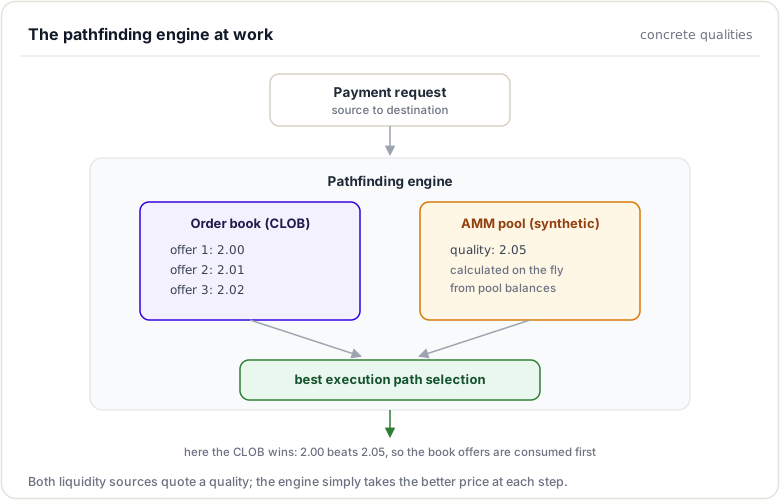
Key Components
| Component | Location | Purpose |
|---|---|---|
| AMMLiquidity | src/libxrpl/tx/paths/AMMLiquidity.cpp |
Generate synthetic offers |
| AMMOffer | src/libxrpl/tx/paths/AMMOffer.cpp |
Represent AMM offers |
| AMMContext | include/xrpl/tx/transactors/dex/AMMContext.h |
Track AMM state during payment |
| BookStep | src/libxrpl/tx/paths/BookStep.cpp |
Integrate AMM with order book |
AMMContext: State Management
In brief: per-payment bookkeeping and the iteration cap.
The AMMContext class tracks AMM usage during payment execution.
Location: include/xrpl/tx/transactors/dex/AMMContext.h
class AMMContext {
    AccountID account_;           // Transaction sender
    bool multiPath_;              // Using multiple paths?
    bool ammUsed_;               // AMM consumed this iteration?
    std::uint16_t ammIters_;     // AMM iteration counter

    constexpr static std::uint8_t MaxIterations = 30;

public:
    // Mark AMM offer as consumed
    void setAMMUsed() { ammUsed_ = true; }

    // Called after each iteration
    void update() {
        if (ammUsed_)
            ++ammIters_;
        ammUsed_ = false;  // Reset for next iteration
    }

    // Check iteration limit
    bool maxItersReached() const {
        return ammIters_ >= MaxIterations;
    }

    // Reset for new iteration
    void clear() { ammUsed_ = false; }
};
Iteration Limit
The 30-iteration limit prevents:
- Infinite loops in complex path finding
- Excessive computation for large payments
- Potential DoS through pathfinding abuse
AMMLiquidity: Offer Generation
In brief: building the synthetic offer that matches the book.
The AMMLiquidity class generates synthetic offers from AMM pools.
Location: src/libxrpl/tx/paths/AMMLiquidity.cpp
template <typename TIn, typename TOut>
class AMMLiquidity {
    AccountID ammAccountID_;
    std::uint32_t tradingFee_;
    Issue issueIn_;
    Issue issueOut_;
    TAmounts<TIn, TOut> initialBalances_;

public:
    // Get AMM offer for payment path
    std::optional<AMMOffer<TIn, TOut>>
    getOffer(ReadView const& view, AMMContext& ctx) const;

    // Fetch current pool balances
    TAmounts<TIn, TOut>
    fetchBalances(ReadView const& view) const;

    // Generate offer matching CLOB quality
    std::optional<TAmounts<TIn, TOut>>
    generateOfferForQuality(Quality const& quality) const;

    // Fibonacci sequence for multi-path
    std::optional<TAmounts<TIn, TOut>>
    generateFibSeqOffer(std::uint16_t iteration) const;
};
Offer Generation Strategies
Single Path Mode
When processing a single payment path, AMM offers are sized to match CLOB quality:
std::optional<AMMOffer<TIn, TOut>>
AMMLiquidity::getOffer(ReadView const& view, AMMContext& ctx) const
{
    // Get best CLOB offer quality
    auto const clobQuality = getBestCLOBQuality(view);

    // Generate AMM offer matching this quality
    auto const amounts = changeSpotPriceQuality(
        balances_,
        clobQuality,
        tradingFee_
    );

    if (!amounts)
        return std::nullopt;

    return AMMOffer<TIn, TOut>(*this, *amounts, balances_, quality);
}
Multi-Path Mode
For payments using multiple paths, Fibonacci sequence sizing prevents over-concentration:
std::optional<TAmounts<TIn, TOut>>
AMMLiquidity::generateFibSeqOffer(std::uint16_t iteration) const
{
    // Fibonacci fractions: 5/20000, 8/20000, 13/20000, 21/20000, ...
    static constexpr std::array<std::uint16_t, 10> fib = {
        5, 8, 13, 21, 34, 55, 89, 144, 233, 377
    };

    auto const fraction = Number(fib[iteration]) / 20000;
    auto const offerIn = balances_.in * fraction;
    auto const offerOut = swapAssetIn(balances_, offerIn, tradingFee_);

    return TAmounts{offerIn, offerOut};
}
AMMOffer: Synthetic Offer Representation
In brief: an offer object that exists only in memory.
The AMMOffer class represents an AMM-backed offer in the pathfinding system. Unlike CLOB offers which are stored on the ledger, AMMOffers are created dynamically during payment execution.
Location: src/libxrpl/tx/paths/AMMOffer.cpp
When Are AMMOffers Created?
AMMOffers are not ledger objects - they are synthetic, ephemeral offers generated on-the-fly:
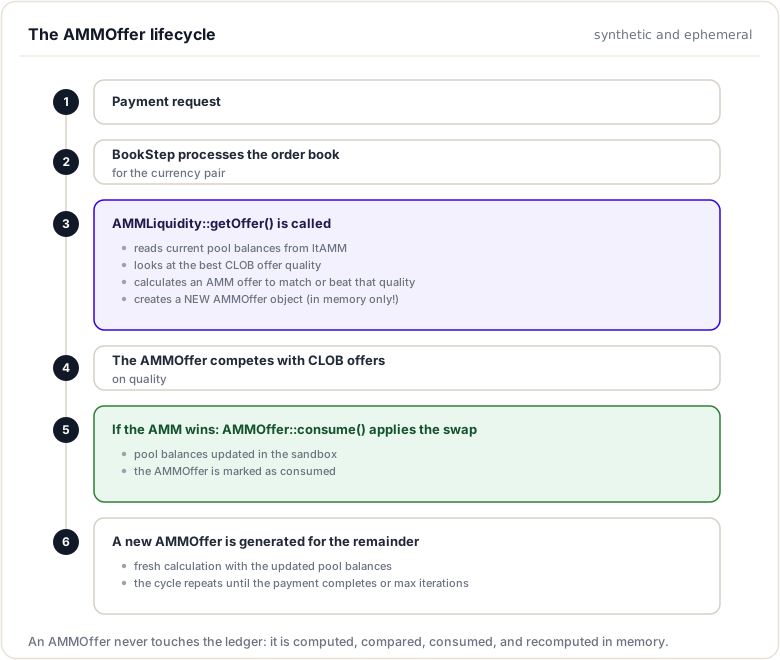
Key Insight: AMMOffers Are Ephemeral
| CLOB Offer | AMMOffer |
|---|---|
| Stored on ledger | Created in memory |
| Persists until filled/cancelled | Exists only during payment execution |
| Has explicit size | Size calculated dynamically |
| Fixed quality | Quality adapts to pool state |
| Created by OfferCreate tx | Created by AMMLiquidity::getOffer() |
How AMMOffers Are Sized
The size of an AMMOffer depends on the context:
Single-Path Mode:
// Match the best CLOB quality
auto amounts = changeSpotPriceQuality(pool, clobQuality, fee);
// AMMOffer is sized so that AFTER the trade,
// the pool's new spot price equals the CLOB quality
Multi-Path Mode:
// Use Fibonacci sequence to avoid over-consumption
// Iteration 0: 5/20000 of pool (0.025%)
// Iteration 1: 8/20000 of pool (0.04%)
// Iteration 2: 13/20000 of pool (0.065%)
// ... growing offers ensure gradual consumption
Structure
template <typename TIn, typename TOut>
class AMMOffer {
    AMMLiquidity<TIn, TOut> const& ammLiquidity_;
    TAmounts<TIn, TOut> amounts_;      // Offer amounts
    TAmounts<TIn, TOut> balances_;     // Current pool balances
    Quality quality_;                   // Spot price quality
    bool consumed_;                     // Has been consumed?

public:
    // Get offer quality (exchange rate)
    Quality quality() const { return quality_; }

    // Limit output to specific amount
    void limitOut(TOut const& limit);

    // Limit input to specific amount
    void limitIn(TIn const& limit);

    // Apply offer to AMM pool
    void consume();

    // Verify pool invariant after trade
    bool checkInvariant() const;
};
Quality Calculation
Quality AMMOffer::quality() const
{
    // Quality = out / in (how much you get per unit spent)
    return Quality(amounts_.out / amounts_.in);
}
Limiting Offers
When the payment doesn't need the full offer:
void AMMOffer::limitOut(TOut const& limit)
{
    if (limit < amounts_.out)
    {
        // Recalculate input for limited output
        amounts_.in = swapAssetOut(balances_, limit, tradingFee_);
        amounts_.out = limit;
    }
}

void AMMOffer::limitIn(TIn const& limit)
{
    if (limit < amounts_.in)
    {
        // Recalculate output for limited input
        amounts_.out = swapAssetIn(balances_, limit, tradingFee_);
        amounts_.in = limit;
    }
}
Consuming Offers
void AMMOffer::consume()
{
    // Mark as consumed
    consumed_ = true;

    // Update balances (for next iteration)
    balances_.in += amounts_.in;
    balances_.out -= amounts_.out;

    // Verify invariant
    assert(checkInvariant());
}
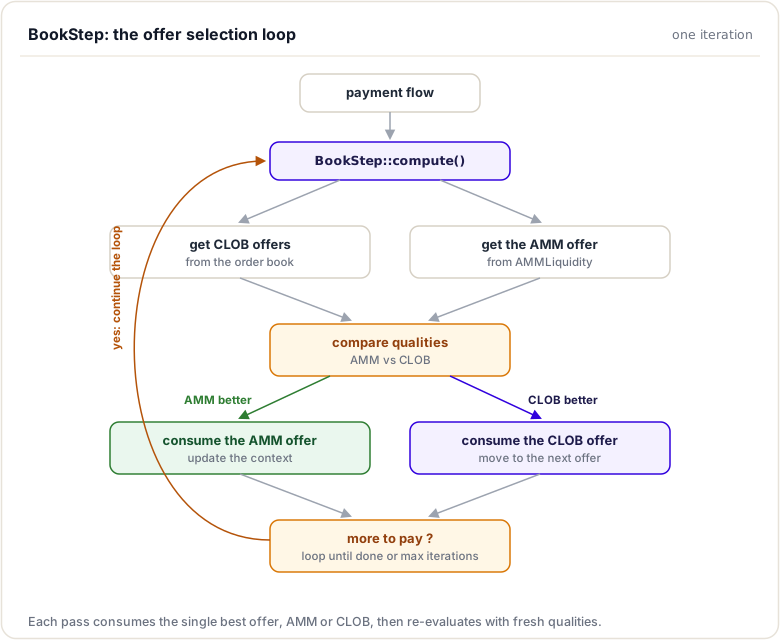
Integration with BookStep
In brief: where AMM and CLOB offers actually compete.
The BookStep class handles order book traversal, including AMM integration.
Location: src/libxrpl/tx/paths/BookStep.cpp
Processing Order
std::pair<TAmounts, bool>
BookStep::compute(
    PaymentSandbox& view,
    AMMContext& ammContext,
    ...)
{
    // 1. Get CLOB offers
    auto clobOffers = getOrderBookOffers(view);

    // 2. Get AMM offer (if available)
    auto ammOffer = ammLiquidity_.getOffer(view, ammContext);

    // 3. Interleave based on quality
    while (hasOffers())
    {
        // Compare qualities
        auto const clobQuality = clobOffers.front().quality();
        auto const ammQuality = ammOffer ? ammOffer->quality() : Quality{0};

        if (ammQuality >= clobQuality && ammOffer)
        {
            // Use AMM offer (better or equal quality)
            consumeAMMOffer(*ammOffer, ammContext);

            // Generate new AMM offer for remaining
            ammOffer = ammLiquidity_.getOffer(view, ammContext);
        }
        else
        {
            // Use CLOB offer
            consumeCLOBOffer(clobOffers.front());
            clobOffers.pop_front();
        }
    }

    return {totalConsumed, success};
}
Quality Competition
AMM and CLOB offers compete purely on quality (exchange rate):
If AMM quality >= CLOB quality:
    Use AMM offer
Else:
    Use CLOB offer
This ensures best execution regardless of liquidity source.
Multi-Path Payment Example
In brief: one payment split across book and pool.
Scenario
Payment: 10,000 XRP -> USD Available liquidity:
- CLOB: 5,000 XRP @ 2.00 USD/XRP
- CLOB: 3,000 XRP @ 1.98 USD/XRP
- AMM Pool: 100,000 XRP / 200,000 USD (spot: 2.00)
Execution
Iteration 1:
  - CLOB offer: 5,000 XRP @ 2.00
  - AMM offer: Generated to match 2.00 quality
  - Result: Split between both at equal quality

Iteration 2:
  - CLOB offer: 3,000 XRP @ 1.98
  - AMM offer: New quality after iteration 1
  - Result: CLOB wins (better quality)

Iteration 3:
  - Remaining: ~2,000 XRP
  - AMM fills remainder at current pool quality

Total: 10,000 XRP -> ~19,800 USD
(Blend of CLOB and AMM liquidity)
Flow Diagram
Performance Considerations
In brief: what all this costs per payment.
Iteration Limits
// Maximum AMM iterations per payment
constexpr std::uint8_t MaxIterations = 30;
Why 30?
- Balances payment quality with computation cost
- Prevents pathfinding abuse
- Sufficient for most payment sizes
Quality Caching
// Cache quality calculations to avoid recomputation
Quality cachedQuality_;
bool qualityValid_ = false;

Quality getQuality() {
    if (!qualityValid_) {
        cachedQuality_ = computeQuality();
        qualityValid_ = true;
    }
    return cachedQuality_;
}
Balance Snapshots
// Snapshot balances at start to avoid repeated ledger reads
TAmounts<TIn, TOut> initialBalances_;

AMMLiquidity(...) {
    initialBalances_ = fetchBalances(view);
}
Edge Cases
In brief: empty pools, one-sided deposits, and other corners.
Empty AMM Pool
if (balances_.in == 0 || balances_.out == 0)
    return std::nullopt;  // No offer available
Iteration Limit Reached
if (ammContext.maxItersReached())
    return std::nullopt;  // Stop using AMM
Quality Worse Than CLOB
if (ammQuality < minAcceptableQuality)
    return std::nullopt;  // Skip AMM for this path
Debugging Tips
In brief: seeing AMM decisions in logs and RPC output.
Tracing AMM Offers
Enable detailed logging:
JLOG(j_.trace()) << "AMM offer: "
    << "in=" << amounts_.in
    << " out=" << amounts_.out
    << " quality=" << quality_;
Verifying Integration
Check that AMM is being considered:
# In rippled logs
grep "AMM offer" debug.log
Testing Quality Competition
Create test scenarios with known CLOB and AMM qualities to verify correct selection.
References to Source Code
src/libxrpl/tx/paths/AMMLiquidity.cpp- Offer generationsrc/libxrpl/tx/paths/AMMOffer.cpp- Offer representationinclude/xrpl/tx/transactors/dex/AMMContext.h- State managementsrc/libxrpl/tx/paths/BookStep.cpp- Integration pointinclude/xrpl/ledger/helpers/AMMHelpers.h- Quality calculations
Cross-References
- AMM Architecture - Pool structure
- AMM Logic - Quality and swap formulas
- The complete transaction lifecycle module (Payment flow)
Summary
This module put the AMM to work through its seven transaction types (Create, Deposit, Withdraw, Vote, Bid, Delete, Clawback) and showed how pool liquidity reaches traders. Rather than being walled off, an AMM appears to pathfinding as synthetic offers, so a payment can route through pools and the order book together.
To remember:
- Seven transactions: AMMCreate, AMMDeposit, AMMWithdraw, AMMVote, AMMBid, AMMDelete, AMMClawback
- Deposit and withdraw come in proportional (both assets) and single-asset (with an implied swap) modes
- AMMCreate builds the pool, the pseudo-account and the LP token, and costs a special (burned) fee
- AMMBid spends LP tokens to win the auction slot's discounted trading fee
- Pathfinding sees pools as synthetic offers: a payment can route through AMMs and the order book together
- Inspect a live pool with the
amm_infoRPC - AMM-specific failures use the
tecAMM_*family - Watch out: a single-asset deposit IS partly a swap; it moves the price and pays slippage even though you are "just adding liquidity"
Next up. You have seen what a big extension looks like. How does such a thing ever go live on a network nobody controls? Next: the amendment system.
Resources
Assignments
0 of 2 completeUnlocks
Finishing this module opens up: