
The amendment lifecycle
The path of an amendment from introduction through majority to activation.
What you'll learn
- Trace an amendment's states and the 80% / two-week rule.
- Understand `tfGotMajority` / `tfLostMajority` and the Change pseudo-transaction.
- Explain amendment-blocked mode.
Introduction
≈45 min · Intermediate · builds on Amendments — overview & architecture
Let's follow one amendment from idea to activation. In this module you'll trace its states through the 80%-for-two-weeks rule, the tfGotMajority / tfLostMajority flags and the EnableAmendment pseudo-transaction, and learn what 'amendment-blocked' means for a node that falls behind. Governance as a state machine.
Lifecycle Overview
In brief: the phases an amendment moves through from idea to enabled.
The lifecycle of an amendment can be represented by the following phases:
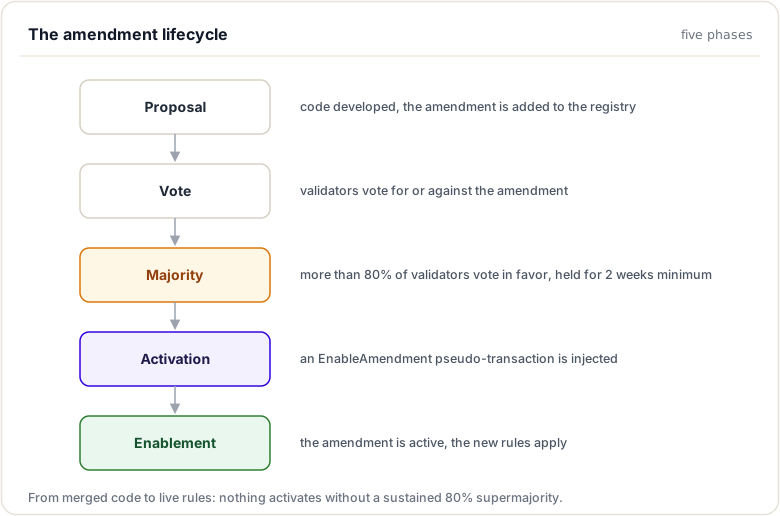
Each phase has specific criteria that must be satisfied before moving to the next. Let's now explore each phase in detail following the Subscriptions example.
Note. "Subscriptions" is used across these amendment modules purely as a hypothetical running example, to make the process concrete. It is not a real, shipped XRPL amendment; its transactors and fields are illustrative, not code you will find in rippled.
Phase 1: Proposal
Code Development
The first phase begins with the development of code that implements the new functionality. For Subscriptions (XLS-0078), this includes:
New data structures:
- Ledger entry type
ltSUBSCRIPTION(0x0055) to store recurring payment authorizations - New fields:
sfAccount: Subscription owner accountsfDestination: Subscription receiver accountsfDestinationTag(optional): Tag to categorize paymentssfAmount: Maximum amount that can be withdrawn per periodsfFrequency: Interval in seconds between periodssfNextPaymentTime: Timestamp of next possible claimsfExpiration(optional): Timestamp of last possible period
New transactions:
ttSUBSCRIPTION_SET: Create or modify a subscription (creation requires Destination, Amount, Frequency)ttSUBSCRIPTION_CLAIM: Claim a payment within available balance limitsttSUBSCRIPTION_CANCEL: Cancel an existing subscription (owner or destination can initiate)
Validation logic:
- Checks in
preflight,preclaim, anddoApply - Management of amounts per period (≤ Amount)
- Support for XRP, IOUs (with trustlines and transfer rates), and MPTs (Multi-Purpose Tokens)
- Arrears management: if a period passes without claim, the opportunity is lost and NextPaymentTime advances by one Frequency interval
- Single claim per period to avoid spam
- Respect freeze states (IOU) and lock (MPT)
- Auto-creation of trustlines and MPToken holdings if authorizations and reserves are sufficient
Reference: XLS-0078 Subscriptions
Amendment Registration
Once the code is ready, the amendment is registered in the system via features.macro:
XRPL_FEATURE(Subscriptions, Supported::Yes, VoteBehavior::DefaultNo)
Parameters:
Subscriptions: Amendment nameSupported::Yes: The code is included and supportedVoteBehavior::DefaultNo: By default, nodes do not vote for (requires explicit activation)
Hash Calculation
The amendment hash is calculated automatically:
Name: "Subscriptions"
Method: SHA-512Half(name)
Hash: 7B73B9E8D8E6E8E8A8B8C8D8E8F8A8B8C8D8E8F8A8B8C8D8E8F8A8B8C8D8E8F8
This hash is the unique identifier that will be used in all network communications and data structures.
Code Distribution
The code containing the new amendment is distributed via:
- A new version of rippled (e.g., 2.3.0)
- Publication on GitHub with detailed release notes
- Announcements on community communication channels
- Documentation on XRPL.org and link to XLS-0078
At this stage, the amendment exists in the code but is not yet enabled. Nodes that update to this version recognize the amendment but do not apply it yet.
Phase 2: Vote
In brief: validators include their support in the validation issued just before each flag ledger.
Vote Activation by Validators
Validators must explicitly activate their vote for the amendment. This is typically done via the RPC command feature:
# Vote for the amendment
xrpld feature 7B73B9E8D8E6E8E8A8B8C8D8E8F8A8B8C8D8E8F8A8B8C8D8E8F8A8B8C8D8E8F8 accept
Or by modifying the configuration file:
[amendments]
7B73B9E8D8E6E8E8A8B8C8D8E8F8A8B8C8D8E8F8A8B8C8D8E8F8A8B8C8D8E8F8
Inclusion in Validations
Once a validator has activated their vote, the vote is not attached to every validation. It is attached only to the validation of a voting ledger — the ledger immediately before a flag ledger. In RCLConsensus.cpp, the validation-building code checks ledger.ledger->isVotingLedger() before setting sfAmendments; Ledger::isVotingLedger() returns true when the next sequence is a multiple of kFlagLedgerInterval (256), i.e. for ledgers with seq ≡ 255 mod 256. So amendment votes travel once per 256-ledger cycle (roughly every 15 minutes), not each ledger. The validation contains:
// Simplified structure of a validation
struct STValidation {
    uint256 ledgerHash;           // Hash of validated ledger
    uint32 ledgerSeq;             // Sequence number
    NetClock::time_point signTime; // Signing moment
    PublicKey publicKey;          // Validator's public key

    // List of supported amendments
    // (present only when the validated ledger is a voting ledger)
    std::vector<uint256> amendments;

    // Validation signature
    Buffer signature;
};
The amendments field contains the list of all amendments the validator wishes to see enabled, including Subscriptions.
Vote Collection
Each node on the network collects validations received from trusted validators and extracts their amendment votes. The system maintains:
TrustedVotes: Structure that records the most recent votes seen from each trusted validator
class TrustedVotes {
private:
    // Associates each trusted validator with the last votes we saw
    // from them and an expiration for that record.
    struct UpvotesAndTimeout {
        std::vector<uint256> upVotes;
        std::optional<NetClock::time_point> timeout;
    };
    hash_map<PublicKey, UpvotesAndTimeout> recordedVotes_;

public:
    // Record the newest votes; expired records are cleared here.
    void recordVotes(
        Rules const& rules,
        std::vector<std::shared_ptr<STValidation>> const& valSet,
        NetClock::time_point const closeTime,
        beast::Journal j,
        std::scoped_lock<std::mutex> const& lock);

    // Aggregate: number of validators with live records, and
    // per-amendment vote counts.
    [[nodiscard]] std::pair<int, hash_map<uint256, int>>
    getVotes(Rules const& rules,
        std::scoped_lock<std::mutex> const& lock) const;
};
Note that the record is per validator, not a simple per-amendment counter: getVotes() produces the amendment → count aggregation on demand from the per-validator records.
Vote retention: A recorded vote stays live for 24 hours (kExpiresAfter = 24h in AmendmentTable.cpp). The purpose of retaining the last vote from each trusted validator is to avoid "flapping": if a validator loses synchronization near a flag ledger, its validations (and therefore its votes) may be missing for that round, which would otherwise make an amendment appear to repeatedly gain and lose support. By holding on to the last vote seen, the node assumes an offline validator did not change its position. Only after 24 hours with no validation from a validator does the node clear that validator's recorded upVotes (there is no separate expire() call — the cleanup happens inside recordVotes()).
Status Monitoring
During the voting phase, the status of Subscriptions can be queried via the RPC command feature:
{
  "7B73B9E8D8E6E8E8A8B8C8D8E8F8A8B8C8D8E8F8A8B8C8D8E8F8A8B8C8D8E8F8": {
    "count": 15,              // 15 validators vote for
    "enabled": false,         // Not yet enabled
    "name": "Subscriptions",
    "supported": true,        // This node supports the amendment
    "threshold": 20,          // threshold = floor(25 * 0.8) = 20
    "validations": 25,        // 25 trusted validators in total
  }
}
Interpretation:
- 15 out of 25 validators vote for Subscriptions (60%)
- The 80% threshold is not yet exceeded (need more than 20 votes, so minimum 21)
- The amendment is supported but not enabled
Note on threshold: The threshold field displays floor(validations * 0.8) = 20, but the comparison in the code uses votes > threshold, so 21 votes minimum are needed to reach majority.
Note on connection role: The count, validations, and threshold fields (and vetoed) are only returned on admin connections — in AmendmentTableImpl::injectJson they are gated on isAdmin. Querying a public server returns only name, enabled, and supported, plus majority when present (the majority field comes from the validated ledger's Majorities and is not admin-gated).
Phase 3: Majority
In brief: crossing 80% support starts a two-week stability countdown.
Exceeding the 80% Threshold
When enough validators activate their vote, the amendment exceeds the required threshold. Let's assume 6 additional validators activate their vote:
{
  "7B73B9E8D8E6E8E8A8B8C8D8E8F8A8B8C8D8E8F8A8B8C8D8E8F8A8B8C8D8E8F8": {
    "count": 21,              // 21 validators vote for (84%)
    "enabled": false,         // Still not enabled
    "majority": 805385181,    // ← NEW: XRPL timestamp when majority recorded
    "name": "Subscriptions",
    "supported": true,
    "threshold": 20,          // floor(25 * 0.8) = 20
    "validations": 25,
  }
}
The majority field: This is the critical moment. This field contains the XRPL Time (seconds since 2000-01-01 00:00:00 UTC) recorded as sfCloseTime when the tfGotMajority pseudo-transaction was applied. In Change::applyAmendment, the value written is view().parentCloseTime() — and since the pseudo-transaction lands in the ledger right after the flag ledger, this is the flag ledger's close time. Because votes are only tallied at flag-ledger boundaries, this is the moment the majority was first observed. In our example: 805385181 corresponds approximately to a date in 2025.
Support calculation: 21/25 = 84% > 80%
tfGotMajority Pseudo-transaction
Vote tallying and pseudo-transaction injection happen once per flag-ledger cycle: in RCLConsensus.cpp, when the previous ledger was a flag ledger (prevLedger->isFlagLedger()), AmendmentTable::doVoting runs and injects the amendment pseudo-transactions into the consensus transaction set. They therefore land in the ledger after the flag ledger (seq ≡ 1 mod 256) — the flag ledger itself contains no amendment pseudo-transactions. At the first such voting round where the tally exceeds the threshold, an EnableAmendment pseudo-transaction with the tfGotMajority flag is injected:
{
  "TransactionType": "EnableAmendment",
  "Account": "rrrrrrrrrrrrrrrrrrrrrhoLvTp",  // Special network account
  "Amendment": "7B73B9E8D8E6E8E8A8B8C8D8E8F8A8B8C8D8E8F8A8B8C8D8E8F8A8B8C8D8E8F8",
  "Flags": 65536,  // tfGotMajority = 0x00010000
  "LedgerSequence": 85432065,
  "TransactionIndex": 0
}
Impact on ledger: This pseudo-transaction adds an entry to the sfMajorities field of the Amendments singleton ledger entry (ltAMENDMENTS, addressed by keylet::amendments()):
{
  "Majorities": [
    {
      "Amendment": "7B73B9E8D8E6E8E8A8B8C8D8E8F8A8B8C8D8E8F8A8B8C8D8E8F8A8B8C8D8E8F8",
      "CloseTime": 805385181
    }
  ]
}
Two-Week Stability Period
From this moment, the amendment enters a mandatory stability period. The hold is purely time-based: kDefaultAmendmentMajorityTime = weeks{2} in SystemParameters.h.
How the duration is enforced:
- At each flag-ledger voting round,
AmendmentTableImpl::doVotingcompares theCloseTimerecorded insfMajoritiesplus the majority time against the ledger close time: the enable action fires whenhasLedgerMajority && ((*majorityTime + majorityTime_) <= closeTime) - The flag-ledger cadence (
kFlagLedgerInterval = 256ledgers, roughly every 15 minutes) only sets where the check happens, not the duration - The duration is configurable per network via
[amendment_majority_time]in the config file (minimum 15 minutes); on mainnet it is the default 2 weeks
Reason for the period: This window allows:
- Node operators to prepare and update their systems
- The community to detect any potential problems
- Exchanges and wallets to adapt their integrations to support subscriptions
- A last opportunity for validators to withdraw their vote if necessary
Loss of Majority (Edge Case)
If during the stability period support falls below 80%, the amendment loses its majority. An EnableAmendment pseudo-transaction with the tfLostMajority flag is injected:
{
  "TransactionType": "EnableAmendment",
  "Account": "rrrrrrrrrrrrrrrrrrrrrhoLvTp",
  "Amendment": "7B73B9E8D8E6E8E8A8B8C8D8E8F8A8B8C8D8E8F8A8B8C8D8E8F8A8B8C8D8E8F8",
  "Flags": 131072,  // tfLostMajority = 0x00020000
  "LedgerSequence": 85434881
}
The majority field disappears from the amendment status, and the countdown restarts from zero if the threshold is reached again.
Key idea. The 80%-for-two-weeks rule is deliberate friction: it gives operators time to upgrade before a change goes live, so nobody is caught out.
Phase 4: Activation
In brief: an EnableAmendment pseudo-transaction turns the amendment on.
Expiration of Stability Period
After two weeks of uninterrupted majority, the amendment is ready to be activated. The network detects this at the flag-ledger voting rounds: the amendment is enabled at the first round whose close time satisfies CloseTime (from sfMajorities) + amendmentMajorityTime ≤ close time.
EnableAmendment Pseudo-transaction
At the first flag-ledger voting round after the period expires, an EnableAmendment pseudo-transaction without flags is injected into the ledger following the flag ledger (seq ≡ 1 mod 256):
{
  "TransactionType": "EnableAmendment",
  "Account": "rrrrrrrrrrrrrrrrrrrrrhoLvTp",
  "Amendment": "7B73B9E8D8E6E8E8A8B8C8D8E8F8A8B8C8D8E8F8A8B8C8D8E8F8A8B8C8D8E8F8",
  "Flags": 0,  // No flag = activation
  "LedgerSequence": 85987585,
  "TransactionIndex": 0,
  "hash": "491378DA1BAAE870A6C247B3E42193E80E507A50858A4E51217685E2765E6CE8"
}
Processing by Change::applyAmendment: This pseudo-transaction is processed by the Change::applyAmendment() function in src/libxrpl/tx/transactors/system/Change.cpp:
TER
Change::applyAmendment()
{
    // Extract the amendment hash from the transaction
    uint256 const amendment(ctx_.tx.getFieldH256(sfAmendment));

    // Retrieve the key of the Amendments singleton ledger entry
    auto const k = keylet::amendments();

    // Read or create the amendments object
    SLE::pointer amendmentObject = view().peek(k);

    if (!amendmentObject)
    {
        // If the object doesn't exist yet, create it (rare)
        amendmentObject = std::make_shared<SLE>(k);
        view().insert(amendmentObject);
    }

    // Read the list of already enabled amendments
    STVector256 amendments = amendmentObject->getFieldV256(sfAmendments);

    // Check if this amendment is already enabled
    if (std::ranges::find(amendments, amendment) != amendments.end())
        return tefALREADY;  // Already enabled, do nothing

    // Read the flags from the transaction
    bool const gotMajority = ctx_.tx.isFlag(tfGotMajority);
    bool const lostMajority = ctx_.tx.isFlag(tfLostMajority);

    // Check flag consistency (can't have both)
    if (gotMajority && lostMajority)
        return temINVALID_FLAG;

    // Prepare a new majorities array
    STArray newMajorities(sfMajorities);

    // Iterate through existing majorities to update
    bool found = false;
    if (amendmentObject->isFieldPresent(sfMajorities))
    {
        STArray const& oldMajorities =
            amendmentObject->getFieldArray(sfMajorities);
        for (auto const& majority : oldMajorities)
        {
            if (majority.getFieldH256(sfAmendment) == amendment)
            {
                if (gotMajority)
                    return tefALREADY;  // Already recorded as majority
                found = true;  // Found, don't copy it (lost majority)
            }
            else
            {
                // pass through
                newMajorities.pushBack(majority);
            }
        }
    }

    // If lostMajority but not in list, error
    if (!found && lostMajority)
        return tefALREADY;

    if (gotMajority)
    {
        // This amendment now has a majority
        newMajorities.pushBack(STObject::makeInnerObject(sfMajority));
        auto& entry = newMajorities.back();
        entry[sfAmendment] = amendment;
        entry[sfCloseTime] =
            view().parentCloseTime().time_since_epoch().count();

        // Warn if amendment is not supported by this node
        if (!ctx_.registry.get().getAmendmentTable().isSupported(amendment))
        {
            JLOG(j_.warn()) << "Unsupported amendment " << amendment
                            << " received a majority.";
        }
    }
    else if (!lostMajority)
    {
        // No flags, enable amendment
        amendments.pushBack(amendment);
        amendmentObject->setFieldV256(sfAmendments, amendments);

        // Enable locally in AmendmentTable
        ctx_.registry.get().getAmendmentTable().enable(amendment);

        // Check if supported - block node if not supported
        if (!ctx_.registry.get().getAmendmentTable().isSupported(amendment))
        {
            JLOG(j_.error()) << "Unsupported amendment " << amendment
                             << " activated: server blocked.";
            ctx_.registry.get().getOPs().setAmendmentBlocked();
        }
    }

    // Update the sfMajorities field
    if (newMajorities.empty())
    {
        amendmentObject->makeFieldAbsent(sfMajorities);  // Remove if empty
    }
    else
    {
        amendmentObject->setFieldArray(sfMajorities, newMajorities);
    }

    // Save changes to ledger
    view().update(amendmentObject);

    return tesSUCCESS;
}
Ledger Update
The amendment is added to the sfAmendments field of the Amendments singleton ledger entry:
{
  "Amendments": [
    "...",  // Other already enabled amendments
    "7B73B9E8D8E6E8E8A8B8C8D8E8F8A8B8C8D8E8F8A8B8C8D8E8F8A8B8C8D8E8F8"
  ]
}
The corresponding entry is removed from the sfMajorities field since the amendment is no longer pending.
Phase 5: Enablement
Application of New Rules
As soon as the amendment is added to the sfAmendments field, all new transactions and all new ledgers must apply the Subscriptions rules.
For Subscriptions (XLS-0078), this means:
ttSUBSCRIPTION_SETtransactions are now valid and can be submitted to create/modify subscriptionsttSUBSCRIPTION_CLAIMtransactions can claim payments within available balance limitsttSUBSCRIPTION_CANCELtransactions can cancel existing subscriptions- The ledger can contain
ltSUBSCRIPTIONobjects (type 0x0055) - Logic for managing periods, balances, and arrears is activated
- Support for XRP, IOUs with trustlines, and MPTs with their specific rules
Rules Object Construction
The state of amendments is encapsulated in the Rules object which is constructed for each ledger:
class Rules {
private:
    std::set<uint256> enabledAmendments_;

public:
    bool enabled(uint256 const& amendment) const {
        return enabledAmendments_.count(amendment) > 0;
    }
};
Transactors and ledger logic consult this object to know which rules to apply:
// In SubscriptionSet::preflight()
NotTEC SubscriptionSet::preflight(PreflightContext const& ctx) {
    if (!ctx.rules.enabled(featureSubscriptions))
        return temDISABLED;

    // ... rest of validation
}
Final Status
The amendment status after activation simplifies:
{
  "7B73B9E8D8E6E8E8A8B8C8D8E8F8A8B8C8D8E8F8A8B8C8D8E8F8A8B8C8D8E8F8": {
    "enabled": true,          // ← Amendment active
    "name": "Subscriptions",
    "supported": true
  }
}
The fields count, threshold, validations, majority disappear because they are no longer relevant once the amendment is enabled.
Complete Timeline: Concrete Example
Here is a realistic timeline for Subscriptions on mainnet:
2025-03-01: Release of rippled 2.3.0 including Subscriptions (XLS-0078)
- Code distributed, nodes begin to update
- Publication of detailed documentation on XRPL.org
2025-03-15: First validators activate their vote
- 5 out of 35 validators vote for (14%)
2025-04-01: Growing momentum
- 20 out of 35 validators vote for (57%)
- Exchanges and wallets begin to prepare their integrations
2025-04-20 14:32:15 UTC: Threshold exceeded
- 29 out of 35 validators vote for (82.9% > 80%)
majorityfield appears with timestamp806021535tfGotMajoritypseudo-transaction injected at ledger 86245633 (the ledger after the flag ledger)
2025-04-20 → 2025-05-04: Stability period
- 2 weeks mandatory waiting
- Support remains stable above 80%
- Final tests on staging environments
2025-05-04 14:41:02 UTC: Activation
- The enable fires at the first flag-ledger voting round at or after the two-week mark, so up to one flag-ledger cycle (~15 minutes) later than the exact anniversary
EnableAmendmentpseudo-transaction (without flag) injected at ledger 86652161- Subscriptions added to
sfAmendmentsfield
2025-05-04 14:41:05 UTC: Enablement
- First ledger with Subscriptions active
- First
ttSUBSCRIPTION_SETtransactions processed - Users can now create subscriptions for recurring payments
State Transition Management
doValidatedLedger: Local Synchronization
After each validated ledger, the amendment table synchronizes its local state with the ledger state. The interface (include/xrpl/ledger/AmendmentTable.h) provides a wrapper that takes the validated ledger, skips the work unless a flag-ledger boundary was crossed (needValidatedLedger()), and extracts the ledger's data with the free functions getEnabledAmendments() and getMajorityAmendments():
/** Called when a new fully-validated ledger is accepted. */
void
doValidatedLedger(std::shared_ptr<ReadView const> const& lastValidatedLedger)
{
    if (needValidatedLedger(lastValidatedLedger->seq()))
    {
        doValidatedLedger(
            lastValidatedLedger->seq(),
            getEnabledAmendments(*lastValidatedLedger),
            getMajorityAmendments(*lastValidatedLedger));
    }
}
The implementation (src/xrpld/app/misc/detail/AmendmentTable.cpp) enables locally everything the ledger says is enabled, then scans the pending majorities to compute firstUnsupportedExpected_ — the earliest time an amendment this node does not support could become enabled, which drives the "amendment warned" state:
void
AmendmentTableImpl::doValidatedLedger(
    LedgerIndex ledgerSeq,
    std::set<uint256> const& enabled,
    majorityAmendments_t const& majority)
{
    for (auto& e : enabled)
        enable(e);

    std::scoped_lock const lock(mutex_);

    // Remember the ledger sequence of this update.
    lastUpdateSeq_ = ledgerSeq;

    // Since we have the whole list in `majority`, reset the time flag, even
    // if it's currently set. If it's not set when the loop is done, then any
    // prior unknown amendments have lost majority.
    firstUnsupportedExpected_.reset();
    for (auto const& [hash, time] : majority)
    {
        AmendmentState const& s = add(hash, lock);

        if (s.enabled)
            continue;

        if (!s.supported)
        {
            JLOG(j_.info()) << "Unsupported amendment " << hash
                            << " reached majority at " << to_string(time);
            if (!firstUnsupportedExpected_ || firstUnsupportedExpected_ > time)
                firstUnsupportedExpected_ = time;
        }
    }
    if (firstUnsupportedExpected_)
        firstUnsupportedExpected_ = *firstUnsupportedExpected_ + majorityTime_;
}
This synchronization ensures that the node's internal state always reflects the validated ledger state.
Detection of Unsupported Amendments
If an amendment is enabled but the local node does not support it, the node enters "amendment blocked" mode. This happens in two places. First, when the pseudo-transaction is applied, Change::applyAmendment blocks the node directly (see the listing above):
if (!ctx_.registry.get().getAmendmentTable().isSupported(amendment))
{
    JLOG(j_.error()) << "Unsupported amendment " << amendment
                     << " activated: server blocked.";
    ctx_.registry.get().getOPs().setAmendmentBlocked();
}
Second, LedgerMaster::setValidLedger re-checks after every call to doValidatedLedger — this catches a node that acquired an already-enabled ledger rather than applying the pseudo-transaction itself:
app_.getAmendmentTable().doValidatedLedger(l);
if (!app_.getOPs().isBlocked())
{
    if (app_.getAmendmentTable().hasUnsupportedEnabled())
    {
        JLOG(journal_.error()) << "One or more unsupported amendments "
                                  "activated: server blocked.";
        app_.getOPs().setAmendmentBlocked();
    }
    // ...
}
This protects network integrity by preventing an outdated node from applying incorrect rules.
Special Cases and Edge Cases
Changes in UNL List
If the list of trusted validators (UNL) changes during the voting or majority phase, the threshold calculation adapts dynamically:
- If validators are added to the UNL, the absolute threshold increases
- If validators are removed, the threshold decreases
- An amendment can lose its majority if enough validators supporting the amendment leave the UNL
Rollback and Contingency
There is no mechanism to disable an amendment once enabled. If a critical problem is discovered after activation:
- A fix must be developed and deployed via a new amendment
- Or a security patch must be distributed urgently
- In extreme cases, out-of-band coordination may be necessary
This is why the two-week stability period is crucial: it offers a last opportunity to detect problems before irreversible activation.
Summary
This module followed one amendment from proposal to activation. You traced its states through the rule that 80% of trusted validators must support it continuously for two weeks, the tfGotMajority / tfLostMajority flags, and the EnableAmendment pseudo-transaction that finally turns it on. You also learned what amendment-blocked means for a node that falls behind: it stops processing to avoid diverging from the network.
To remember:
- Phases: proposal, vote, majority, activation, enablement
- The rule: MORE than 80% of trusted validators, held continuously for two weeks (
kDefaultAmendmentMajorityTime) tfGotMajoritymarks the threshold crossing (timer starts);tfLostMajoritymarks a drop (timer resets)EnableAmendmentpseudo-transactions (processed by theChangetransactor) record it on-ledger; the flaglessEnableAmendmentfinally switches it on- After enablement, nodes that do not support the amendment become amendment-blocked and stop processing
- Votes travel in the validation just before each flag ledger (once per 256-ledger cycle) and recorded votes are retained for 24 hours
- Track it live:
feature <hash>shows count vs threshold and the majority timestamp (count/threshold/validations require an admin connection) - Watch out: losing majority resets the two-week clock entirely; support must be continuous, not cumulative
Next up. Activation is not just protocol, it is people. Next: voting and network coordination, how the ecosystem actually rolls a change out.
Resources
Assignments
0 of 2 complete