
Advanced RPC features
Subscriptions, WebSocket streams and gRPC — beyond simple request / response.
What you'll learn
- Implement subscription and streaming behaviour.
- Understand the WebSocket and gRPC paths.
- Handle advanced handler concerns.
Introduction
≈45 min · Intermediate · builds on Testing RPC handlers
Request-and-response is only the beginning. In this module you'll go further: subscriptions and WebSocket streams that push updates as they happen, batch requests, and the basics of the gRPC path. These are the features behind the real-time explorers, wallets and dashboards built on XRPL.
Streaming Responses
In brief: send large results incrementally instead of all at once.
Streaming lets a handler send multiple response chunks over a single connection, useful for large result sets or real-time updates. Three patterns exist:
| Pattern | Transport | When to use |
|---|---|---|
| Progress messages | WebSocket | long-running queries, keep the client informed |
| Pagination with a marker | any | large result sets, client-controlled pace |
| Chunked encoding | HTTP | large single responses without WebSocket |
The pagination pattern is the one you will meet everywhere in rippled's own handlers (account_lines, account_objects, ledger_data):
Json::Value doPagedStream(RPC::JsonContext& context)
{
    // 1. Read and cap the page size
    unsigned int pageSize = std::min(
        context.params.get("limit", 100).asUInt(), 1000u);

    // 2. Resume where the previous page stopped
    std::string marker = context.params.get("marker", "").asString();

    // 3. Fetch one page from the ledger ...
    // 4. If more results remain, return a new marker
    Json::Value response;
    response[jss::status] = jss::success;
    response["items"] = items;
    if (!nextMarker.empty())
        response["marker"] = nextMarker;   // client sends it back for page 2
    return response;
}
What this code shows:
- the server never holds state between pages: the
markercarries the position - limits are always capped server-side, whatever the client asks for
- the last page is signalled by the absence of a marker
Subscription Mechanisms
In brief: push updates to clients as ledgers, transactions, and validations happen.
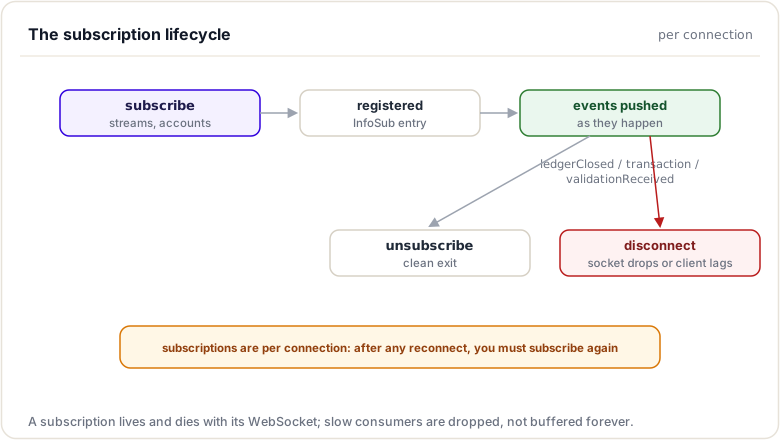
A client subscribes once, then receives typed push messages. The three core streams:
| Stream | Push message type |
Fired when |
|---|---|---|
ledger |
ledgerClosed |
a ledger closes (index, hash, fees, txn count) |
transactions / accounts |
transaction |
a transaction is applied (tx JSON + metadata) |
validations |
validationReceived |
a validation message arrives from a validator |
A ledgerClosed push looks like this:
{
    "type": "ledgerClosed",
    "ledger_index": 12345,
    "ledger_hash": "...",
    "fee_base": 12,
    "reserve_base": 10000000,
    "txn_count": 45
}
The subscribe handler, reduced to its skeleton
The real implementation lives in src/xrpld/rpc/handlers/subscribe/Subscribe.cpp; the shape is:
Json::Value doSubscribe(RPC::JsonContext& context)
{
    // 1. At least one subscription target is required
    if (!context.params.isMember("streams") &&
        !context.params.isMember("accounts"))
        return rpcError(RpcInvalidParams);

    // 2. Validate each stream name against the known set
    //    (ledger, transactions, validations, server, ...)

    // 3. Validate each account with parseBase58<AccountID>
    //    and reject the whole request on the first bad one

    // 4. Register the subscriptions with InfoSub
    //    (the transport layer owns the connection state)

    Json::Value response;
    response[jss::status] = jss::success;
    return response;
}
What matters here:
- validation is all-or-nothing: one malformed account rejects the request
- the handler never stores connection state itself;
InfoSubdoes unsubscribemirrors the same shape and removes the entries
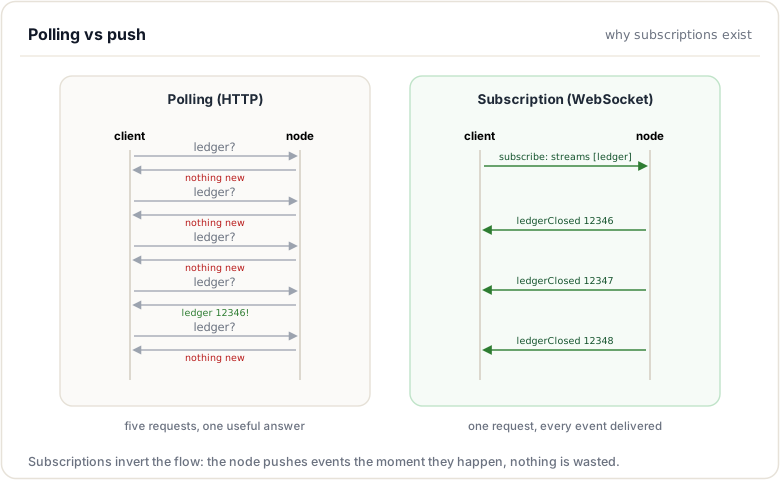
Key idea. Subscriptions flip the model: instead of the client polling, the node pushes updates as they happen. This is what powers live explorers and wallets.
Batch Request Processing
In brief: handle several commands in a single request.
A batch is simply an array of standard requests, each with its own id. Note that rippled itself does not accept JSON-RPC batch arrays natively: batching is a client- or proxy-side pattern, and the processor sketched below is what such a gateway implements:
[
    { "method": "account_info", "params": [{"account": "rN7n..."}], "id": 1 },
    { "method": "ledger", "params": [{"ledger_index": "validated"}], "id": 2 }
]
The processor loops over the array, dispatches each entry through the normal handler table, and collects the results:
Json::Value processBatchRequests(RPC::JsonContext& context)
{
    Json::Value batchResults(Json::arrayValue);
    for (auto const& request : context.params)
    {
        // build a child JsonContext for this entry,
        // look up the handler by request["method"], run it,
        // and catch exceptions so one failure never kills the batch
        Json::Value itemResult = /* dispatch(request) */;
        itemResult["id"] = request.get("id", Json::Value::null);
        batchResults.append(itemResult);
    }
    return batchResults;   // one array in, one array out
}
Rules a good batch processor follows:
- each entry gets its own error handling: one bad request must not fail the batch
- results carry the caller's
idso responses can be matched out of order - the ledger is resolved once and shared across entries (the big win)
- the batch size counts against resource limits like any other request
gRPC Integration Basics
In brief: the gRPC path alongside JSON-RPC and WebSocket.
rippled also exposes a binary gRPC API, defined in protobuf under include/xrpl/proto/org/xrpl/rpc/v1. A service is a set of typed request/response pairs:
service XRPLedgerAPIService {   // the real name in xrp_ledger.proto
    rpc GetAccountInfo(GetAccountInfoRequest)
        returns (GetAccountInfoResponse);
}

message GetAccountInfoRequest {
    string account = 1;
    string ledger_index = 2;
}

message GetAccountInfoResponse {
    string balance = 2;
    uint32 sequence = 3;
    bool validated = 5;
}
The server-side implementation is a thin adapter around the JSON handlers:
grpc::Status GetAccountInfo(grpc::ServerContext* ctx,
    GetAccountInfoRequest const* request,
    GetAccountInfoResponse* response) override
{
    // 1. Convert the protobuf request into Json::Value params
    // 2. Build an RPC::JsonContext and call doAccountInfo()
    // 3. Map a JSON error onto grpc::StatusCode::INVALID_ARGUMENT
    // 4. Copy the JSON fields into the typed protobuf response
    response->set_balance(result["balance"].asString());
    return grpc::Status::OK;
}
Three things to remember about the gRPC path:
- it listens on its own port (configured in
[port_grpc]), separate from HTTP/WS - handlers reuse the JSON implementations: gRPC is a translation layer, not a fork
- clients get generated, typed stubs in any language from the same
.protofiles
Broadcasting Updates
When a ledger closes or a transaction applies, the server side walks the subscriber lists and pushes the typed message to every matching connection:
void broadcastLedgerClosed(std::shared_ptr<Ledger const> const& ledger,
                           NetworkOPs& netOps)
{
    Json::Value message;
    message["type"] = "ledgerClosed";
    message[jss::ledger_index] = ledger->info().seq;
    message["ledger_hash"] = to_string(ledger->hash());
    netOps.broadcastMessage(message);   // fan-out to subscribers
}
Transaction broadcasts work the same way, but fan out only to the connections subscribed to the affected accounts.
Performance Considerations
Advanced features multiply load, so every one of them ships with a guard rail:
| Guard rail | Typical value | Protects against |
|---|---|---|
| Max items per streamed page | 1,000-10,000 | one query monopolising the node |
| Max subscriptions per connection | ~100 | subscriber list explosion |
| Slow-consumer drop | transport-level | one lagging client blocking the fan-out |
| Shared ledger per batch | 1 lookup | repeated ledger resolution |
The pattern is always the same: cap the work per request, push the continuation cost back to the client (markers), and never let one connection degrade the others.
Summary
This module went beyond simple request and response. You saw subscriptions and WebSocket streaming, where the node pushes updates as ledgers, transactions, and validations happen, along with batch requests and the basics of the gRPC path. These are the features behind the real-time explorers, wallets, and dashboards built on XRPL.
To remember:
subscribestreams:ledger,transactions,validations,server, plus per-account variants- Push messages to know:
ledgerClosed,transaction,validationReceived - Streams exist on WebSocket only, not HTTP
- Batch = an array of requests processed in one round trip
- gRPC services are proto-defined (
org.xrpl.rpc.v1) on their own port InfoSubis the server-side subscription machinery- Slow consumers get dropped: design clients to keep up or buffer
- Watch out: subscriptions are per-connection; after a WebSocket reconnect you MUST re-subscribe
Next up. RPC closed. New phase, the heart of the system: before studying how nodes agree, look closely at the thing they agree ON. Next: ledger architecture and data structures.
Resources
Assignments
0 of 2 complete