
State-management foundations
Why blockchain state needs a cryptographic commitment, and the tree / Merkle / Patricia-trie foundations behind XRPL's SHAMap.
What you'll learn
- Explain why naive state storage fails for a trustless network.
- Understand cryptographic hashing, Merkle trees and radix-16 Patricia tries.
- Connect these foundations to SHAMap's design.
Introduction
≈60 min · Intermediate · builds on Protocols & wire messages
Before you meet XRPL's clever state structures, it's worth understanding the problem they solve. In this module you'll see why a naive database can't work for a trustless network, and build up the ideas (cryptographic hashing, Merkle trees, radix-16 Patricia tries) that make verifiable, efficiently-syncable state possible. Get these foundations and the SHAMap, coming next, will feel inevitable rather than magical.
The Naive Approach: What Fails
In brief: a plain key-value store cannot prove its state is correct to an untrusting network.
Let's consider what happens if you store blockchain state like a simple key-value database:
State Storage:
accounts = {
  "rN7n7otQDd6FczFgLdlqtyMVrn3LNU8B4C": { balance: 100 XRP, ... },
  "rLHzPsX6oXkzU2qL12kHCH8G8cnZv1rBJh": { balance: 50 XRP, ... },
  "r3kmLJN5D28dHuH8vZvVrDjiV5sNSiUQXD": { balance: 75 XRP, ... },
  ...
}
Transaction Processing:
- Validator receives transaction: send 10 XRP from Alice to Bob
- Validator checks Alice's balance (100 XRP available)
- Validator updates Alice's balance to 90 XRP
- Validator updates Bob's balance to 60 XRP
- State is now modified
The Problem: No Verification
Without a cryptographic commitment to the state, any node can claim any state is correct:
Alice broadcasts: "My balance is 1,000,000 XRP"
Bob broadcasts: "My balance is 1,000,000 XRP"
Charlie broadcasts: "Everyone's balance is 0 XRP"

Which is correct? Without a central authority, there's no way to know.
The Problem: Expensive Synchronization
A new node joining the network needs to learn the current state. With naive storage:
- New node requests: "Send me all account state"
- Network sends millions of accounts, gigabytes of data
- New node has no way to verify this data is correct
- Process takes hours or days
The Requirement: Cryptographic Commitment
In brief: you need one hash that commits to the entire state, authentically and completely.
Blockchain state needs a cryptographic commitment: a single value that guarantees:
- Authenticity: The value commits to the actual state (not a forgery)
- Completeness: All accounts are included (not cherry-picked)
- Uniqueness: Only one commitment can represent a given state
This is what cryptographic hashes provide:
uint256 stateHash = hashFunction(serializeAllState());
Now a validator can broadcast: "The current state root is 0xAB12EF..."
Other nodes can verify this is correct by computing the same hash. If someone tries to cheat with different state, the hash will be different.
The Trade-off Problem:
But hashing all state from scratch has a terrible cost:
- Every account lookup requires computing the hash of all million accounts
- Synchronizing with a peer requires hashing millions of accounts multiple times
- A single account change requires rehashing everything
- Performance becomes prohibitive
The SHAMap Solution: Merkle Trees
In brief: a tree of hashes makes single-entry changes cheap and lets nodes compare state by root hash.
XRPL solves the cryptographic commitment problem with a Merkle tree:
Instead of hashing all accounts together, organize them in a tree structure:
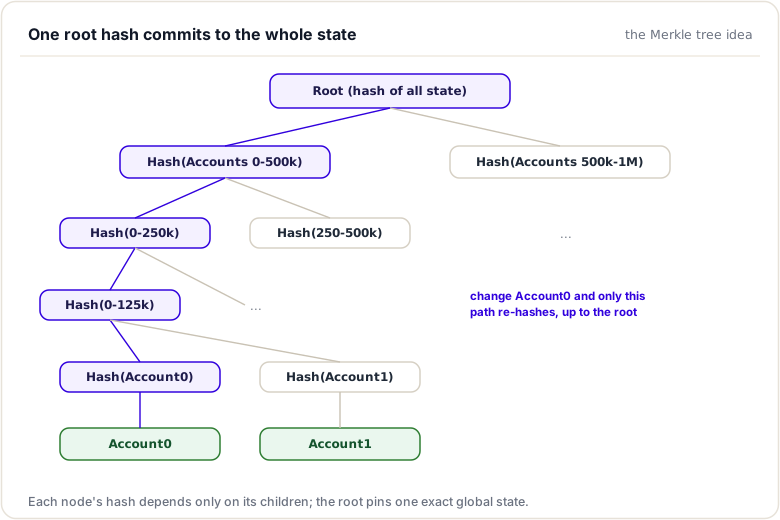
Key Insight: Each node's hash depends only on its descendants, not the entire tree:
- Change Account0 → rehash 4 nodes (path from leaf to root)
- Not millions of nodes
Synchronization Benefit:
When syncing with a peer:
- Compare root hashes
- If they match: entire state is identical (no need to compare anything else)
- If they differ: identify which subtree diverges
- Only synchronize the different parts
- Recursive process: compare child hashes, descend into differences
A tree of 1 million accounts becomes synchronizable in a few thousand comparisons instead of millions.
Key idea. Change one leaf and only the hashes on the path to the root change. That single property is what makes both tamper-evidence and cheap syncing possible.
The Patricia Trie Optimization
In brief: keying the tree by the entry's own hash keeps it balanced and navigable, radix-16.
A simple binary tree has a problem: unbalanced growth. If accounts are added sequentially, the tree becomes a linked list, losing logarithmic properties.
Patricia tries (Radix N tries) solve this:
- Use the account identifier (a 256-bit hash) as a navigation guide
- Each level of the tree represents 4 bits (one hex digit) of the account hash
- This produces a balanced, predictable tree structure
- Tree depth is always ~64 levels (256 bits / 4 bits per level)
XRPL's Choice: Patricia trie with radix 16 (hex digits):
Level 0 (root): Evaluate first hex digit of account hash (0-F)
  → Child 0, 1, 2, ... or F

Level 1: Evaluate second hex digit
  → One of 16 children

... and so on
This gives a balanced tree with:
- Depth: 64 levels (one per hex digit of 256-bit key)
- Branching: Up to 16 children per node
- Perfect for accounts identified by 160-bit hashes
NodeStore: From Memory to Disk
Now we have SHAMap: an elegant in-memory data structure for cryptographically-committed state.
But there's a problem: When the validator crashes, all in-memory state vanishes.
The next startup:
- Reads the ledger blockchain from disk
- Replays every transaction from genesis
- Reconstructs the current state
- For mainnet: this takes weeks
NodeStore solves this by making SHAMap persistent:
- Every node in the SHAMap is serialized to storage
- Identified by its cryptographic hash
- Retrievable by any peer that needs it
- On startup, state is reconstructed from disk in minutes, not weeks
The Storage Challenge:
But persistence introduces new challenges:
- Database Size: A mature XRPL ledger creates millions of nodes. Storage can be terabytes.
- Lookup Performance: Database queries are 1000x slower than memory access
- Write Efficiency: Persisting every state change is I/O intensive
- Backend Flexibility: Different operators need different storage engines (RocksDB, NuDB, SQLite)
NodeStore addresses each:
- Caching: Keep hot data in memory, query disk only when needed
- Abstraction: Support multiple database backends with identical logic
- Batch Operations: Write multiple nodes atomically
- Online Deletion: Rotate databases to manage disk space without downtime
The Complete Picture
SHAMap's Role:
- Maintains blockchain state in a Merkle tree structure
- Provides cryptographic commitment through root hash
- Enables efficient synchronization through hash comparison
- Supports proof generation for trustless verification
NodeStore's Role:
- Persists SHAMap nodes to durable storage
- Provides on-demand node retrieval
- Implements intelligent caching to minimize I/O
- Abstracts database implementation details
Together:
They solve the complete blockchain state management problem:
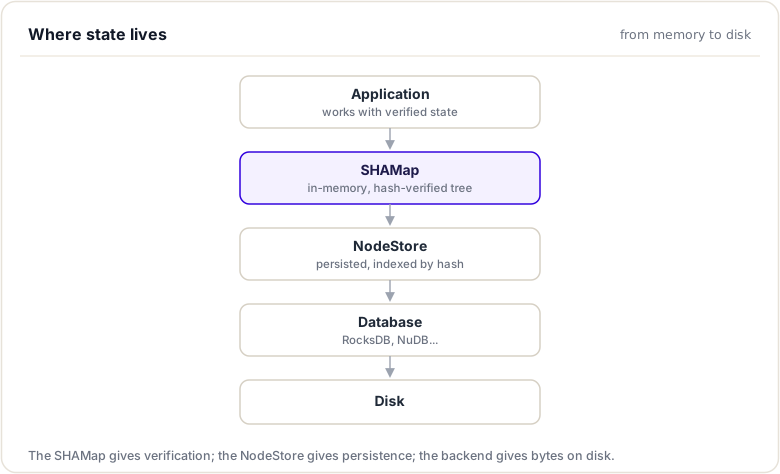
A validator can:
- Process transactions at microsecond latencies (SHAMap is in-memory)
- Know state is persisted safely (NodeStore writes atomically)
- Sync new peers in minutes (hash-based comparison finds differences)
- Recover from crashes without replaying genesis (state reconstructed from disk)
- Switch database backends without changing application logic
Why This Matters
In brief: these ideas are exactly what the SHAMap, coming next, is built from.
Understanding SHAMap and NodeStore is essential because:
- Consensus Correctness: The root hash is what validators vote on. You cannot understand consensus without understanding how that hash is computed.
- Synchronization Performance: Why can a new node catch up to the network in minutes? Because hash-based tree comparison eliminates redundant data transfer.
- API Performance: Why do account lookups return in milliseconds? Because careful caching keeps hot nodes in memory.
- Operational Reliability: Why can validators safely delete old data? Because the rotating database enables online deletion without service interruption.
- Scalability Limits: Why does XRPL have practical limits on transaction volume? Because synchronizing and storing the ever-growing tree hits physical limits of disk I/O and memory.
These aren't just implementation details, they're fundamental to what XRPL is and how it works.
Looking Ahead
In the next chapter, we'll explore the mathematical foundations: Merkle trees, Patricia tries, and cryptographic hashing. Then we'll dive deep into the SHAMap implementation, followed by the NodeStore persistence layer.
By the end of this module, you'll understand not just what SHAMap and NodeStore do, but why they're architected the way they are, and how to reason about their correctness, performance, and limitations.
Trees, Hashing, and Cryptographic Commitments
Introduction
Before diving into the implementation of SHAMap and NodeStore, we need to understand the mathematical foundations they're built on. This chapter covers:
- Cryptographic hashing and why it creates mathematical guarantees
- Tree structures and why they matter for efficiency
- How Merkle trees combine both to create verifiable commitments to data
- Patricia tries and why they're optimal for key-value storage
Don't skip this chapter thinking it's just theory. Every design decision in SHAMap flows directly from the properties of these data structures. Understanding the foundations will make the implementation clear.
Cryptographic Hash Functions
A cryptographic hash function H has three critical properties:
1. Determinism
H(x) always returns the same result
H("hello") = 0x2cf24dba5fb0a30e26e83b2ac5b9e29e1b161e5c1fa7425e73043362938b9824
H("hello") = 0x2cf24dba5fb0a30e26e83b2ac5b9e29e1b161e5c1fa7425e73043362938b9824
Same input, always same output. This enables verification: others can compute the same hash and confirm correctness.
2. Collision Resistance
Finding two different inputs with the same hash output is computationally infeasible:
H(x) = H(y) where x ≠ y  → "collision"

For SHA-256: Finding a collision requires ~2^128 operations
Current computers: ~10^18 operations/second
Time required: 10^20 seconds ≈ 3 billion years

Cryptographic security: "practical impossibility"
3. Avalanche Effect
Tiny changes produce completely different outputs:
H("hello") = 0x2cf24dba5fb0a30e26e83b2ac5b9e29e1b161e5c1fa7425e73043362938b9824
H("hallo") = 0xd3751713b7ac3d1ab39b1f7b1859d6e7baeac08b8cdb1c8fefd1f96a3f3c17f8

Change one character → hash completely changes
Implication for XRPL:
Hash output acts as a "fingerprint" of data:
- Two accounts with identical state have identical hashes
- Even one byte difference produces completely different hashes
- Anyone can verify a claimed hash by recomputing it
- Cannot forge a hash without recomputing it (collision-resistant)
XRPL uses SHA-512Half: First 256 bits of SHA-512. This gives:
- 256-bit output (32 bytes, fits in a uint256)
- Security level of ~128 bits (same as AES-128)
- Good performance for cryptographic verification
Tree Structures
Trees are recursive data structures: a root node with zero or more children, each of which is a tree.
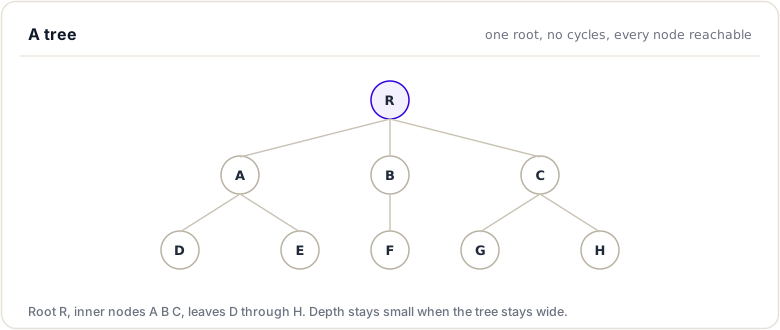
Key Tree Property: Logarithmic Depth
For a balanced tree with branching factor B and N items:
- Depth = log_B(N)
- Binary tree (B=2): 1M items → depth 20
- Radix-16 tree (B=16): 1M items → depth 5
- Radix-256 tree (B=256): 1M items → depth 3
Why Depth Matters:
- Access time: proportional to depth
- Update time: change leaf → rehash path from leaf to root (depth operations)
- Synchronization: identify differences by comparing hashes (depth comparisons)
Higher branching factor = shallower tree = faster operations.
The Balance Problem:
But trees can become unbalanced:
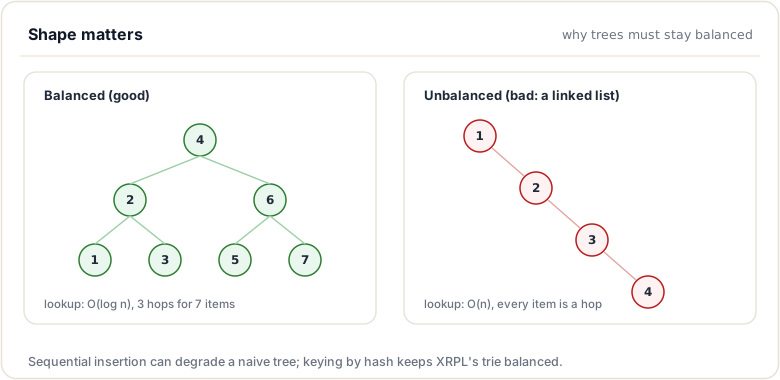
For blockchain state, accounts are inserted in unpredictable order. Without careful tree structure, you get unbalanced trees and logarithmic operations degrade.
Patricia Tries (Radix Tries)
Patricia tries solve the balance problem by using the key itself as navigation.
Basic Idea:
For a 256-bit key (like an account address), use the bits to guide traversal:
- Radix-2 (binary): Each bit (0 or 1) determines left or right child
- Radix-4: Each 2-bit pair determines one of 4 children
- Radix-16 (hex): Each 4-bit nibble determines one of 16 children
- Radix-256: Each 8-bit byte determines one of 256 children
Example: Radix-16 Patricia Trie
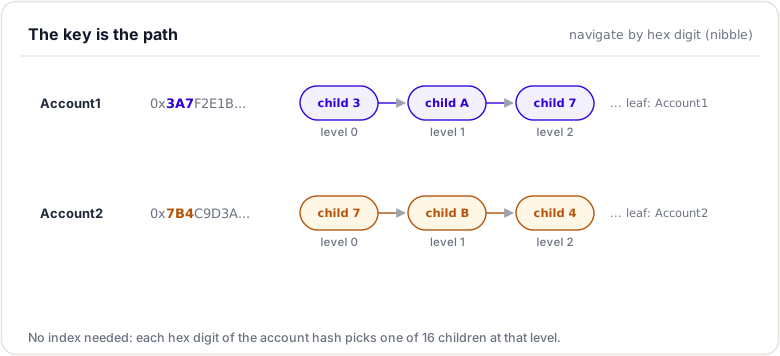
Balance Guarantee:
Since navigation is determined by the key:
- All paths from root to any leaf have the same structure
- Tree depth depends only on key length (256 bits / 4 bits = 64 levels)
- Perfect balance for any set of keys
Space Trade-off:
Inner nodes have up to 16 pointers (for radix-16), but most sparse:
- Many branches are empty (no accounts in that range)
- Compressed representation avoids wasting space
- Net result: similar space as binary tree despite higher branching
XRPL's Choice: Radix-16
// From rippled source: 16 possible children per level
static const int NUM_BRANCHES = 16;

// Each level represents 4 bits (one hex digit) of the key
for (int i = 0; i < keyLengthInBits; i += 4) {
    int branch = (key >> (keyLengthInBits - i - 4)) & 0x0F;
    // Navigate to child at position 'branch'
}
Why radix-16?
- Shallow trees: 256-bit keys → 64 levels (log_16 of ledger size)
- Manageable fanout: 16 children per node (balanced tree complexity)
- Natural alignment: hex notation matches code
- Proven in Bitcoin and Ethereum: both use similar approaches
Merkle Trees
A Merkle tree combines tree structure with cryptographic hashing:
Definition:
- Leaf nodes: Contain data (accounts, transactions)
- Inner nodes: Contain hashes of their children
- Root hash: Represents the entire tree
Key Property: Hash Propagation
When a leaf changes, its hash changes. This affects its parent:
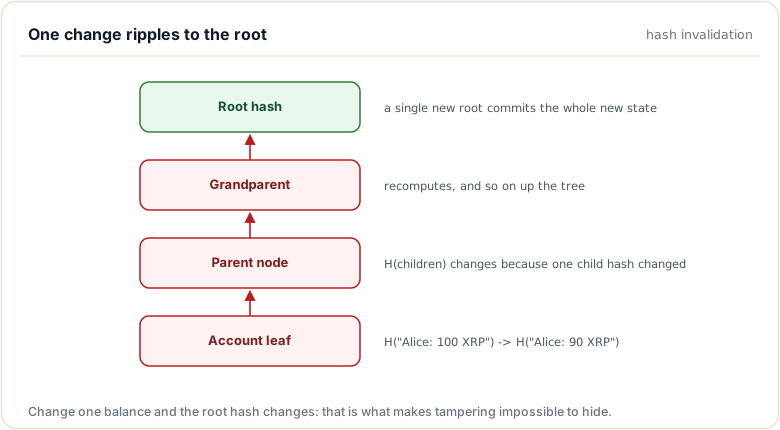
Benefit: O(1) Subtree Comparison
Compare two trees:
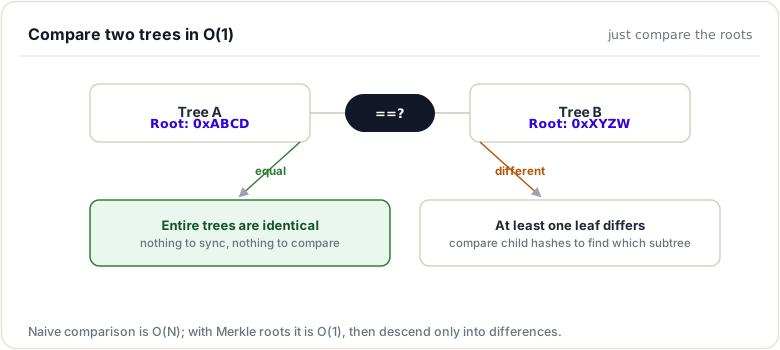
Without Merkle trees:
Compare all N leaves directly: O(N) time
With Merkle trees:
Compare root hashes: O(1) time
If different, compare child hashes to find divergence: O(log N) comparisons
Benefit: Logarithmic Proofs
Prove that a specific item is in the tree:
Merkle Proof for "Alice: 90 XRP":

Show:  H("Alice: 90 XRP") = 0x1234...
       H(Sibling1) = 0x5678...
       H(Sibling2) = 0x9ABC...

Verifier computes:
  Combine with siblings working up to root
  Verify final hash matches claimed root

Only need to show O(log N) nodes, not entire tree
XRPL's Merkle-Patricia Trie
XRPL's SHAMap combines both approaches:
Patricia Trie Structure:
- Navigation determined by account key (256-bit hash)
- Radix-16 branching (hex digit at each level)
- Perfect balance regardless of account insertion order
Merkle Properties:
- Each node contains hash of its content
- Inner node hash computed from children's hashes
- Root hash represents entire ledger state
- Changes propagate up to root
The Result:
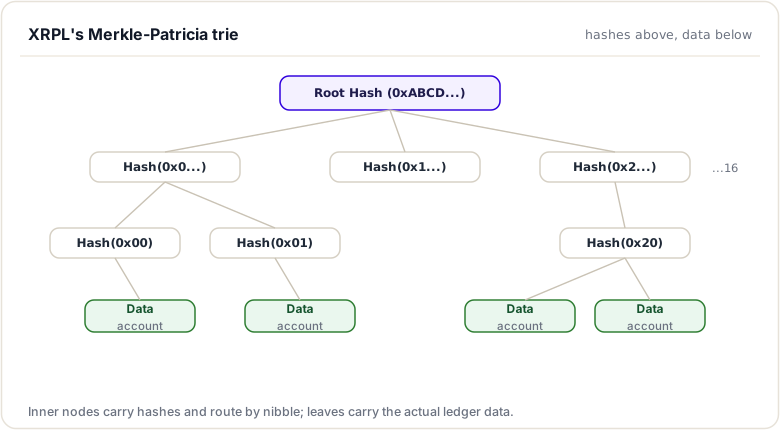
Properties:
- Leaf depth: exactly log_16(number of accounts) ≈ 5 levels for 1M accounts
- Hash changes: only O(log N) nodes affected by any modification
- Verification: O(1) root hash comparison, O(log N) proof verification
- Synchronization: O(log N) hash comparisons to find differences
Hashing Algorithms in XRPL
XRPL uses SHA-512Half for all hashing:
// From rippled source
uint256 hashFunc(Blob const& data) {
    using hasher = SHA512Half;  // SHA-512, keep first 256 bits
    return hasher()(data);
}
Why SHA-512Half instead of SHA-256?
- SHA-512 has better performance on 64-bit CPUs
- Taking first 256 bits gives same security as SHA-256
- But faster on modern hardware
- 256-bit output fits uint256 perfectly
Hash Computation in SHAMap:
Inner nodes hash their children's hashes:
uint256 computeHash(SHAMapInnerNode& node) {
    Blob data;
    for (int i = 0; i < 16; ++i) {
        if (node.hasChild(i)) {
            uint256 childHash = node.getChildHash(i);
            data.append(childHash);  // Concatenate child hashes
        }
    }
    return SHA512Half(data);
}
Leaf nodes hash their content with a type prefix:
uint256 computeHash(SHAMapLeafNode& leaf, Type type) {
    Blob data;
    data.push_back(type);  // Type prefix prevents hash collision
    data.append(leaf.getKey());
    data.append(leaf.getData());
    return SHA512Half(data);
}
Why Type Prefixes?
Prevent collisions between different types of data:
Account with data: 0xAA || 0xBBBB
Leaf type 1, data 0xAA, item 0xBBBB

Transaction with data: 0xAABB || 0xBB
Leaf type 2, data 0xAABB, item 0xBB

These have same content but different meaning!
With type prefix:
  H(1 || 0xAA || 0xBBBB) ≠ H(2 || 0xAABB || 0xBB)
Immutability and Copy-on-Write
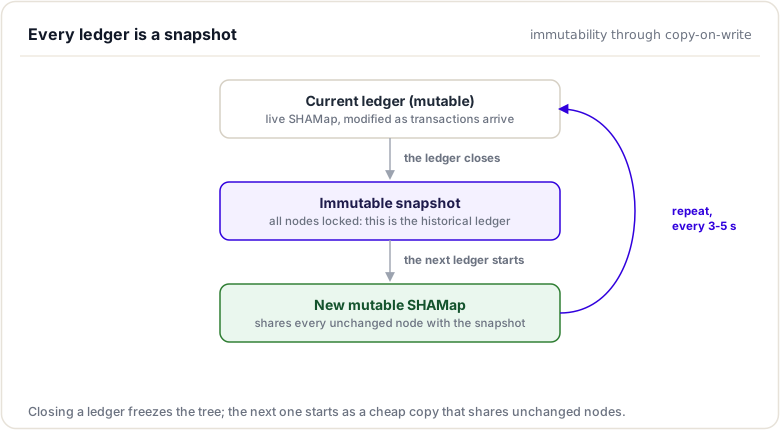
Once a Merkle tree root hash is committed to (published in a ledger), that entire tree must be immutable:
- Changing any leaf would change the root hash
- Root hash commitment would become invalid
- Trust in the ledger is broken
Solution: Snapshots
For each ledger version, create a snapshot:
Copy-on-Write:
When a mutable SHAMap modifies a shared node:
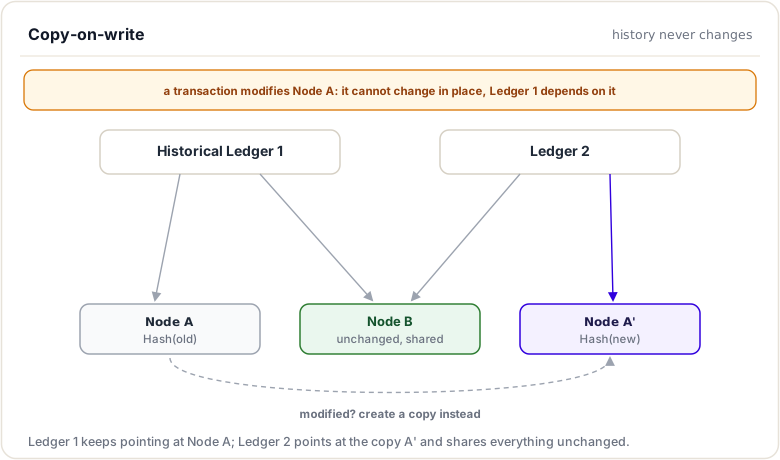
Both ledgers are verified by their root hashes, but they share most of the tree (unchanged nodes).
Summary
This module built up the ideas behind XRPL's state storage. It showed why a naive key-value store fails for a trustless network, then introduced cryptographic hashing, Merkle trees, and radix-16 Patricia tries, the pieces that make state verifiable and cheap to sync. The key insight is that a tree of hashes lets a single change touch only the path to the root, and lets nodes compare state by comparing one root hash. These foundations are exactly what the SHAMap is built from.
To remember:
- Naive key-value state fails trustless networks: no cryptographic commitment, no cheap verification
- One root hash commits to the whole state: authenticity, completeness, uniqueness
- Merkle tree: changing one leaf rehashes only the path to the root, O(depth) not O(state)
- Radix-16 Patricia trie: the key itself routes, one nibble (4 bits) per level
- Copy-on-write: snapshots share unchanged subtrees, so per-ledger immutability is cheap
- Equal root hashes mean identical state; a difference tells you exactly which subtree to descend
- The workhorse hash is SHA-512Half: SHA-512, keep the first 256 bits
- Watch out: these are the load-bearing ideas behind the SHAMap; if syncing or proofs ever feel magic, come back here
Next up. You know why the state tree exists. Now go inside it: how the SHAMap actually stores a million accounts and fingerprints them all in one 32-byte hash.
Resources
Assignments
0 of 2 complete